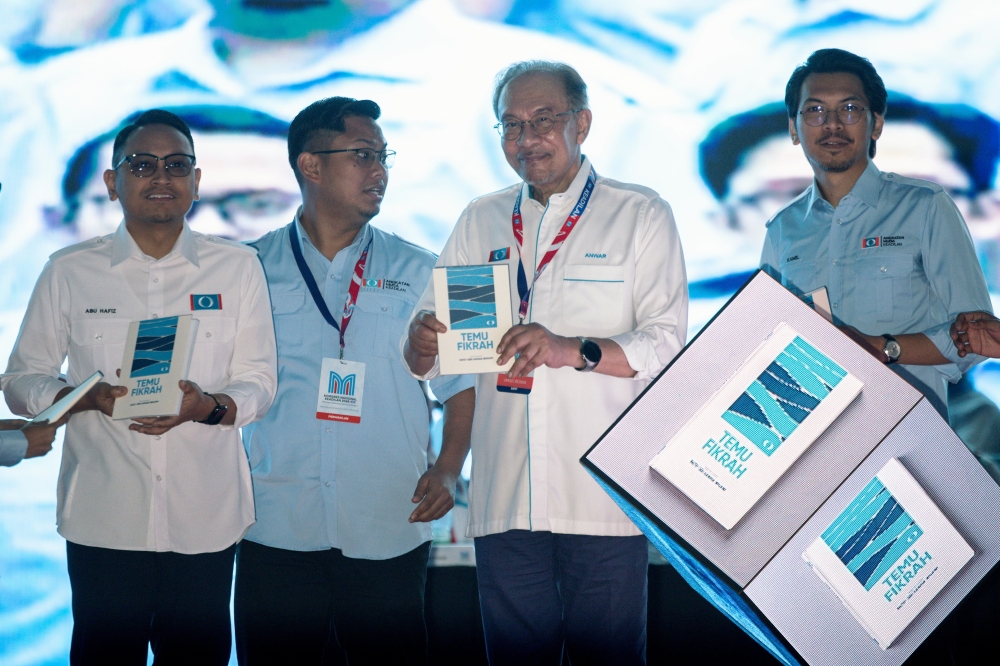
Prime Minister Datuk Seri Anwar Ibrahim unveiled Temu Fikrah in Melaka on August 16, marking a significant moment for Parti Keadilan Rakyat's youth wing as it attempts to balance traditional party ideology with contemporary governance demands. The document represents an ambitious effort to synthesize the party's foundational values with practical implementation strategies across economic, social, and institutional spheres, positioning the younger generation of PKR members to engage more systematically with the government's broader developmental agenda.
The introduction of Temu Fikrah signals recognition within PKR that youth engagement requires more than rhetorical alignment with party principles. By presenting both conceptual frameworks and operational guidelines, the manifesto acknowledges that younger politicians and activists need tangible pathways to translate ideology into policy outcomes. This dual-track approach addresses a longstanding challenge in Malaysian politics: bridging the gap between party doctrine and executive responsibility in governance.
Courage emerges as a foundational pillar within the Temu Fikrah framework, positioning PKR Youth to advocate for bold policy positions while maintaining party discipline and coalition stability. In Malaysia's delicate political environment, where coalition governments require careful navigation of competing interests, establishing courage as a guiding principle signals PKR's commitment to principled stands on governance matters without destabilizing the ruling coalition. This distinction matters significantly for younger party members who might otherwise view compromise as ideological betrayal.
Creativity represents the second major dimension, reflecting broader acknowledgement that governance challenges in the 2020s demand innovative solutions rather than inherited bureaucratic approaches. PKR Youth's emphasis on creative problem-solving positions the party to address Malaysia's structural economic challenges, skills gaps, and digital transformation imperatives. The inclusion of creativity signals that the party understands contemporary governance cannot rely solely on traditional administrative frameworks, particularly as younger cohorts increasingly question conventional approaches to public service delivery and resource allocation.
The manifesto's alignment with Madani governance—the Prime Minister's overarching development philosophy emphasizing prosperity, dignity, and sustainability—provides essential coherence between party-specific youth initiatives and national development priorities. Rather than positioning PKR Youth as a distinct or oppositional force, Temu Fikrah frames the youth wing as integral to actualizing Madani principles across government structures and community engagements. This integration strengthens PKR's institutional position within the ruling coalition while giving youth members clear metrics for evaluating their contributions to national objectives.
For Malaysian policymakers and political observers, the launch underscores a broader trend toward institutionalizing youth participation in governance structures. As demographic realities mean younger voters constitute an increasingly important electoral constituency, political parties must demonstrate they possess systematic frameworks for youth engagement beyond campaign-season mobilization. Temu Fikrah's combination of manifesto and operational manual suggests PKR recognizes that credibility with younger supporters requires sustained institutional investment and transparent pathways for influence.
The timing of the launch reflects calculations about political momentum and coalition stability. By providing PKR Youth with structured ideological and operational frameworks, the party leadership can channel youthful energy toward coalition-supporting initiatives while establishing clear parameters for acceptable political expression. This approach helps mitigate risks of youth-driven activism fragmenting party discipline or creating internal tensions with more senior leadership elements invested in coalition maintenance.
Regionally, Malaysia's experience with youth manifestos and political engagement holds implications for democratic development across Southeast Asia. As the region confronts persistent challenges around institutional legitimacy, economic inclusivity, and generational political transition, the mechanisms through which parties integrate youth participation into governance structures influence broader democratic quality. PKR's systematic approach offers a model worth monitoring, though outcomes will ultimately depend on implementation fidelity and whether young party members perceive genuine influence over policy outcomes.
The emphasis on both courage and creativity within Madani governance frameworks suggests PKR recognizes that sustainable political legitimacy requires demonstrating capacity to address tangible Malaysian concerns—rising living costs, employment quality, institutional accountability, digital infrastructure development—rather than securing support through patronage alone. Youth-focused initiatives become credible only when younger members can demonstrate visible contributions to improving material conditions and institutional responsiveness that their peers value.
Looking forward, Temu Fikrah's success will be measured not merely by its content or ceremonial launch but by observable shifts in how PKR Youth approaches policy advocacy, community engagement, and coalition participation. The manifesto-manual framework will prove valuable only insofar as party leadership genuinely incorporates youth perspectives into decision-making processes and young members report meaningful opportunities to influence party direction and governmental priorities. For Anwar Ibrahim and PKR's institutional development, this launch represents a strategic investment in demonstrating that the party possesses governance depth extending beyond the Prime Minister's personal leadership into generationally-distributed cadre structures.

