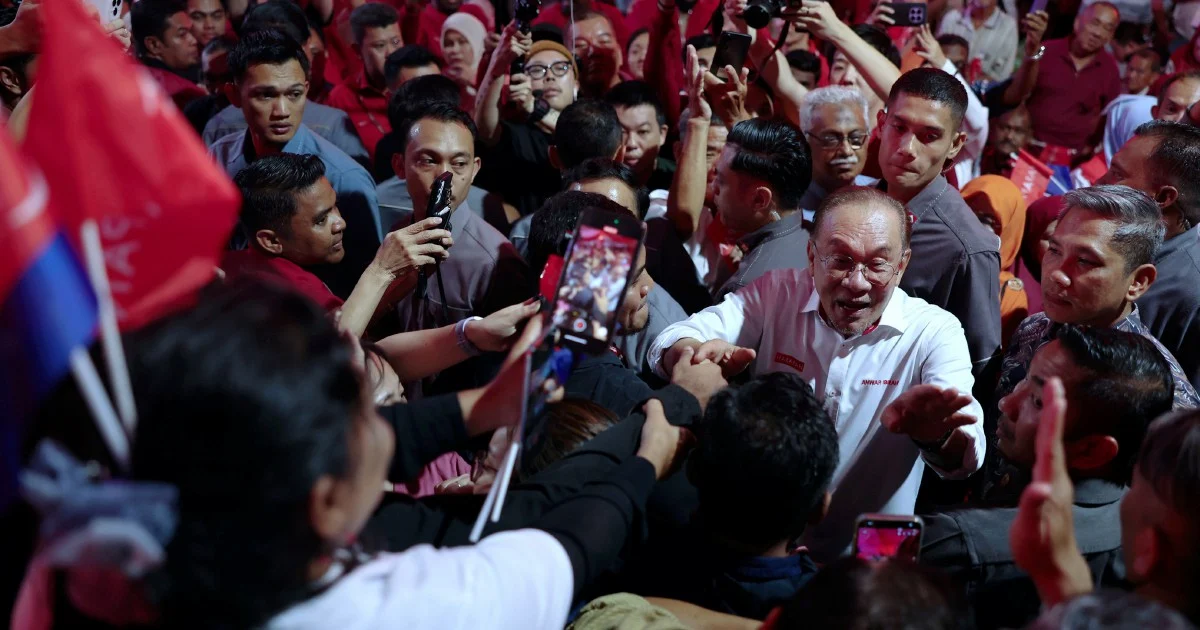
Pakatan Harapan laid down its electoral marker in Johor on Thursday when coalition chairman Datuk Seri Anwar Ibrahim formally unveiled the complete roster of 56 candidates contesting the July 11 state election, signalling an ambitious attempt to displace Barisan Nasional from a stronghold it has governed for nearly seven decades. The announcement, made in Tangkak, represents the coalition's largest coordinated campaign push into the southern state since the 2018 general election, when PH achieved its historic federal breakthrough before internal fractures weakened its position in Johor specifically.
The strategic significance of the Johor contest cannot be overstated for Malaysia's broader political trajectory. The state remains BN's most reliable electoral fortress and a crucial revenue generator for the federal government, making any credible challenge from the Opposition a watershed moment in Malaysian politics. Control of Johor would fundamentally reshape the electoral mathematics heading toward the next general election, potentially emboldening anti-BN sentiment in neighbouring states and fortifying PH's weakened standing after a series of defections and internal realignments that culminated in the 2022 Ismail Sabri and Anwar administrations. For regional observers, a PH victory in Johor would signal that Malaysia's political system remains competitive and not permanently locked into single-party dominance, a question that has preoccupied analysts tracking democratic backsliding across Southeast Asia.
Anwar's personal leadership of the candidate announcement underscores PH's investment in the contest as a referendum on his government's stewardship and policy agenda. As Prime Minister, Anwar carries responsibility for economic performance, subsidy rationalisation measures that have affected household budgets, and the pace of promised institutional reforms. The Johor campaign therefore functions as both a test of voter confidence in his administration and a mechanism for renewing the coalition's grassroots momentum, which has flagged significantly since 2020 when internal disputes over prime ministerial succession between Anwar and Mahathir Mohamad fractured the original unity. The candidate slate, representing contributions from PH's constituent parties, reflects negotiations over resource allocation and seat division, with implications for intra-coalition power dynamics that Malaysian political observers track closely.
The geographic spread of PH's 56 candidates across Johor's state constituencies demonstrates the coalition's intention to mount comprehensive competition rather than tactical contests in selected pockets. This approach differs markedly from earlier Opposition strategies that concentrated resources on urban and semi-urban seats where class-based voting patterns traditionally favoured anti-BN coalitions. Instead, the scale of PH's candidate deployment suggests an attempt to genuinely compete in rural constituencies and Bumiputera-majority areas where BN has historically dominated through effective patronage networks and appeals to race-based political identity.
The Johor election assumes heightened importance against Malaysia's recent political volatility and institutional stress. The state has experienced significant administrative disruption following inter-communal tensions related to land disputes and religious sensitivity issues that erupted into public controversy in 2022 and 2023. An incoming PH administration would inherit complex governance challenges requiring both competence and cross-community trust. For investors and international observers tracking institutional stability in a strategically positioned Southeast Asian economy, the Johor election represents a test of Malaysian democracy's capacity to generate peaceful power transitions and orderly governance change.
For Malaysian voters, particularly in Johor, the election frames a concrete choice between competing policy visions. PH's platform emphasises institutional reform, anti-corruption measures, and social spending prioritisation, contrasting with BN's emphasis on continuity, Bumiputera-centric development policies, and strong-state governance traditions. The coalition's candidate selections will communicate implicit messages about policy priorities and demographic composition, with particular significance attached to representations of young professionals, women, and minority communities seeking inclusion in political power structures that have remained relatively stable under BN leadership.
The timing of the Johor election also intersects with broader Southeast Asian political transitions. Thailand, Indonesia, and the Philippines have experienced significant democratic ebbs and flows in recent years, with Malaysia's political system frequently cited as a regional reference point for institutional resilience despite internal contradictions. A credible Opposition performance in Johor would reinforce narratives of Malaysia as a functioning competitive democracy, while a decisive BN victory might suggest that institutional entrenchment and patronage networks remain insurmountable obstacles to electoral challenge across the region's middle-income democracies.
Anwar's strategic positioning as the face of PH's Johor campaign reflects broader coalition calculations about which personality and narrative can most effectively mobilise diverse voter constituencies. His appeal extends beyond traditional urban, middle-class Opposition supporters to include rural Malays and Bumiputera communities seeking alternative political representation. The 2018 federal election demonstrated PH's capacity to win over previously loyal BN constituencies through messaging that emphasised institutional reform and corruption accountability. Whether that coalition can replicate such cross-cutting appeals in a state-level contest where local issues predominate and ethnic politics traditionally exerts stronger influence remains contested among political analysts.
Looking at the campaign period ahead, PH faces the challenge of translating candidate announcements into effective ground mobilisation, messaging discipline, and sustained voter engagement. The coalition's track record in recent state elections has been mixed, with significant losses in Melaka and Selangor demonstrating the difficulty of maintaining electoral momentum when internal contradictions over leadership and policy direction become visible to voters. The comprehensive slate announced in Johor therefore represents necessary institutional investment, but ultimate electoral success will depend on execution, candidate quality, and the government's ability to deliver perceived progress on living standards and institutional reform during the campaign period.
The July 11 Johor election will unfold against the backdrop of Malaysia's ongoing transformation from a dominant-party system toward more genuinely competitive politics. Whether PH's ambitious candidate deployment translates into meaningful territorial gains or BN consolidates its hold on this crucial state will shape Malaysian and regional political trajectories for years ahead. For observers worldwide tracking democratic vitality in Southeast Asia, the Johor contest represents one of the region's most significant electoral contests, offering concrete evidence of whether Malaysia's institutions can generate peaceful, competitive power alternation or whether structural advantages locked into the state apparatus remain too formidable for electoral challenge.