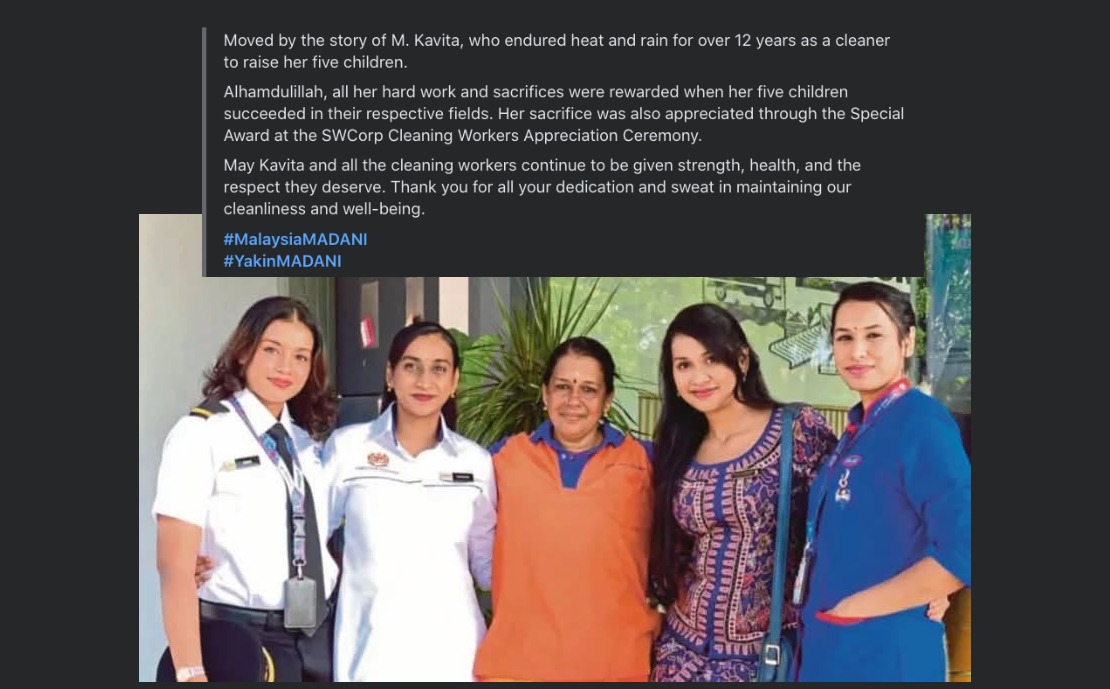
Prime Minister Datuk Seri Anwar Ibrahim has offered a public commendation to M. Kavita, a cleaning services worker in Seremban whose perseverance in raising her five children while employed as a street sweeper for more than 12 years has become an inspirational narrative in Malaysia. The recognition, shared through a Facebook post, underscores the premier's acknowledgement of the often invisible contributions made by lower-income workers to Malaysian society and their families' advancement despite significant economic constraints.
Kavita's story gained widespread prominence across social media platforms following an emotional milestone last month when her four daughters appeared at her workplace to celebrate her 50th birthday. The occasion became particularly poignant when the daughters revealed themselves dressed in their professional uniforms, representing their respective careers as a pilot, cabin crew member, and a staff nurse. The spontaneous celebration captured the emotional payoff of decades of maternal sacrifice, prompting Kavita to break down in tears—a moment that resonated strongly with online audiences and highlighted the tangible outcomes of her relentless commitment to her children's futures.
In his statement, Anwar explicitly acknowledged that Kavita's years of gruelling labour had resulted in genuine professional success across all five offspring. By publicly attributing their accomplishments to her sacrifices rather than portraying success as individual achievement alone, the Prime Minister positioned parental dedication as a foundational element of intergenerational mobility. This framing carries particular resonance in Malaysia, where discussions about social mobility often overlook the unpaid emotional and physical labour primarily undertaken by women in lower socioeconomic brackets.
The Prime Minister's tribute extends beyond Kavita individually, encompassing a broader class of workers whose labour forms the infrastructure of urban cleanliness. His explicit call for continued blessings upon street sweepers and cleaning workers nationally represents a rare moment of executive-level recognition for an occupational category that frequently experiences social invisibility and status marginalisation. By connecting Kavita's experience to systemic appreciation for the entire sanitation workforce, Anwar positioned her narrative as emblematic of wider patterns of undervalued contribution.
Kavita's formal recognition through a Special Award at the recent Cleaning Workers' Day Appreciation ceremony organised by SWCorp demonstrates institutional acknowledgement running parallel to Anwar's personal tribute. Such dual recognition at both governmental and ceremonial levels signals a deliberate effort to elevate the narrative around domestic and civic cleaning services, occupations that remain underappreciated despite their essential role in public health infrastructure and urban maintenance.
The circumstances of Kavita's employment with SWM Environment underscore the structural conditions within which such stories of upward mobility emerge. Workers in sanitation services typically face demanding physical labour across all weather conditions, limited benefits, and minimal job security—conditions that make her sustained commitment to her children's education and development particularly noteworthy. Her ability to finance her daughters' education through professional advancement pathways, particularly into aviation and healthcare sectors, reflects determination operating against significant systemic barriers.
From a broader Malaysian perspective, Kavita's achievement contributes to ongoing conversations about social equity and accessible pathways for lower-income families. The pilot daughter's career particularly signifies breakthrough into professional sectors historically characterised by more selective recruitment and socioeconomic gatekeeping. The presence of a nurse within the professional mix similarly addresses Malaysia's ongoing need for healthcare workforce expansion, suggesting that removing educational and economic barriers for lower-income families generates skilled workers addressing national labour shortages.
The viral nature of Kavita's story on social media platforms indicates public hunger for narrative frameworks that challenge deficit-based representations of poverty and working-class life. Rather than portraying street sweepers and their families through paternalistic or sympathetic lenses, Kavita's daughters' visible professional success demands recognition of agency, determination, and structural competence existing within communities experiencing economic marginalisation. This narrative shift carries implications for policy discussions around social support, education access, and workplace dignity.
Anwar's invocation of respect alongside strength and good health represents a deliberate recalibration of how political leadership linguistically frames working-class contribution. By positioning respect not as aspirational but as deserved, the statement implicitly critiques social hierarchies that render sanitation workers socially invisible despite their essential function. For Malaysian readers and workers across Southeast Asia similarly situated in service sectors, such recognition provides rare acknowledgement from the highest political level.
The intersection of Kavita's personal achievement with her formal recognition raises questions about replicability and systemic support. While her story demonstrates extraordinary individual resilience, sustainable improvement in outcomes for sanitation workers' families would require policy interventions addressing wages, benefits, educational access, and career progression within the sector itself. Her success, though admirable, should not become an excuse for maintaining structural inequalities that render such outcomes exceptional rather than standard.
Moving forward, the sustained attention to Kavita's narrative offers Malaysia an opportunity to examine whether similar recognition and support extends beyond individual exemplars to entire communities and occupational categories. The test of genuine respect for cleaning workers lies not in celebrating those whose children escape the sector, but in ensuring dignity and advancement opportunities for workers who remain, and in creating conditions where such extraordinary sacrifice becomes unnecessary for family prosperity.

