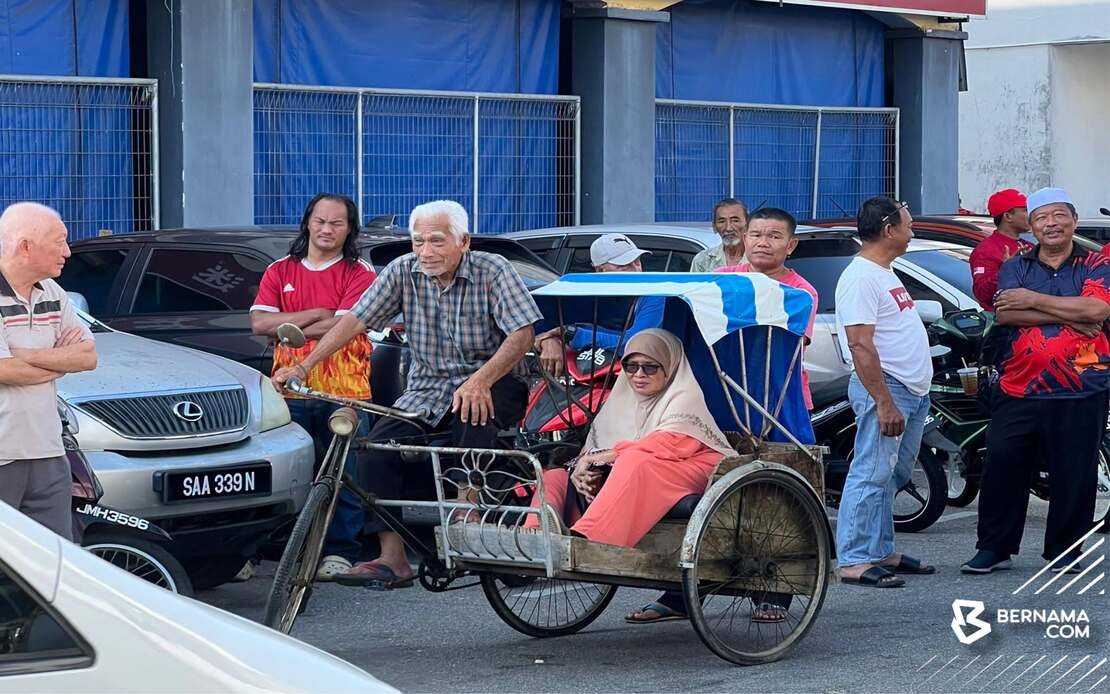
Prime Minister Datuk Seri Anwar Ibrahim has expressed heartfelt appreciation for the determination shown by an elderly couple from Batu Pahat, Johor, who made an unusual journey to attempt meeting him during his recent visit to the state. The gesture, which involved an 86-year-old man steering a trishaw for close to a kilometre with his wife aboard, resonated deeply with the premier, who took to social media to acknowledge their effort and offer an apology for the missed encounter.
Abdul Razak Pelangga and his wife, Jamilah Samsudin, 64, learnt of Anwar's planned breakfast stop at Kedai Kopi Hailam Sri Medan in Senggarang only the previous day. Despite having alternative transportation options available—a car and motorcycle—Abdul Razak made the deliberate choice to transport his wife by trishaw, prioritising her wish to see the country's leader over convenience. His reasoning was practical yet considerate: navigating parking challenges in the busy town would have proven difficult, particularly given his age.
The couple's home in Kampung Parit Bugis lies a considerable distance from the coffeeshop where the Prime Minister had scheduled his public engagement. Abdul Razak, who serves as an imam at Masjid Raudhatul Jannah Parit Bugis, nonetheless committed to the journey, underscoring how the visit had captured local imagination in this small Johor settlement. The decision reflects a broader pattern of community enthusiasm for political leaders' grassroots visits, though it also highlights the mobility challenges faced by rural and aging Malaysians.
On the day itself, Anwar spent approximately 50 minutes at the eatery, where he engaged in a structured meet-and-greet programme designed to connect with residents of the Senggarang state constituency. This engagement was part of his wider campaigning effort in conjunction with the Johor State Election, a significant political event for the state. The visit was intended as an opportunity for the Premier to demonstrate accessibility and solidarity with ordinary Malaysians, particularly in constituencies outside the federal capital.
The unfortunate timing meant that despite their considerable effort, Abdul Razak and Jamilah did not manage to meet Anwar in person at the venue. This missed connection, however, became the catalyst for the Prime Minister's public acknowledgement. Rather than allowing the couple's effort to go unnoticed, Anwar took to Facebook to express his regret at the circumstances that prevented a face-to-face meeting. His response demonstrates an awareness of the symbolic value of such gestures in Malaysian political culture, where personal connection and recognition hold considerable weight.
In his social media statement, Anwar conveyed genuine gratitude while extending an olive branch of sorts, suggesting that future opportunities for a meeting might arise. His message—written in Malay—invoked religious sentiment, wishing the couple good health and divine blessings upon their affairs. This approach reflects the Prime Minister's tendency to integrate Islamic values and terminology into his public communications, a strategy that resonates particularly well in Johor, a state with strong Islamic traditions and significant Malay-Muslim populations.
The incident serves as a microcosm of several interconnected themes in contemporary Malaysian politics. First, it illustrates the enduring appeal of direct political engagement, particularly in smaller towns and villages where such visits remain relatively uncommon and thus highly anticipated. For residents of Senggarang, a modest locality that might otherwise receive limited attention from national political figures, the Prime Minister's presence represented an affirmation of their place within the national consciousness. Second, the episode highlights generational attitudes toward civic participation: an 86-year-old man's willingness to undertake physical effort to witness a political figure suggests how deeply embedded such participation remains within Malaysian civic culture.
The story also touches upon practical governance concerns relevant to Malaysian policymakers and regional observers. The couple's transportation choices—their reliance on a trishaw as a viable option despite owning motorised vehicles—reflects the continuing importance of such vehicles in Malaysian towns. Meanwhile, their concern about parking availability points to urban planning challenges that persist in secondary towns throughout the country. These mundane details, embedded within a heartwarming narrative, offer subtle commentary on the quality of public infrastructure and the lived experience of Malaysian citizens beyond major urban centres.
From a political communications perspective, Anwar's response demonstrates the currency of authentic sentiment in an age of often-choreographed political messaging. By publicly acknowledging the couple rather than allowing the incident to pass unnoticed, he converted a missed encounter into a moment of genuine connection with his audience. The Facebook post likely generated significant engagement among his followers, many of whom would recognise themselves in the couple's story—ordinary Malaysians going to lengths to participate in the democratic process and connect with their leaders.
The incident also carries implications for how political campaigns operate in Malaysia's smaller towns and rural areas. Campaign visits to secondary constituencies often receive less media attention and strategic focus than those in urban centres, yet they remain crucial for maintaining political relevance across the diverse Malaysian landscape. Stories like that of Abdul Razak and Jamilah help sustain the narrative that political leaders care about these peripheral communities, even if logistical constraints sometimes prevent the intended interactions from materialising.
Looking ahead, the episode raises questions about how political engagement can be improved for elderly and rural Malaysians. The couple's need to undertake a strenuous journey for what they perceived as an important civic moment suggests potential gaps in how political accessibility is structured in smaller communities. Whether through advance notification systems, more frequent visits to secondary constituencies, or alternative engagement mechanisms, there may be room for political parties and government to enhance inclusion for those less able to participate in conventional campaign activities.
Ultimately, while the couple did not achieve their primary objective of meeting the Prime Minister face-to-face, their story achieved something arguably more valuable in the Malaysian political context: public recognition and appreciation from the nation's leader. For Abdul Razak and Jamilah, Anwar's Facebook acknowledgement—with its invocation of blessings and expression of hope for future meetings—likely proved more memorable than a fleeting handshake would have been. The incident demonstrates how moments of genuine human connection, even when imperfect, can resonate far beyond the immediate participants.

