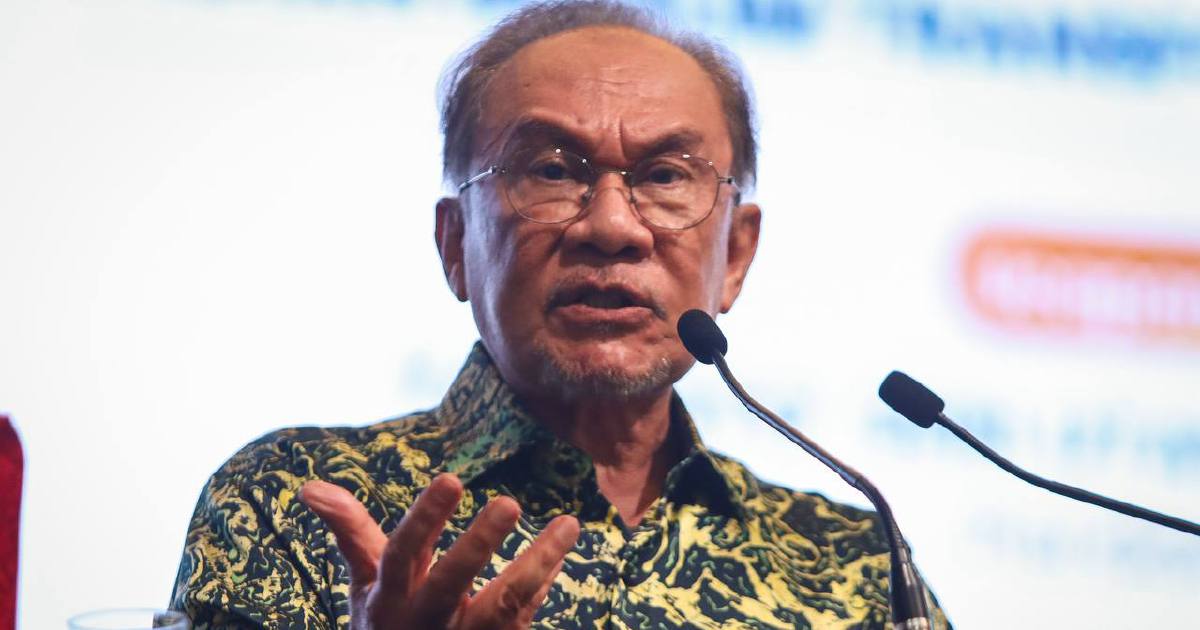
Prime Minister Datuk Seri Anwar Ibrahim has directly challenged Kedah Menteri Besar Datuk Seri Muhammad Sanusi Md Nor's recent statements about Tanah Melayu, reaffirming instead that Malaysia's competitive advantage rests upon creating space for every resident in the national project. The disagreement, aired publicly at Bukit Mertajam, underscores ongoing tensions within the ruling coalition over how Malaysia should define itself and its relationship with citizens of diverse backgrounds.
Anwar's intervention signals a deeper philosophical divide within the government about national identity and inclusion. Rather than dismiss Sanusi's position outright, the Prime Minister outlined a competing vision in which strength derives not from exclusion or historical mythologies, but from pragmatic recognition that a diverse population operating as one economic and social entity produces better outcomes. This framing resets the debate away from cultural grievance and toward material national interest.
The Kedah Menteri Besar's earlier remarks on Tanah Melayu had touched upon a historically sensitive topic in Malaysian politics. The concept has long served as shorthand in certain political circles for assertions about ethnic primacy and historical land claims. Sanusi's invocation of the term, whether intended as cultural commentary or political positioning, revived a discourse that many believe complicates Malaysia's ability to manage pluralism effectively. Anwar's response suggests the federal government wishes to move past such formulations.
This clash between Anwar and Sanusi also reflects broader coalition dynamics. Kedah, a state governed by Perikatan Nasional forces aligned with federal structures, occasionally pulls in different directions from the federal coalition when it comes to messaging on identity and inclusion. Such friction, while manageable, indicates that building consensus on how modern Malaysia should understand itself remains incomplete across political leadership.
For Malaysian citizens from non-Malay and non-Muslim backgrounds, Anwar's public rebuttal carries symbolic weight. Many have grown accustomed to hearing appeals to Tanah Melayu that implicitly position them as guests rather than co-creators of national destiny. The Prime Minister's insistence that embracing all citizens forms the actual foundation of national strength offers a corrective, though it remains to be seen whether this philosophical stance translates into concrete policy shifts or recruitment into national institutions.
Economically, Anwar's position aligns with the government's stated agenda to enhance competitiveness and attract investment. International capital increasingly demands assurance regarding social stability and inclusive governance. A narrative emphasising historical territoriality and ethnic possession, by contrast, introduces uncertainty and reinforces perceptions of instability or discrimination. The Prime Minister appears to recognise that nationalist rhetoric of an exclusive variety works against the economic modernisation agenda he champions.
The timing of this public disagreement also matters. Malaysia navigates a period of political complexity, with multiple coalitions sharing federal and state power, each with distinct constituencies and ideological orientations. Sanusi's remarks, coming from a state government not entirely within the federal coalition's direct control, may have been understood as testing boundaries or staking out differentiated ground. Anwar's response clarifies red lines: certain formulations of identity and belonging fall outside the bounds of acceptable coalition governance.
Historically, Malaysian leadership has oscillated between inclusive rhetoric and ethnically-inflected nationalism. Earlier prime ministers including Tun Abdullah Ahmad Badawi and Najib Tun Razak frequently paid lip service to unity, though implementation often lagged. Anwar's repeated emphasis on embracing all citizens suggests a genuine strategic commitment, though sceptics may note that rhetoric alone, without accompanying institutional change and power redistribution, produces limited transformation.
For Southeast Asia more broadly, Malaysia's internal debate on inclusion carries weight. The region contains multiple plural societies navigating similar questions about national identity and minority rights. Malaysia's approach—whether it tilts toward exclusion or genuine embrace—sends signals that influence how other governments calibrate their own policies. An Indonesia or Singapore watching Malaysian political movements gains insight into how competing visions of national belonging play out.
The Prime Minister's framing also sidesteps older constitutional debates. Rather than rehash arguments about Article 153 and Bumiputera provisions, Anwar focuses on a forward-looking prosperity argument. This rhetorical move potentially opens space for discussing reforms without immediate constitutional confrontation, though it may also frustrate those seeking explicit commitments to dismantling affirmative action structures.
Looking ahead, whether Anwar can translate his public position into durable institutional change depends partly on his political durability and partly on whether the coalition backing him shares this inclusive vision. Sanusi's continued independent positioning suggests that consensus remains fragile. The Kedah Menteri Besar's willingness to express divergent views on national identity indicates that state-level leaders enjoy sufficient autonomy to challenge federal messaging, complicating efforts to project unified national narrative.
Ultimately, this exchange reflects Malaysia at an inflection point. The nation cannot indefinitely sustain a founding bargain designed for 1957 in a 2024 context of global capital mobility, generational change, and evolved citizen expectations. Anwar's defence of inclusive citizenship, whatever its implementation gaps, acknowledges this reality. Sanusi's invocation of Tanah Melayu reaches backward. The political struggle over which direction Malaysia faces will shape not only national identity but also economic trajectory and social stability in the years ahead.

