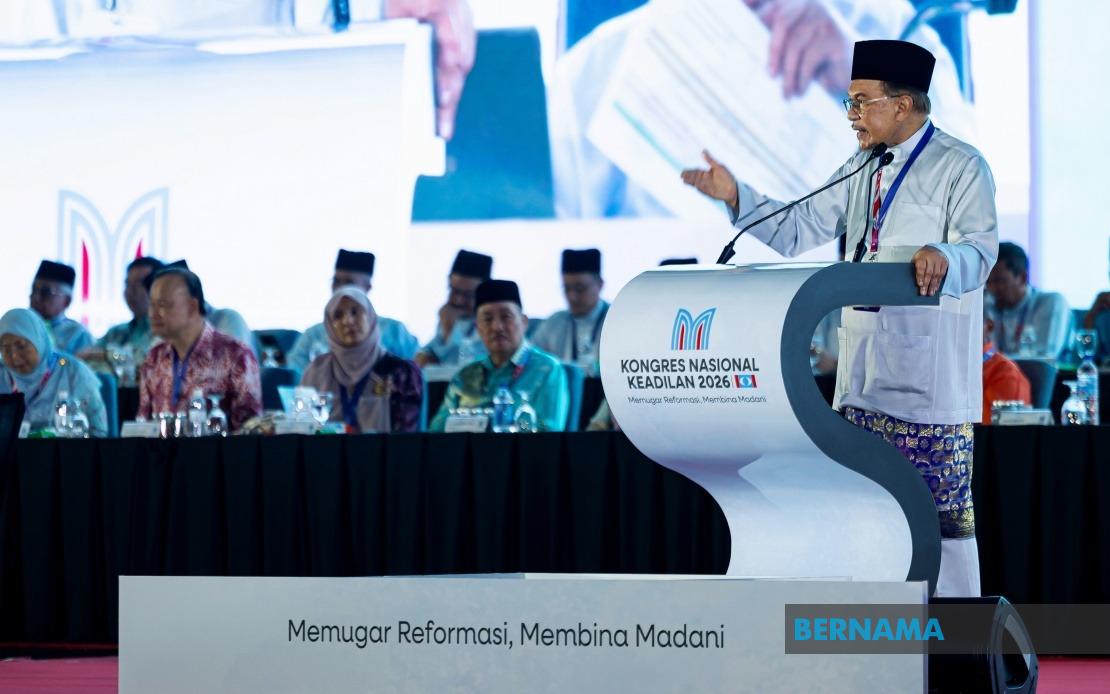
At the PKR National Congress in Melaka on Thursday, Prime Minister Datuk Seri Anwar Ibrahim moved swiftly to quell suggestions that his working relationship with Deputy Prime Minister Datuk Seri Dr Ahmad Zahid Hamidi has deteriorated. Speaking to reporters following his presidential address at the Melaka International Trade Centre, Anwar characterised recent claims of a rift as reflecting an individual's interpretive lens rather than representing any genuine breakdown in their political partnership.
The Prime Minister's statement came in direct response to comments made by former UMNO Youth chief Khairy Jamaluddin, who had alleged that trust between Anwar and Ahmad Zahid had reached its lowest point since the Unity Government took shape after the 15th General Election. Khairy's assertions reflected what he perceived as increasingly strained relations between Barisan Nasional and Pakatan Harapan, tensions he attributed partly to BN's decision to collaborate with Perikatan Nasional in the Negeri Sembilan state election.
Anwar's rebuttal revealed deeper philosophical differences in how various political figures interpret coalition dynamics. The Prime Minister contrasted his approach with that of critics, emphasising that whereas some observers naturally gravitate toward viewing political relationships through a lens of conflict and confrontation, he deliberately chose to prioritise dialogue and collaborative resolution. This distinction proved significant because it suggests that perceptions of coalition instability may stem as much from interpretive frameworks as from objective deterioration in political relationships.
To underscore the soundness of the Unity Government partnership, Anwar highlighted his public acknowledgment during the congress of Ahmad Zahid's instrumental role in facilitating the coalition's formation. The Prime Minister specifically credited both the Deputy Prime Minister and UMNO as essential participants in establishing the Unity Government structure that has governed Malaysia since late 2022. By publicly expressing gratitude for Ahmad Zahid's contribution, Anwar attempted to reinforce their continued alignment on foundational governance issues.
The timing of this declaration carried particular weight given the heightened political environment surrounding recent state elections. Negeri Sembilan's decision to partner with Perikatan Nasional rather than maintain strict adherence to the existing coalition architecture had prompted speculation about fractures within the broader Unity Government framework. Such moves, while representing tactical adjustments at the state level, inevitably raised questions about whether similar divergences might emerge at the federal level.
Anwar's framing of potential disagreements as manageable through peaceful discussion rather than confrontation suggested a deliberate strategy to normalise the existence of differing strategic preferences within the coalition while maintaining that such differences need not threaten the government's stability. This approach acknowledges the reality that BN and PH operate from distinct constituencies and strategic interests, yet insists these differences can be negotiated without destabilising the administration.
The broader context illuminates why such reassurances matter for Malaysia's political stability. The Unity Government represented a significant departure from traditional adversarial politics, requiring UMNO and PAS-aligned parties to work alongside former opponents in Pakatan Harapan. This arrangement has inherently created friction points, as neither bloc has entirely abandoned its separate agenda or organisational interests. Each component party continues to maintain partisan identity while navigating shared governance responsibilities.
From a Malaysian perspective, the maintenance of coalition cohesion directly affects government effectiveness on critical issues including economic management, policy continuity, and investment confidence. International and domestic observers monitoring Malaysia's political trajectory closely watch for signs of either genuine institutional breakdown or merely tactical repositioning within the coalition structure. Anwar's intervention appears designed to signal that the latter interpretation remains accurate.
The Prime Minister's emphasis on peaceful resolution mechanisms rather than public recrimination suggests a preference for managing coalition tensions through private channels and institutional mechanisms rather than allowing them to spill into the public domain where they might undermine confidence in government stability. This approach contrasts with the more combative style that Anwar attributed to his critics, implying that sensationalism about political relationships may itself generate instability regardless of actual conditions.
Looking forward, the sustainability of the Unity Government likely depends on whether component parties can effectively balance their separate organisational interests with shared governance objectives. Ahmad Zahid's position as both Deputy Prime Minister and UMNO president places him uniquely positioned to navigate this dual responsibility, making the quality of his working relationship with Anwar particularly consequential. Anwar's public reaffirmation of this partnership sends an important signal about his commitment to the coalition structure despite inevitable friction points.
The episode also reveals how political communication operates in Malaysia's contemporary environment, where narrative framing by respected observers like Khairy can quickly generate speculation about institutional stability even when underlying conditions remain stable. Anwar's swift response demonstrates awareness that allowing such narratives to circulate unchallenged could itself become destabilising, regardless of their factual accuracy. By providing his own interpretation and emphasising continuity rather than rupture, he sought to reset the conversation within parameters more favourable to coalition stability.

