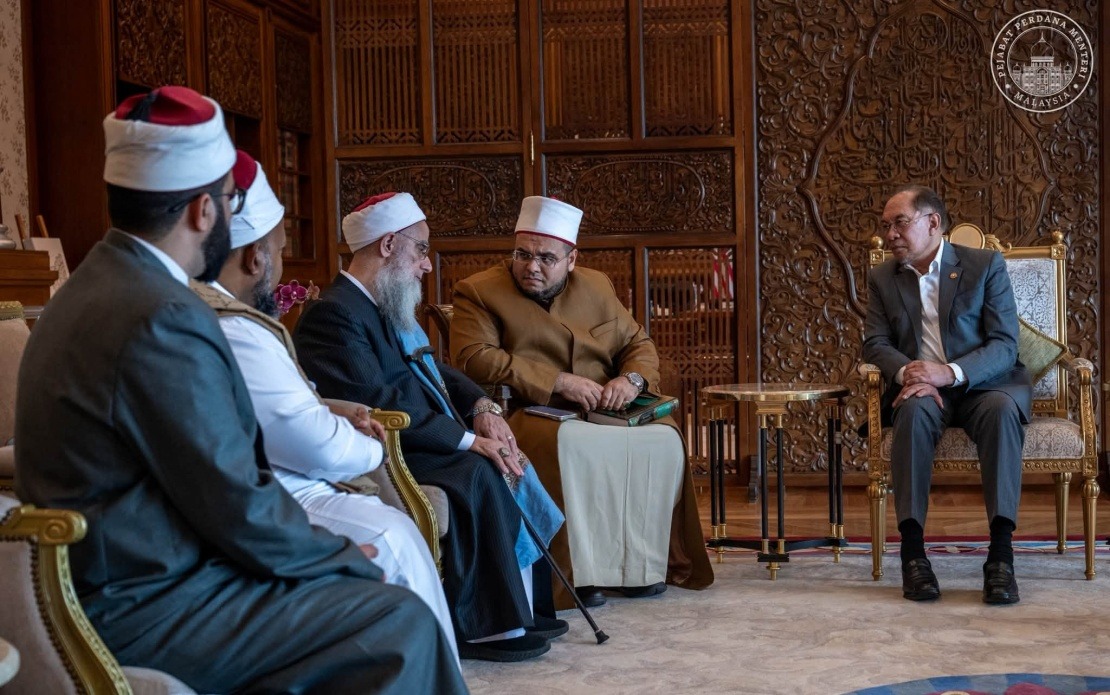
Prime Minister Datuk Seri Anwar Ibrahim received a courtesy visit from one of the Arab world's most respected Islamic scholars, Sheikh Dr Mustafa An-Nadwi Al-Hasani, at his official residence in Putrajaya on July 20. The meeting highlighted Malaysia's continued engagement with prominent Islamic thought leaders from across the Muslim world and underscored the government's commitment to fostering intellectual discourse grounded in traditional Islamic learning.
Sheikh Dr Mustafa hails from Mansurah in Egypt and has established himself as a commanding voice in Islamic jurisprudence and hadith scholarship. Anwar's public acknowledgement of the scholar's credentials emphasised his recognition as an authority who has dedicated his academic career to recovering and promoting classical Islamic knowledge systems, particularly those centred on authenticating and interpreting prophetic traditions. The Prime Minister's decision to meet the visiting scholar reflects Malaysia's positioning as a hub for interfaith dialogue and Islamic intellectual exchange within Southeast Asia.
What distinguished this encounter in the Prime Minister's characterisation was his articulation of why such scholars matter in the contemporary moment. Anwar observed that in an age increasingly dominated by sensationalism and superficial engagement with ideas, figures like Sheikh Dr Mustafa represent an antidote—embodying an approach to knowledge that emphasises depth, careful scholarship, and moral grounding. This framing resonates with ongoing debates in Malaysia about the quality of public discourse and the need to counterbalance viral misinformation with substantive learning.
Sheikh Dr Mustafa's lineage within Islamic scholarship carries particular weight. He is counted among the prominent students of Sheikh Abul Hasan Ali al-Nadwi, a 20th-century Islamic reformer and educator whose influence extended across the Muslim world. The student-teacher relationship highlights continuity within Islamic intellectual traditions and suggests that Sheikh Dr Mustafa carries forward a legacy of moderate, knowledge-centred scholarship that eschews extremism while maintaining fidelity to classical sources.
During the Putrajaya meeting, the two leaders moved beyond ceremonial pleasantries to substantive discussion. Anwar and Sheikh Dr Mustafa exchanged perspectives on pressing contemporary issues affecting Muslims globally and regionally. These conversations likely touched on the balance between tradition and modernity in Islamic thought, the role of scholars in promoting social cohesion, and how classical learning can address modern challenges. For Malaysia, such dialogues are strategically important as the country positions itself as a moderate Islamic voice in an increasingly polarised global landscape.
The scholar's presence in Malaysia during the week of the meeting was not incidental. Sheikh Dr Mustafa was conducting a series of knowledge sessions across the country, offering Malaysian audiences direct access to his expertise in hadith studies and Islamic jurisprudence. These sessions represent the type of intellectual nourishment that Anwar referenced in his public comments—substantive learning experiences that deepen understanding of Islamic tradition rather than exploit religious sentiment for political or commercial gain.
Anwar's public gratitude towards Sheikh Dr Mustafa extended beyond diplomatic courtesy. He specifically thanked the visiting scholar for offering prayers and counsel regarding Malaysia's national unity and prosperity. This acknowledgement carries cultural and political significance within the Malaysian context, where unity across religious and ethnic lines remains a foundational principle enshrined in the Federal Constitution. By receiving blessings from an internationally recognised Islamic figure on behalf of national cohesion, Anwar reinforced the government's commitment to this principle.
The Prime Minister's closing remarks in his Facebook statement revealed the deeper purpose behind the engagement. He invoked prayers for Sheikh Dr Mustafa's wellbeing, the flourishing of his scholarly work, and his continued capacity to guide communities with wisdom, moderation, and compassion. This formulation—wisdom, moderation, compassion—encapsulates values that Malaysian policymakers frequently emphasise when articulating the country's distinctive Islamic identity, one that distinguishes itself from more rigid or extremist interpretations.
For Malaysian observers, this diplomatic exchange illustrates how intellectual and religious figures continue to shape government agendas and public discourse. The visibility granted to Sheikh Dr Mustafa's visit and the Prime Minister's detailed engagement with his ideas sends signals about what the government values in Islamic thought—scholarship grounded in classical sources, commitment to rigorous learning, emphasis on community welfare and social harmony, and resistance to populist or sensationalist approaches to religion.
The broader significance extends to Malaysia's regional role. As Southeast Asia's largest Muslim-majority nation with substantial Christian, Buddhist, and Hindu populations, Malaysia's approach to Islamic scholarship and engagement with international Islamic figures influences how the region navigates religious pluralism and moderatism. Anwar's reception of Sheikh Dr Mustafa suggests continued investment in positioning Malaysia as a space where serious Islamic intellectual work can flourish alongside secular governance and religious diversity.
Such high-level meetings between government leaders and visiting scholars also facilitate knowledge transfer and network-building within Islamic academic circles. Sheikh Dr Mustafa's sessions during his Malaysian visit likely created opportunities for local Islamic scholars, students, and intellectuals to engage directly with one of the Arab world's leading hadith experts, strengthening Malaysia's connections to broader Islamic learning communities and potentially influencing future directions in Islamic education and scholarship within the country.

