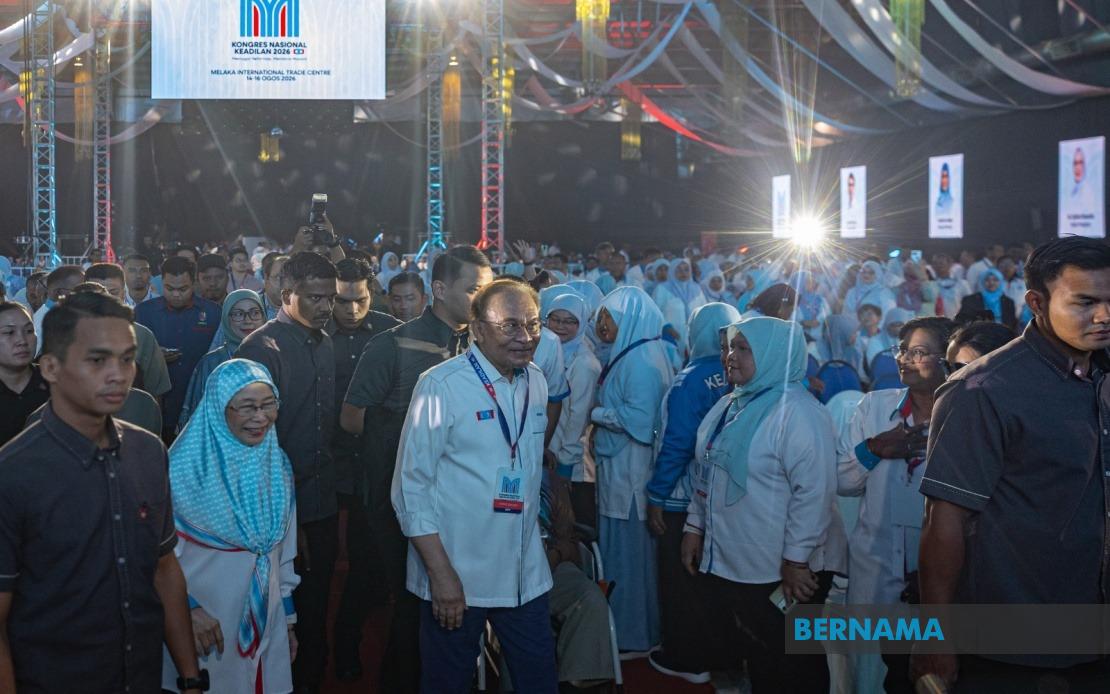
Prime Minister Datuk Seri Anwar Ibrahim has moved to shore up confidence in the Unity Government's fractious alliance with UMNO and Barisan Nasional, declaring at the PKR National Congress 2026 in Melaka that continued cooperation with the coalition remains essential for Malaysia's future. Speaking at the Melaka International Trade Centre on August 16, the PKR president underscored that recent political developments should not derail the broader partnership that has underpinned federal governance.
Anwar's remarks appear calibrated to address mounting speculation about the stability of the ruling coalition, which has faced periodic strain as its constituent parties navigate competing interests and regional power dynamics. By publicly reaffirming the commitment to work alongside UMNO-BN, the Prime Minister has signalled that pragmatism and institutional continuity will guide decision-making at the highest levels, rather than reactive responses to political friction or personalised grievances within the government.
The emphasis on prioritising "political stability and the people's prosperity" reflects a governing philosophy that seeks to position the Unity Government as focused on bread-and-butter concerns. For Malaysian voters, many of whom remain sceptical about the durability of coalitions that unite formerly antagonistic parties, such messaging carries weight in an environment where economic performance and price stability directly influence electoral sentiment. Anwar's framing suggests that internal coalition management, while necessary, should not overshadow the delivery of tangible improvements in living standards and employment growth.
Anwar's assertion that political decisions must not be "driven by personal interests, positions or anger" appears directed at party figures within both PKR and UMNO who have occasionally aired disagreements publicly. The statement carries implicit acknowledgement that such tensions exist and require disciplined leadership to manage. By invoking collective responsibility, the Prime Minister has set a benchmark against which coalition partners can be measured—a move that potentially constrains opportunistic defections or public displays of discontent that might further destabilise the government.
The Unity Government's partnership with UMNO-BN, formed following the 2022 elections, represented a historic realignment in Malaysian politics, bringing together parties that had opposed one another for decades. The arrangement has delivered electoral arithmetic advantages and demonstrated an ability to pass legislation, yet it remains structurally delicate. UMNO's dominance in rural and Malay-Muslim constituencies provides electoral ballast, while PKR and its allies anchor urban and younger voter bases. Any rupture threatens both coalition partners' electoral prospects, a reality that Anwar's language subtly acknowledges.
Economic considerations loom large in this equation. Malaysia's growth momentum has been moderate, inflation concerns persist in pockets of the population, and the government faces pressure to demonstrate fiscal responsibility while funding development priorities. A coalition collapse would likely trigger a political crisis that markets and international investors would view unfavourably, potentially affecting the ringgit and investor confidence. Anwar's emphasis on "economic growth" as a pillar of the partnership reflects these material stakes.
The timing of Anwar's comments at a major PKR gathering carries significance beyond their content. The PKR National Congress represents the largest component party in the coalition after UMNO, and Anwar's use of this platform to publicly commit to continued cooperation sends a signal to his own party cadre that internal party interests must not override coalition cohesion. This is particularly important given that PKR members may harbour ambitions for greater ministerial representation or feel constrained by partnership arrangements with a larger rival.
Regional implications also merit consideration. The stability of Malaysia's federal government carries resonance across Southeast Asia, influencing investment patterns, trade relationships, and the region's political dynamics. A coalition breakdown could weaken Malaysia's voice on regional platforms and distract from pressing issues such as economic integration, maritime security, and engagement with major powers. Anwar's commitment to continuity thus extends beyond domestic borders.
Looking forward, the sustainability of the Unity Government will likely depend on the coalition's ability to deliver visible achievements in areas where voters feel immediate impact—inflation management, wage growth, infrastructure completion, and education quality. Anwar's framing suggests that the leadership recognises these linkages. However, coalition stability also requires mechanisms to manage inevitable disagreements and distributional conflicts between partners, which remain largely opaque to public scrutiny.
The Prime Minister's statement also implicitly acknowledges that some elements within both PKR and UMNO may prefer alternative arrangements. The political landscape includes other potential coalition configurations, and maintaining discipline around the existing arrangement requires consistent messaging from the top. By publicly committing to the UMNO-BN partnership while simultaneously urging restraint and wisdom in decision-making, Anwar has attempted to occupy the centre ground of Malaysian politics—a position essential for a prime minister leading a coalition of rivals.

