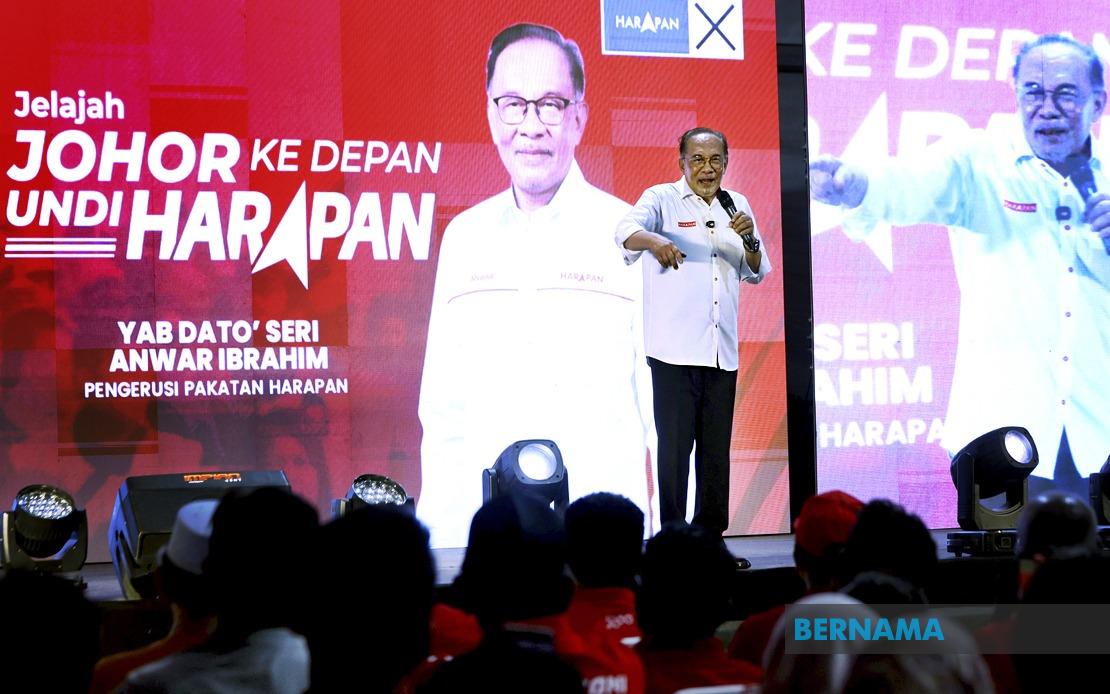
Prime Minister Datuk Seri Anwar Ibrahim has drawn a line in the sand over corruption, declaring that Malaysia's era of systematic plunder and crony capitalism has definitively ended under his MADANI Government. Speaking at a campaign rally in Sungai Mati during the Johor State Election drive, Anwar articulated a vision of governance centred on integrity as the non-negotiable foundation of leadership, signalling a fundamental departure from practices that marked earlier administrations.
The Prime Minister's remarks came as his coalition campaigns intensely across Johor ahead of the July 11 state election, where 172 candidates will contest 56 seats. Anwar's emphasis on clean administration reflects a core promise that underpinned Pakatan Harapan's electoral coalition—the systematic dismantling of networks that allegedly channelled public resources to favoured individuals and their families. This positioning carries particular weight in Johor, traditionally a stronghold of rival parties, where Anwar has concentrated significant campaign effort over two days of engagements.
Centrally, Anwar rejected the notion that leadership quality should be assessed through racial or communal lenses, instead championing merit and moral character as the sole criteria for holding office. His formulation—calling for honest Malay leaders, ethical Chinese leaders, and leaders of integrity across all communities—represents an attempt to transcend what he characterised as narrow identity politics deliberately weaponised to obscure past administrative failures. This framing appears designed to neutralise opposition accusations that the coalition lacks support among particular demographic groups, by arguing that voters should prioritise honesty over ethnic appeals.
The substance of Anwar's anti-corruption message centres on the cessation of what he termed the old model of abusing governmental power to concentrate wealth within ruling circles. He specifically identified the practice of awarding state contracts to family members, enriching children through state mechanisms, and directing public opportunities to connected businesspeople as hallmarks of the discredited system. By naming these mechanisms explicitly, the Prime Minister signals that his administration recognises the technical apparatus through which corruption operated historically and now seeks to dismantle it.
Crucially, Anwar offered an explicit guarantee that his government would extend no protective umbrella to corrupt officials. This assurance carries operational significance because previous transitions of power in Malaysia have sometimes seen selective prosecution based on political calculation rather than consistent application of law. By pledging impartial treatment regardless of an official's position or patronage networks, Anwar positions anti-corruption not merely as rhetorical commitment but as institutional practice that would differentiate his administration from its predecessor.
The timing of these remarks reflects broader political dynamics in Malaysia's post-2018 environment, where multiple power transitions have created competing narratives about governance quality and administrative integrity. Anwar's insistence that the public judge leaders on honesty rather than political messaging appears partially directed at the opposition, whom he characterises as attempting to exploit narrow sentiments to regain federal power while concealing their own historical record. This rhetorical strategy seeks to reframe electoral choice as fundamentally about which coalition has genuinely reformed itself versus which merely seeks to return to previous arrangements.
For Malaysian voters, particularly those in Johor where state-level elections often serve as referenda on federal government performance, Anwar's framing presents anti-corruption and good governance as the central issue demanding their attention and votes. He explicitly urged Johor electors to reject leaders lacking integrity, linking their voting decisions directly to intergenerational consequences—essentially arguing that tolerance for corruption today compromises the future available to younger Malaysians. This populist appeal to parental concern about inheritance of institutional quality may resonate in constituencies where governance failures have created tangible hardship.
The gathering at Sungai Mati, attended also by Penang Chief Minister Chow Kon Yeow and Ledang MP Syed Ibrahim Syed Noh, underscored the coalition-building dimensions of the anti-corruption message. By assembling leaders across different parties and states united around the integrity theme, Anwar presented corruption as a challenge transcending narrow partisan boundaries—a shared threat to national welfare rather than political advantage for one side. This approach potentially broadens the appeal of anti-corruption messaging beyond traditional coalition constituencies.
The practical implications of Anwar's hardline stance extend across Malaysia's Southeast Asian context. As regional economies face increasing scrutiny regarding corruption's impact on competitiveness and development outcomes, Malaysia's explicit commitment to administrative integrity could carry weight in attracting investment and maintaining international credibility. Conversely, failure to operationalise these pledges consistently would risk exposing them as mere campaign rhetoric, potentially deepening public cynicism about governance quality and institutional reform.
From an analytical perspective, Anwar's repeated emphasis on ending the culture of plunder suggests recognition that corruption remains a mobilising issue for Malaysian voters despite years of high-profile cases and prosecutions. Rather than treating anti-corruption as resolved through previous convictions, he treats it as requiring continuous reaffirmation and institutional vigilance. This ongoing emphasis reflects the reality that public confidence in institutional independence and merit-based governance remains fractured across Malaysia's diverse polity.
The trajectory of these commitments will ultimately be measured not in campaign rhetoric but in prosecutorial decisions, procurement transparency, and personnel decisions made over coming months and years. Whether Anwar's MADANI Government can translate his categorical pledges into demonstrable institutional change—through systematic reform of contracting procedures, independence of anti-corruption agencies, and equitable application of justice—will determine whether this particular transition in Malaysia's governance narrative represents genuine reform or another iteration of familiar political cycles.

