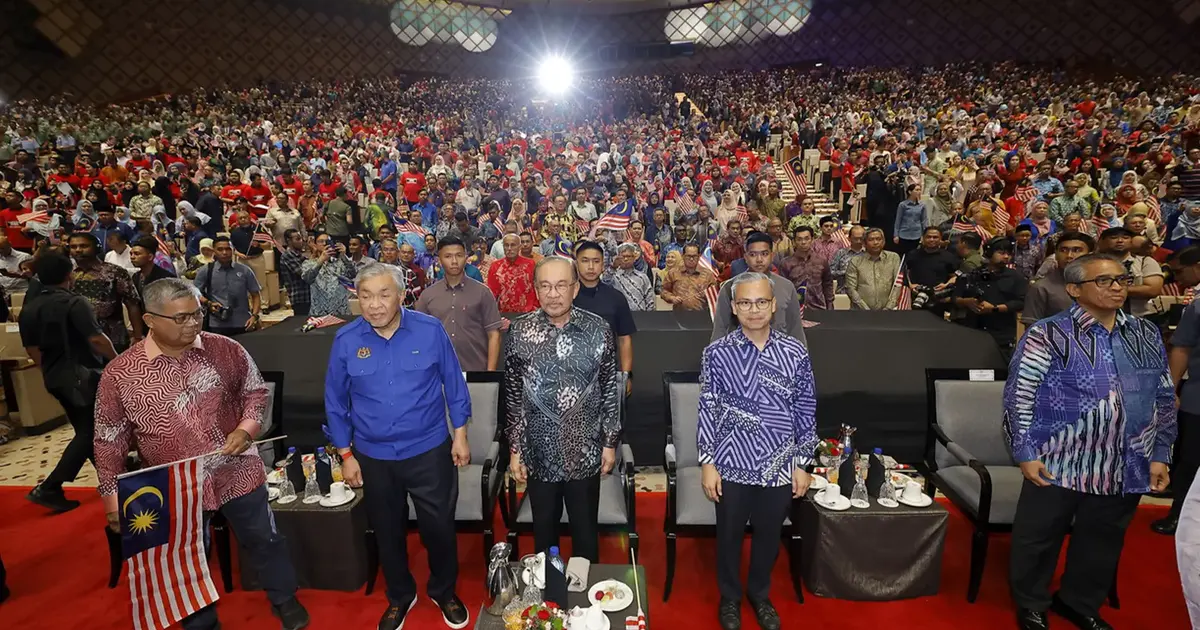
Prime Minister Anwar Ibrahim has announced an initiative to return substantial sums held in seized government accounts back to the Malaysian public, characterising the move as a fundamental expression of the administration's commitment to equitable wealth distribution across the nation. The pledge reflects a broader ideological stance within the current government that the country's resources ultimately belong to and should be directly accessible to ordinary Malaysians rather than remaining locked within state coffers or subject to protracted bureaucratic processes.
The decision to release these impounded funds represents a significant shift in how Malaysia's governing structure approaches capital management and public welfare. Rather than retaining seized assets within government treasuries for infrastructure projects or fiscal reserves as has historically been the practice, the Prime Minister's position suggests a reorientation toward direct citizen benefit. This approach carries particular resonance given Malaysia's history of asset recovery efforts, including large-scale anti-corruption initiatives that have accumulated considerable sums through civil forfeitures and criminal convictions.
Anwar's framing of this policy initiative emphasises a philosophical principle that has gained prominence in Malaysian political discourse over recent years: the notion that state resources exist fundamentally for the welfare of the population rather than as autonomous government holdings. This represents a conceptual departure from traditional treasury management, where accumulated reserves serve functions such as economic stabilisation, emergency response capacity, and long-term infrastructure planning. The Prime Minister's articulation suggests that distributing these particular funds aligns more closely with democratic accountability and the fundamental social contract between government and citizens.
The practical implications of returning billions in seized funds remain subject to clarification regarding implementation mechanisms. Questions naturally arise about distribution methodology, eligibility criteria, timing of payments, and whether the returned capital will take the form of direct payments, tax relief, subsidies, or alternative arrangements. Each approach carries distinct economic consequences and administrative requirements. Direct cash distributions, for instance, would require comprehensive identification systems and payment infrastructure, while tax-based returns might prove administratively simpler but less equitable across income brackets.
From a Malaysian perspective, this initiative connects to ongoing conversations about wealth inequality and whether accumulated government assets should be mobilised for immediate citizen benefit. The country has experienced substantial economic growth yet faces persistent regional disparities and wealth concentration concerns. The return of seized funds could theoretically address immediate liquidity challenges for selected populations, though the scope and reach of such programmes remain undefined at this juncture.
For Southeast Asian observers, Malaysia's approach offers an instructive case study in how developing democracies balance fiscal responsibility with democratic principles and public distribution of state assets. Regional governments frequently grapple with similar questions regarding anti-corruption recoveries, abandoned government accounts, and the appropriate disposition of impounded wealth. Malaysia's choice to prioritise citizen access represents one answer to these enduring policy tensions.
The financial magnitude of seized assets available for distribution warrants consideration within Malaysia's broader economic context. Billions in recovered funds could represent meaningful sums relative to household incomes and purchasing power, particularly for lower-income communities. Simultaneously, the opportunity cost of directing these resources away from infrastructure investment, debt reduction, or economic development initiatives merits serious policy analysis. The government must weigh immediate citizen benefit against medium and long-term economic priorities.
Anwar's emphasis on wealth equity reflects broader governance themes characterising his administration's early tenure. The commitment to transparent resource management and public-centric policy has featured prominently in government communications and legislative initiatives. The seized funds initiative can be understood as consistent with this governing philosophy, though implementation details will ultimately determine whether the policy achieves its stated objectives of broad-based wealth sharing.
The decision also carries implications for Malaysia's international standing and investor confidence. Foreign observers and business communities monitor government financial stewardship closely, and policies affecting capital management can influence economic perception and investment decisions. The return of seized funds, if executed transparently and sustainably, might reinforce perceptions of improved governance, while mismanagement or inequitable distribution could undermine such confidence.
Implementation timelines and specific fund allocations will require careful communication to set realistic public expectations. The government faces the challenge of translating a policy principle into concrete actions that demonstrably benefit Malaysian citizens while maintaining fiscal stability. Public understanding of the initiative's scope, eligibility requirements, and timeline will shape public reception and perceived success.
Looking forward, the seized funds initiative represents an opportunity to test whether redistributive governance approaches can function effectively within Malaysia's bureaucratic and financial systems. Success would potentially position the government favourably with constituencies prioritising equitable wealth distribution, while failure or delays might generate public frustration. The coming months will prove instructive regarding both the programme's practical viability and its broader implications for Malaysian governance and public policy direction.

