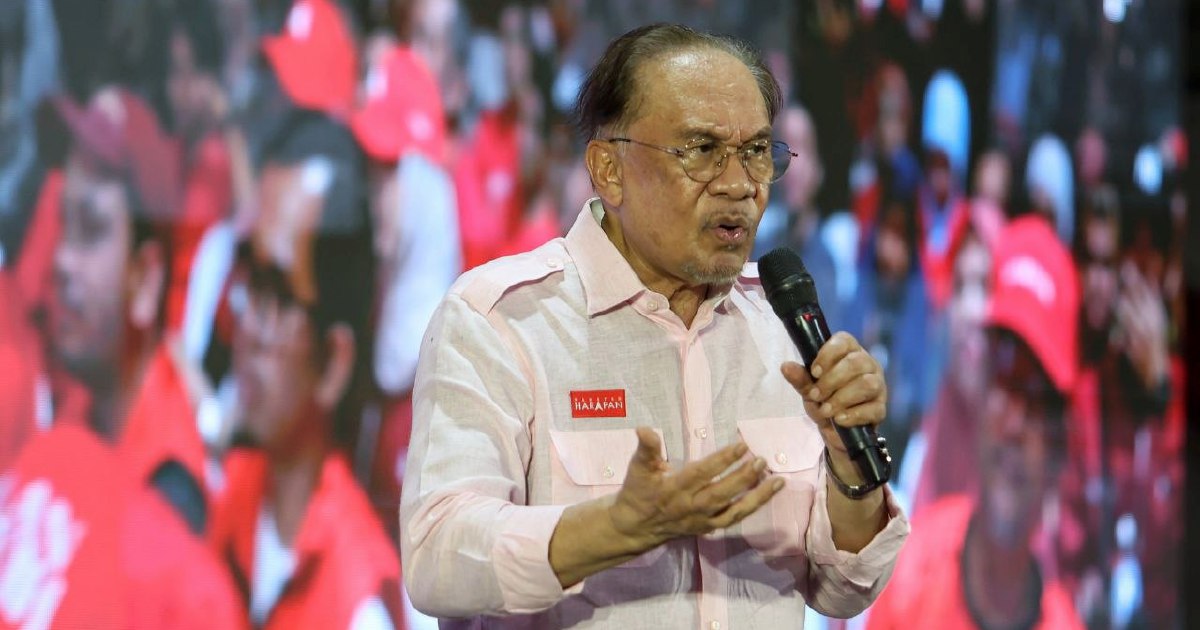
Prime Minister Datuk Seri Anwar Ibrahim has reassured Malaysians that the federal unity government will remain stable and functional despite the upcoming electoral contest in Negeri Sembilan, where his Pakatan Harapan-led coalition will challenge Barisan Nasional for control of the state. Speaking in Seremban, the premier underscored his commitment to maintaining the delicate political arrangements at the national level even as his administration pursues electoral gains in individual states.
The statement represents a careful balancing act for Anwar, who must simultaneously energise his coalition's campaign machinery in Negeri Sembilan while reassuring investors, business leaders, and the general public that constitutional governance and ministerial cooperation will not be disrupted by partisan competition. This dual messaging reflects the complex political landscape Malaysia has navigated since the 2022 general election, when no single coalition secured a parliamentary majority, necessitating cross-party cooperation at the federal level.
The unity government framework has proven instrumental in enabling Malaysia to function across multiple elections and state-level contests without triggering governmental collapse. By explicitly vouching for the architecture's continuance, Anwar appears to be signalling that electoral competition at the state level need not threaten the broader political consensus that has kept the coalition functional. This distinction between federal and state-level politics has become increasingly important as Malaysia confronts simultaneous contests across different tiers of governance.
Negeri Sembilan has historically been a competitive arena where different coalitions have alternated power. The upcoming state election represents a significant opportunity for Pakatan Harapan to demonstrate electoral strength and expand its footprint beyond its current strongholds. However, the state's political dynamics also reflect broader national trends, making it a bellwether for underlying shifts in voter sentiment across the peninsula.
Anwar's emphasis on federal stability carries particular weight given international perceptions of Malaysian governance. The stability of the unity government has been crucial for policy continuity on economic reforms, infrastructure projects, and regional diplomatic initiatives. Any suggestion of instability at the federal level could unsettle financial markets and complicate Malaysia's efforts to attract foreign investment during a competitive period for regional capital flows.
The Barisan Nasional, which held sway in Negeri Sembilan until recent years, remains a formidable force in state politics. The contest between the two coalitions reflects the broader polarisation of Malaysian politics, though both maintain some level of cooperation at the federal tier. This arrangement, while sometimes appearing contradictory to outside observers, has become the operational norm in contemporary Malaysian politics, where state autonomy and federal cohesion coexist through careful negotiation and mutual understanding.
Anwar's public commitment to unity government stability also serves to preempt concerns about potential defections or parliamentary complications should electoral momentum shift dramatically in any particular direction. By stressing the primacy of federal governance arrangements, he frames state elections as separate contests that should not be weaponised to destabilise the broader political settlement. This framing becomes increasingly important as opposition figures might otherwise seek to capitalise on electoral victories to demand greater influence or concessions at the national level.
The Negeri Sembilan election itself carries significance for several policy areas directly under state purview, including land administration, Islamic affairs, and local economic development. Voters will be deciding not merely on federal coalition affiliation but on the state government's capacity to manage these domains effectively. The contest thus represents a genuine test of competing visions for state governance rather than a simple referendum on national leadership.
For Malaysian investors and the business community, Anwar's reassurance addresses a key concern about the predictability of the policy environment. Economic actors require confidence that government remains functional regardless of which party holds which position. By explicitly separating electoral competition from governmental stability, the premier attempts to maintain investor confidence while his coalition wages campaigns for specific offices and constituencies.
The unity government model that Anwar references has not been without tensions and complications. Coalition partners have occasionally disagreed on policy matters, and questions periodically arise about the sustainability of such diverse political arrangements. Nevertheless, the model has demonstrably delivered on governance continuity and has managed Malaysia through a period of considerable political complexity without institutional breakdown.
Negeri Sembilan's voters will ultimately determine the state's political direction through their ballots. However, Anwar's public stance—that federal cooperation transcends state-level electoral outcomes—establishes a framework within which the competition can unfold without threatening the broader stability that Malaysian citizens and international observers have come to expect from the federal government's functioning in this era of coalition politics.

