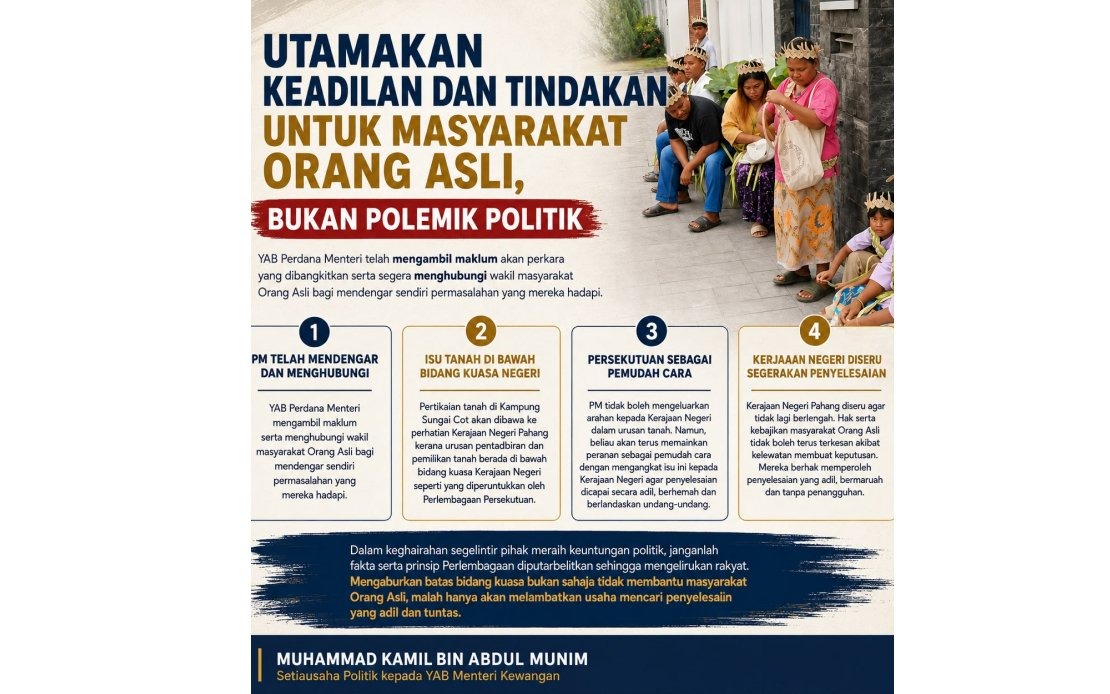
Prime Minister Datuk Seri Anwar Ibrahim is positioning himself as a facilitator in efforts to resolve the contentious land ownership dispute affecting the Orang Asli community in Kampung Sungai Cot, located in Maran, Pahang. Through his political secretary to the Finance Minister, Muhammad Kamil Abdul Munim, Anwar signalled his willingness to engage both the affected indigenous community and the state administration to achieve what he describes as a fair and legally sound resolution to a matter that has long troubled the residents of this settlement.
The Prime Minister has already taken initial steps toward involvement by personally reaching out to representatives of the Orang Asli community to understand the precise difficulties they are confronting. This direct engagement reflects an attempt to move beyond superficial political gestures and grasp the substantive challenges at stake. Muhammad Kamil's statement emphasised that Anwar takes the matter seriously and intends to escalate it within official channels to ensure it receives appropriate attention from the Pahang State Government, which holds jurisdiction over land administration and property rights in the state.
However, Anwar's involvement comes with significant constitutional constraints that both the Prime Minister's office and state authorities must navigate carefully. Under Malaysia's federal framework, land matters remain firmly within the purview of state governments rather than the federal administration. The Federal Constitution explicitly reserves land administration and ownership questions to the states, a principle that the political secretary emphasised in his statement. This division of powers means that despite the Prime Minister's political authority and national profile, he cannot unilaterally direct or impose solutions on what is fundamentally a state-level issue.
The distinction between facilitating and directing has become a crucial talking point in this context. Muhammad Kamil stressed that while Anwar lacks the constitutional authority to issue directives to the Pahang State Government on land questions, the Prime Minister has committed to playing an active intermediary role. This framing suggests an approach where the federal government applies diplomatic pressure and coordinates efforts without overstepping its constitutional boundaries. The Prime Minister intends to bring the matter before state authorities in a manner that emphasises both urgency and fairness, hoping to catalyse action rather than substitute for state decision-making.
The political secretary's statement also contained pointed criticism of certain parties attempting to exploit the situation for electoral advantage. Muhammad Kamil cautioned against distorting constitutional principles or misrepresenting facts in ways that mislead the public about what the Prime Minister can or cannot accomplish. This reference appears directed at opposition figures or others who might use the Orang Asli land dispute to attack the government while offering no viable alternative approaches. The statement suggests that premature political scoring could actually impede genuine resolution efforts by clouding the substantive issues involved.
The Orang Asli community in Kampung Sungai Cot faces a situation where their land rights remain unresolved, creating uncertainty about property ownership, usage rights, and security of tenure. For indigenous communities across Malaysia, such disputes are not merely technical legal questions but existential matters affecting their ability to maintain their way of life, preserve their cultural heritage, and pass property to future generations. The stakes for residents of Kampung Sungai Cot are thus considerably higher than typical land administration cases, adding moral weight to the push for swift resolution.
Muhammad Kamil's statement explicitly urged the Pahang State Government to move with urgency in fulfilling its responsibilities toward the Orang Asli community. The political secretary argued that further delays in decision-making would continue to negatively affect the rights and welfare of residents, suggesting that the state administration has the capacity to resolve the matter but may lack sufficient political will or administrative momentum. This public exhortation represents a form of federal pressure, using media statements to highlight state government inaction or sluggishness without formally overriding state authority.
The timing of the Prime Minister's involvement reflects broader national attention to indigenous land rights. Orang Asli communities across Peninsular Malaysia have long advocated for recognition and protection of their ancestral lands, with various disputes reaching different stages of resolution through courts, state assemblies, and federal initiatives. The Kampung Sungai Cot case has apparently gained sufficient prominence or political salience that it now commands attention at the highest levels of the federal government, suggesting either that affected residents have successfully escalated their concerns or that political leaders have recognised the issue's importance.
Anwar's personal contact with community representatives signals a shift toward more direct engagement with indigenous stakeholders rather than operating solely through bureaucratic channels. This approach acknowledges that Orang Asli communities often feel overlooked by government institutions and may require direct assurance from national leadership that their concerns are being heard. By personally communicating with representatives, the Prime Minister attempted to establish credibility and demonstrate commitment beyond what routine administrative processes might convey.
The path forward involves coordination between the federal government's facilitating role and the Pahang State Government's decision-making authority. The state government must ultimately determine how land rights will be allocated, protected, or transferred, but it will do so with heightened awareness that the Prime Minister is monitoring progress and considering federal options for supporting a resolution. This dynamic creates incentives for the state to act decisively while avoiding actions that would invite federal intervention or negative national attention.
For the Orang Asli community in Kampung Sungai Cot, the Prime Minister's commitment to a facilitating role offers both opportunity and uncertainty. It represents an escalation of their concerns within the political system and acknowledgment from the nation's top leader that their situation deserves urgent attention. However, the actual resolution will depend on whether state authorities prioritise their land dispute amid competing demands and whether the federal government maintains pressure or allows the matter to recede from national focus once initial commitments have been made public.

