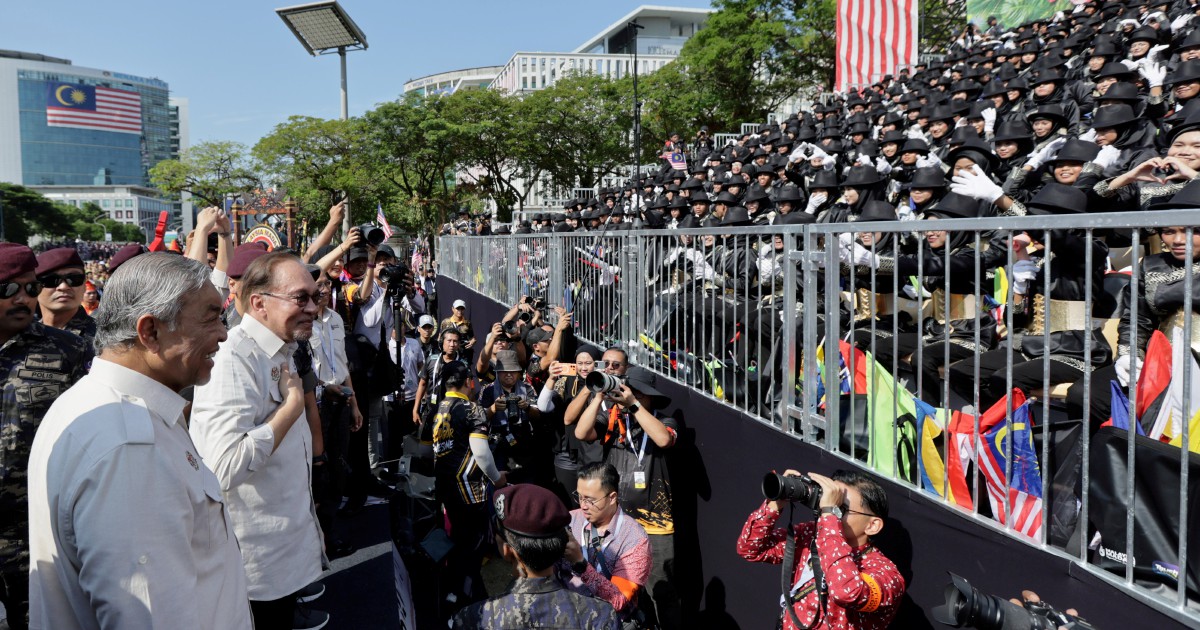
Prime Minister Datuk Seri Anwar Ibrahim eschewed the formality typically associated with high-level officials at state ceremonies, instead opting for an extended personal engagement with ordinary Malaysians during a walkabout that followed the National Day parade at Dataran Putrajaya. Rather than proceeding swiftly to official vehicles or returning to administrative duties, the Prime Minister made deliberate stops throughout the crowd to exchange pleasantries, listen to constituents, and share embraces with children present at the celebration.
The informal interaction marked a departure from the conventional protocol often observed at official parade proceedings, where dignitaries typically maintain a measured distance from crowds. Anwar's decision to spend additional time mingling with families and young Malaysians demonstrated an intentional effort to bridge the gap between political leadership and the general public. His approach reflected a broader philosophy of accessibility that he has emphasised during his tenure, seeking to present himself as approachable and connected to the everyday concerns of citizens.
The walkabout unfolded against the backdrop of Malaysia's National Day commemorations, an occasion when citizens gather to celebrate national identity and unity. Dataran Putrajaya, the purpose-built administrative capital, provided a fitting venue for the gathering, as the plaza regularly hosts major national events and ceremonies. The choice to engage in extended public interaction at such a symbolic location carried particular resonance, positioning the Prime Minister as a participant in collective national sentiment rather than merely a ceremonial figurehead.
Children appeared to be the primary focus of Anwar's attention during the walkabout, with multiple instances of the Prime Minister kneeling or bending to speak with young Malaysians at eye level and accepting hugs. This deliberate engagement with the younger generation holds significance beyond mere optics, suggesting an intention to foster positive associations between children and national leadership during formative years. The warmth of such interactions, captured in public view, serves to humanise political figures in ways that conventional governance rarely permits.
Anwar's approachability during public appearances has become increasingly characteristic of his administration's communication style. The walkabout exemplifies how modern political leaders leverage informal settings to project an image of connectedness and concern for their constituents. However, such moments also serve practical political functions, allowing leaders to gather immediate feedback from citizens and project accessibility ahead of future electoral cycles or policy announcements.
The interaction occurred within the broader context of Malaysia's diverse and multicultural society, where National Day celebrations serve as occasions for citizens of all ethnic and religious backgrounds to participate in shared civic rituals. Anwar's engagement with the crowd reflected an understanding that such celebrations offer opportunities for leaders to demonstrate commitment to national cohesion and unity at the grassroots level.
For Malaysian observers accustomed to more formal interactions between high office holders and the public, the Prime Minister's extended walkabout represented a notable stylistic choice. The willingness to spend time on personal engagement, rather than adhering strictly to programmed schedules, suggested a prioritisation of direct human connection over administrative efficiency. This approach carries implications for how the prime ministerial office presents itself to the public, potentially establishing expectations for greater accessibility in future public appearances.
The National Day parade itself serves as an annual demonstration of Malaysia's defence capabilities, national identity, and collective pride. By extending his presence at the venue beyond the formal parade proceedings to engage with attendees, Anwar positioned the celebration as an occasion for broader national dialogue rather than merely a military or administrative spectacle. This framing emphasises the role of ordinary Malaysians in national life and identity formation.
The moment captured at Dataran Putrajaya also occurs within a regional context where political leaders across Southeast Asia employ various strategies to manage their public personas and relationship with constituents. Anwar's informal engagement approach contrasts with more distant or formal leadership styles observed in certain neighbouring countries, potentially reflecting different political traditions and public expectations within Malaysia's democratic system.
For the children and families who encountered the Prime Minister during the walkabout, the experience likely constituted a memorable civic moment—an unexpected opportunity to interact directly with the nation's highest-ranking political leader. Such personal encounters, however brief, often become family stories and contribute to individuals' sense of connection to national institutions and leadership.
As political communication increasingly occurs through digital platforms and televised addresses, opportunities for spontaneous human interaction between leaders and citizens have become increasingly rare. The Prime Minister's decision to prioritise such moments at significant national occasions thus carries heightened symbolic weight, suggesting an intentional effort to maintain channels of direct engagement despite the prevalence of mediated communication.
The walkabout ultimately reflects broader questions about leadership style, accessibility, and the public expectations surrounding those who hold high office. By choosing to spend additional time in conversation and physical contact with members of the public, Anwar signalled that such engagement remains central to his conception of the prime ministerial role, regardless of administrative pressures or formal schedule constraints.

