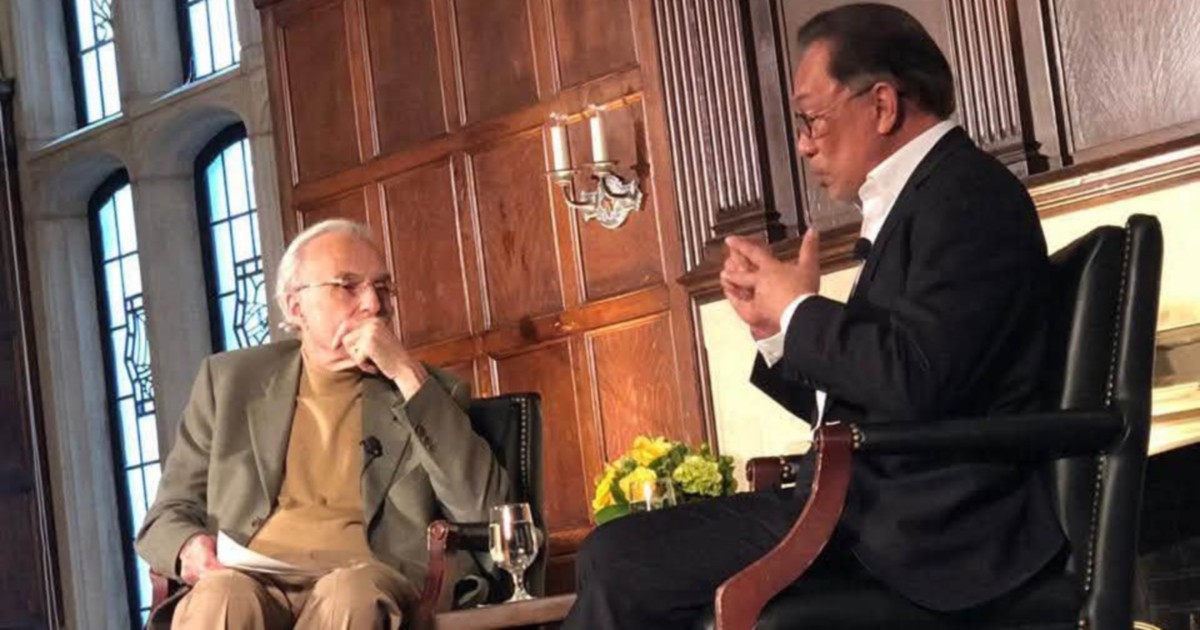
Prime Minister Datuk Seri Anwar Ibrahim has paid tribute to Professor John L. Esposito, the internationally recognized authority on Islamic studies and civilization, following the scholar's passing. The Premier's gesture of mourning underscores the significance of Esposito's intellectual contributions to global understanding of Islam and his influence across academic and policy circles worldwide.
Esposito's scholarly legacy spans several decades of rigorous examination into Islamic history, religion, and contemporary Muslim societies. His work has profoundly shaped how universities, governments, and international organizations approach the study of Islam in the modern world. Through his prolific writing and research, he bridged the gap between Western academic inquiry and Islamic intellectual traditions, earning respect from Muslim and non-Muslim scholars alike.
The Georgetown University professor was instrumental in establishing the Prince Alwaleed Bin Talal Center for Muslim-Christian Understanding, an institution dedicated to fostering interfaith dialogue and scholarly exchange. This centre became a beacon for researchers investigating the intersection of Islamic faith with contemporary political, social, and economic realities. His pioneering work in demonstrating Islam's compatibility with democratic values and pluralistic societies influenced policy discussions at the highest levels of government and international forums.
For Malaysia specifically, Esposito's scholarship carries particular relevance. His nuanced analyses of Muslim-majority democracies and moderate Islamic governance provided intellectual frameworks that resonated with Malaysia's own experience as a multicultural, multireligious nation attempting to balance Islamic principles with secular constitutional governance. Malaysian academics and policymakers have long drawn upon his research when contextualizing debates around Islam's role in contemporary Southeast Asian societies.
Beyond the scholarly realm, Esposito served as a cultural bridge during turbulent periods of international relations. His willingness to engage in public intellectualism—speaking to media, advising governments, and publishing for general audiences—helped counter sweeping generalizations and stereotypes about Islam and Muslims in the post-9/11 era. At a time when Islamophobia threatened to distort public discourse, his credible voice offered evidence-based perspectives grounded in historical fact and academic rigor.
The scholar's influence extended into the Arab world and across Muslim-majority nations where his work was widely translated and studied. Universities from Cairo to Jakarta incorporated his texts into curricula, recognizing that his approach combined scholarly objectivity with cultural sensitivity. His collaborations with Muslim intellectuals and theologians demonstrated that rigorous examination of Islamic traditions need not be defensive or polemical, but could instead illuminate shared human concerns across religious divides.
Esposito's methodology emphasized understanding Islam on its own terms rather than through purely external frameworks. This approach earned him citations in academic work addressing religious extremism, moderate Islam, women's rights within Islamic contexts, and the evolution of Islamic thought through centuries of diverse interpretation. His ability to navigate complex theological questions while maintaining scholarly distance proved invaluable to researchers attempting to separate ideology from evidence-based analysis.
His passing represents a loss not merely to Middle Eastern studies or Islamic scholarship, but to the broader intellectual project of fostering cross-cultural understanding at a moment when such dialogue has become increasingly vital. In an era marked by polarization and sectarian tensions, Esposito's decades-long commitment to showing the diversity of Islamic thought and practice offered a counterweight to reductionist narratives.
For Malaysia's academic community and intellectual leadership, Esposito's work remains deeply relevant to ongoing conversations about Islam's relationship with modernity, governance structures in Muslim societies, and the possibility of reconciling religious faith with secular legal frameworks. His scholarly legacy will continue influencing generations of researchers examining these complex intersections.
Prime Minister Anwar Ibrahim's formal expression of condolences reflects Malaysia's appreciation for Esposito's contributions to global Islamic scholarship and his decades of dedicated work promoting mutual understanding between different religious and cultural traditions. The scholar's passing marks the end of an era in Islamic studies, leaving behind an extensive body of work that will continue guiding academic inquiry and informing policy discussions well into the future.

