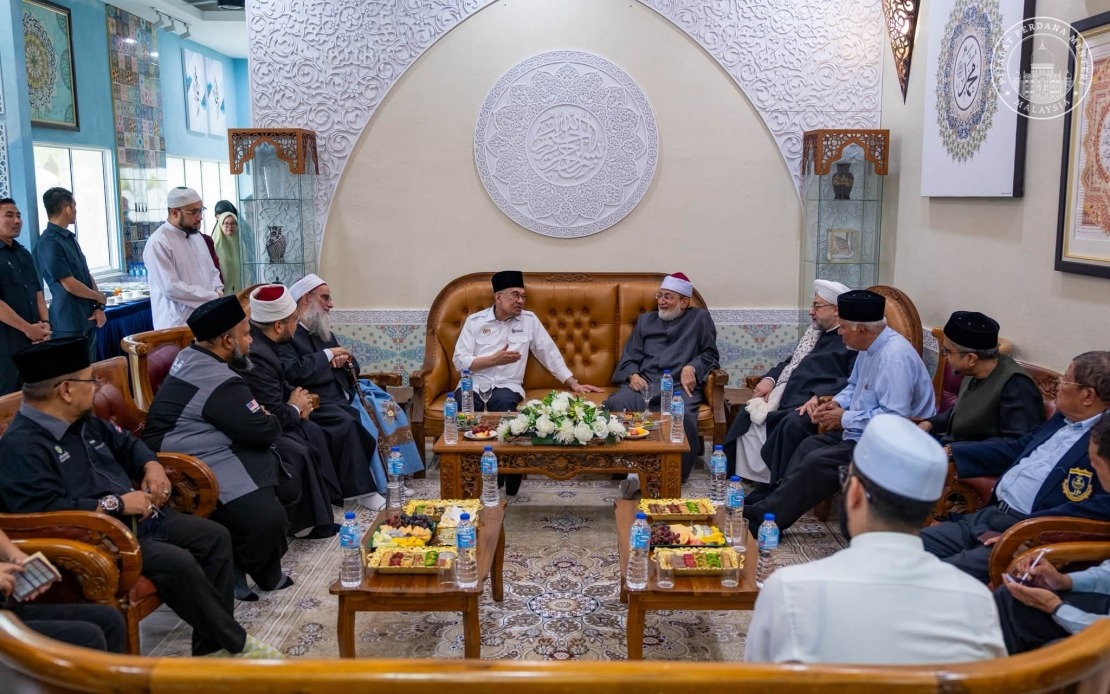
Prime Minister Datuk Seri Anwar Ibrahim took time from his official duties on August 19 to meet with three internationally respected Islamic scholars who are visiting Malaysia. The encounters, which took place at Nasyrul Quran, reflect Anwar's emphasis on deepening engagement with religious thought leaders and integrating Islamic scholarship into national discourse.
The three visitors represent different dimensions of Islamic expertise and influence across the Muslim world. Al-Fadhil Al-Allamah Al-Muhaddith Syeikh Dr Mustafa al-Nadwi Al-Hasani is a renowned hadith scholar from Egypt, specialising in the authentication and interpretation of prophetic traditions. Al-Fadhil Al-Allamah Al-Muqri' Syeikh Dr Ahmad Isa Al-Ma'sarawy is recognised internationally for his mastery of Quranic recitation, an art form that commands considerable respect within Islamic circles. The third guest, Al-Fadhil Al-Syeikh Maulana Al-Sayyid Afeefuddin Al-Jailani, serves as custodian of the waqf properties, mosque, and mausoleum associated with the historical figure Syeikh Abdul Qadir Al-Jailani, linking him to one of Islam's most influential spiritual traditions.
Through a Facebook statement, Anwar characterised the meetings as an opportunity to inquire about the scholars' wellbeing, solicit their counsel, and request their prayers for the nation. His public remarks emphasised gratitude toward these religious figures for dedicating time to Malaysia and contributing their knowledge toward advancing Islamic understanding. This approach aligns with Anwar's broader political narrative since assuming office, which has prioritised positioning Malaysia as a beacon of progressive Islamic thought while maintaining orthodox religious credentials.
The Prime Minister's stated objectives during these encounters extended beyond courtesy calls. Anwar explicitly framed the visits as part of efforts to disseminate authentic Islamic teachings throughout the country. This positioning suggests a calculated strategy to leverage the international standing of these scholars to enhance the credibility and reach of religious messaging within Malaysian society. For a leader whose political legitimacy has sometimes been questioned by conservative religious constituencies, such associations carry symbolic weight.
The emphasis on building "a society that is virtuous, knowledgeable and lives in harmony" reflects consistent themes in Anwar's public communications. By connecting scholarly visits to societal outcomes, the Prime Minister frames religious engagement not as sectarian or divisive but as foundational to national cohesion. This framing becomes particularly significant given Malaysia's complex religious landscape, where Islam holds constitutional primacy while the nation is home to substantial Buddhist, Christian, Hindu, and other faith communities.
The choice of venue—Nasyrul Quran, an Islamic educational institution—suggests deliberate curatorship of the encounter's symbolic meaning. Rather than receiving scholars at the Prime Minister's official residence or parliamentary offices, the location emphasises the religious and educational dimensions of these meetings over their political aspects. Such staging decisions matter in Malaysian politics, where perceptions of how leaders engage with religious authority shape broader narratives about their Islamic credentials.
For Malaysia's Islamic education sector, visits from scholars of this calibre can stimulate intellectual exchange and elevate the status of local institutions. The presence of an Egyptian hadith specialist and an Iraqi custodian of significant religious heritage suggests potential knowledge transfer opportunities for Malaysian scholars and students. International collaboration in Islamic studies has grown increasingly important as Malaysian universities seek to strengthen their academic standing and compete regionally.
Anwar's invocation of Islamic phrases like "Alhamdulillah wa syukrulillah" (praise and gratitude to Allah) and "insya-Allah" (God willing) in his public statements serves multiple functions simultaneously. These linguistic choices communicate authenticity to religiously observant audiences while remaining accessible to secular-minded citizens familiar with Malaysian public discourse norms. The balance reflects the perpetual negotiation required of Malaysian leaders governing a constitutionally Islamic state with plural social realities.
The visit also carries subtle diplomatic dimensions. Engaging scholars from Egypt and Iraq signals Malaysia's integration within broader Islamic intellectual networks spanning the Arab world. At a time when Southeast Asian nations increasingly assert regional autonomy in foreign policy, such scholarly exchanges represent soft power mechanisms through which Malaysia reinforces its role as a respected participant in global Islamic conversations rather than merely a recipient of external religious authority.
These types of engagements, while seemingly ceremonial, function as important components of Malaysia's governance ecosystem. By demonstrating openness to prominent Islamic voices and positioning himself as a bridge between international Islamic scholarship and local contexts, Anwar attempts to consolidate support among constituencies concerned about religious authenticity and knowledge. Simultaneously, the framing of these meetings around harmony and virtue aims to reassure pluralist constituencies that Islamic emphasis remains compatible with Malaysian unity.

