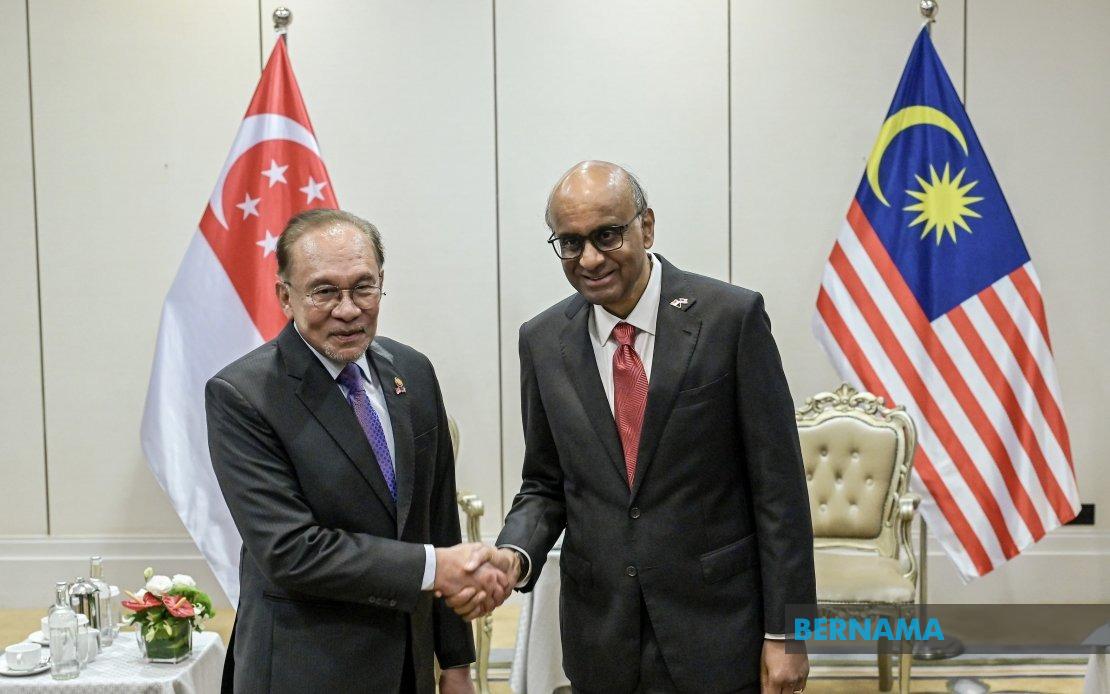
Prime Minister Datuk Seri Anwar Ibrahim extended a formal courtesy meeting to Singapore President Tharman Shanmugaratnam on Monday as the Singapore head of state commenced a three-day official visit to Malaysia. The 40-minute engagement, held in Kuala Lumpur, represented a significant diplomatic moment in the ongoing strengthening of relations between the two neighbouring nations. The occasion drew participation from several senior Malaysian government figures, underscoring the importance placed on the bilateral relationship at the highest levels of the administration.
Accompanying the Prime Minister in the meeting were Foreign Minister Datuk Seri Mohamad Hasan, Investment, Trade and Industry Minister Datuk Seri Johari Abdul Ghani, and Entrepreneur and Cooperatives Development Minister Steven Sim Chee Keong, alongside delegations of high-ranking officials from both countries. The broad representation reflected the multifaceted nature of Malaysia-Singapore engagement, spanning foreign affairs, commerce, investment, and development initiatives. Such comprehensive attendance signals the range of policy areas that both governments view as requiring coordinated attention.
President Tharman's visit officially commenced with a state reception ceremony at Istana Negara, where he was welcomed by the Yang di-Pertuan Agong Sultan Ibrahim with full ceremonial honours. This formal protocol underscored the dignified status accorded to the visiting dignitary and reflected the ceremonial importance both nations attach to high-level official interactions. The three-day programme, running from July 13 to 15, was undertaken at the personal invitation of His Majesty the King, demonstrating the prominence of state visits as vehicles for reinforcing bilateral relationships.
The timing of President Tharman's visit carries particular significance, as it functions as a reciprocal exchange following His Majesty Sultan Ibrahim's state visit to Singapore in May 2024. This alternating pattern of high-level visits between national leaders has become a hallmark of Malaysia-Singapore diplomatic practice, establishing predictable rhythms of engagement that help sustain momentum in bilateral relations. Such reciprocal visits provide opportunities for both sides to reaffirm shared interests and explore emerging areas of cooperation without the urgency or specific agendas that might characterise bilateral crises.
The economic dimension of the relationship remains its most consequential pillar. Singapore continues to occupy the position of Malaysia's second-largest trading partner globally, a ranking that reflects the depth of commercial integration between the two economies. Within the broader regional context of ASEAN member states, Singapore's importance to Malaysia is even more pronounced, ranking as the largest trading partner among ASEAN nations. This concentration of regional trade with Singapore underscores Malaysia's economic interdependence with its smaller neighbour and the necessity of maintaining stable and mutually beneficial commercial relations.
The scale of bilateral commerce demonstrates the vitality of the economic relationship. In 2025 alone, total trade between Malaysia and Singapore reached RM402.35 billion, equivalent to approximately US$93.97 billion. Although this figure represents only a modest increase of 1.5 per cent compared with 2024, it maintained the already substantial level of economic exchange that characterizes the relationship. For Malaysian readers and policymakers, this consistency in trade volumes offers reassurance of the stability that underpins commercial planning and investment decisions affecting both economies.
The early-year performance provides a more encouraging outlook for the trajectory of bilateral commerce. From January through May 2025, Malaysia-Singapore bilateral trade expanded by 14.5 per cent year-on-year, reaching RM189.90 billion, or approximately US$47.87 billion. This figure compared favourably against the RM165.93 billion (US$37.65 billion) recorded during the equivalent five-month period in 2024. The acceleration in growth rate during the first half of the year suggests strengthening commercial momentum that extends beyond the nominal growth recorded for the full year 2024, indicating robust underlying demand and transaction volumes between the two economies.
For Malaysian manufacturers, traders, and investors, these trade statistics carry immediate practical implications. The consistent high volume of commerce across such diverse sectors as manufacturing, petrochemicals, financial services, and logistics reflects the complementary nature of the two economies. Singapore's role as a trading hub, financial centre, and transhipment point for Southeast Asian commerce creates multiple avenues through which Malaysian goods and services reach broader Asian and global markets. Conversely, Singapore's expertise in financial intermediation, maritime services, and advanced manufacturing complements Malaysian strengths in natural resources, agricultural production, and labour-intensive industries.
The diplomatic visit also carries implications extending beyond bilateral Malaysia-Singapore relations to the broader ASEAN framework. As the two largest economies by nominal GDP in Southeast Asia, Malaysia and Singapore's relationship often serves as a bellwether for regional stability and cooperation. Strong bilateral engagement between their leaders signals to the wider ASEAN community that the two nations remain committed to constructive dialogue and economic integration. This is particularly important given historical tensions and ongoing disputes in areas such as maritime boundaries and water agreements, where consistent high-level dialogue helps prevent escalation.
For Malaysian business communities, the continuation of these high-level visits and the robust trade performance they help facilitate offer encouragement regarding medium-term commercial prospects. The fact that early-2025 trade growth significantly outpaced the full-year 2024 rate suggests that supply chains, investment flows, and commercial partnerships between the two nations continue adapting and expanding. This dynamic trading relationship provides Malaysian enterprises with reliable market access and partnership opportunities that are essential for competitiveness in an increasingly complex regional economy.
Looking forward, the consistency of bilateral engagement demonstrated through reciprocal state visits suggests that both nations view their relationship as fundamental to their respective economic and strategic interests. For Malaysia particularly, maintaining strong relations with Singapore remains essential for ensuring stable access to key financial services, efficient port facilities, and regional trading networks. The diplomatic protocols observed during President Tharman's visit, combined with the substantive economic metrics underlying the relationship, indicate that Malaysia-Singapore partnership will continue evolving as a cornerstone of regional stability and prosperity.

