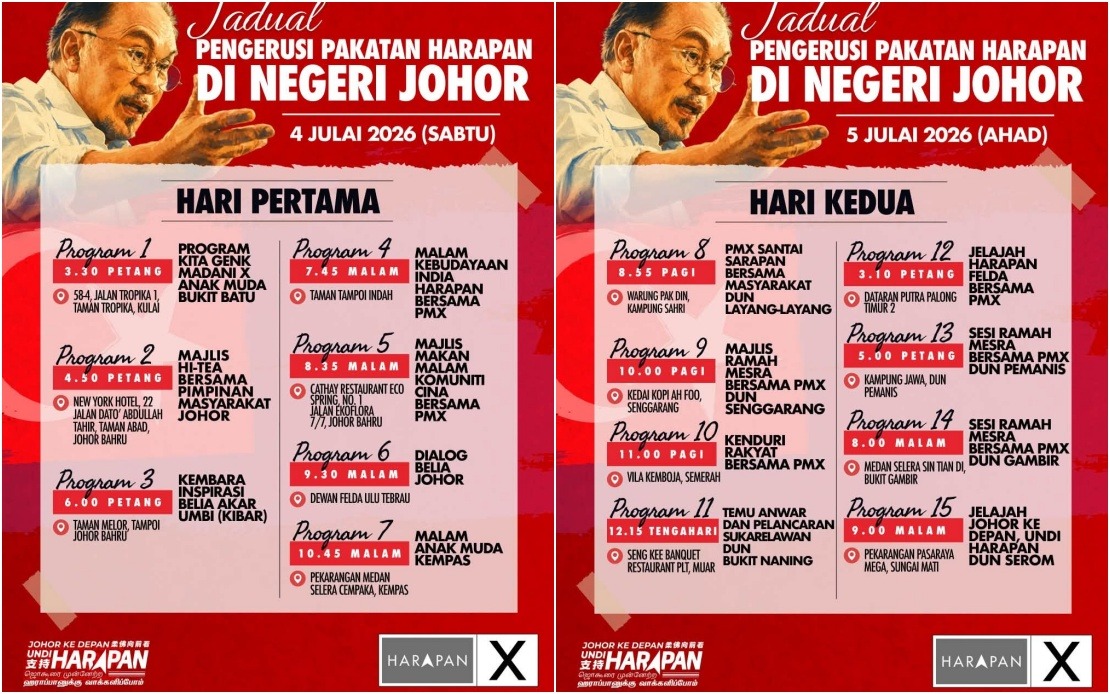
Prime Minister Datuk Seri Anwar Ibrahim is undertaking a demanding campaign schedule across Johor this weekend, with plans to attend 15 separate events as Pakatan Harapan chairman in a push to energise the coalition's electoral machinery ahead of the 16th state election. The widespread engagement reflects the strategic importance PH places on Johor, a state that remains a competitive battleground between competing political coalitions and where grassroots mobilisation can prove decisive in securing marginal constituencies.
Anwar's Saturday and Sunday itinerary demonstrates the sophistication of modern political campaigning in Malaysia, where party leaders coordinate multiple events across demographic and community lines to maximise voter contact and media exposure. The schedule spans from mid-afternoon through late evening, beginning with the Kita Genk MADANI x Anak Muda Bukit Batu programme in Kulai at 3.30 pm on Saturday, followed by a community leaders gathering at 4.50 pm, and continuing through evening cultural and dialogue sessions that extend past 10 pm. This density of engagement allows PH to reach diverse voter blocs—youth, Indian community members, Chinese residents, and rural constituents—within a concentrated timeframe, reinforcing the coalition's message of inclusivity across Malaysia's multi-ethnic landscape.
The breadth of the campaign reflects PH's recognition that victory in the 56 contested seats requires simultaneously consolidating existing support while expanding appeal among swing voters. Saturday evening's programming specifically targets Malaysia's Indian and Chinese communities through dedicated cultural events and dinners, constituencies that have historically influenced election outcomes in urban and semi-urban Johor constituencies. The Indian Cultural Night and Chinese Community Dinner represent deliberate outreach to communities whose voting patterns can determine outcomes in tightly contested seats, and whose confidence in PH's governance record remains important for the coalition's electoral prospects.
Youth engagement features prominently throughout the itinerary, underscoring PH's strategic focus on mobilising younger voters who may feel disconnected from traditional political messaging. The Anak Muda Bukit Batu programme, Youth Dialogue, and Anak Muda Kempas Night specifically target voters aged 18-40, a demographic whose participation rates can significantly shift election mathematics. In Johor's context, where PH competes against entrenched opposition and competing Malay-Muslim political narratives, capturing youth enthusiasm becomes critical for demonstrating momentum and breaking through traditional voting patterns that have favoured other parties.
Sunday's programming shifts toward constituent engagement and rural outreach, with events scheduled in constituencies including Layang-Layang, Senggarang, Semerah, and Bukit Naning. The breakfast session with Layang-Layang constituents at Warung Pak Din carries particular significance as it allows Anwar to engage voters in an informal setting, a tactic that humanises political leadership beyond formal rally presentations. The Kenduri Rakyat (People's feast) in Semerah maintains this accessibility approach while the Felda Bersama event targets smallholder plantation workers and their families, communities whose economic interests require PH's attention regarding commodity support prices and agricultural development funding.
The campaign schedule also reveals tactical sophistication in how PH allocates senior leadership resources. Anwar's personal attendance at 15 separate events represents extraordinary commitment of the Prime Minister's time, a decision that signals to party machinery and candidates that the leadership prioritises the Johor contest. This contrasts with approaches where prime ministers maintain distance from state-level campaigns, and suggests PH considers the Johor result consequential for national political momentum. The frequency and variety of events indicate that each programme targets specific constituencies or demographic groups, multiplying opportunities for local media coverage and social media amplification that extends reach beyond immediate attendees.
Johor's electoral significance within Malaysia's broader political context cannot be overstated. As the second-largest state by population and a consistent political bellwether, outcomes in Johor often foreshadow national trends. PH's current control of federal government provides both advantages—resources and incumbency benefits—and vulnerabilities—voter frustration with implementation challenges or governance setbacks. The intensive campaign reflects awareness that Johor constituencies remain competitive and that maintaining PH's electoral coalition requires visible, sustained engagement from senior leadership rather than administrative reliance on appointment powers.
The timing of Anwar's campaign also responds to the compressed election cycle, with voting scheduled for July 11 and early voting on July 7. This narrow window—less than two weeks from the original announcement—requires rapid mobilisation of campaign infrastructure and voter contact operations. Weekend programming allows Anwar to maximise accessibility for working voters while enabling the party to concentrate volunteer and logistics resources across multiple events in relatively close geographic proximity. The concentration of activity in what appears to be Johor Bahru and surrounding constituencies suggests strategic targeting toward urban and semi-urban seats where PH maintains higher baseline support and where voter mobility facilitates attendance at multiple events.
The 56 candidates PH fields across the 56 state seats represent the coalition's complete slate for Johor, indicating commitment to contesting comprehensively rather than ceding seats to opposition parties. However, this full competition across all seats requires significant resource deployment, and Anwar's visible participation serves to validate candidate credibility and demonstrate party unity. In Malaysian politics where candidate selection sometimes provokes internal friction, particularly regarding seat allocations among coalition partners, visible leadership support helps consolidate grassroots confidence despite any previous tensions over candidacy decisions.
For Johor voters, Anwar's intensive weekend presence offers unusual accessibility to the Prime Minister outside formal parliamentary settings, though observers should recognise that campaign events fundamentally differ from governance accountability forums. The informal settings at breakfast and community dinners, as well as youth dialogues, create opportunities for voters to raise local concerns directly, though question-and-answer depth necessarily remains limited in large crowd settings. The sheer number of events suggests some may be brief, with Anwar potentially covering multiple venues through rapid movement rather than extended engagement at individual locations.
The campaign also reflects PH's communication strategy emphasising the MADANI governance framework and positioning around inclusivity and economic development. Event titles referencing MADANI, along with the emphasis on youth, community leaders, and rural outreach, construct a narrative of broad-based coalition building. Whether this narrative resonates with Johor voters—particularly among rural and older demographic segments—will become apparent through July 11 results. The intensive weekend campaign represents PH's determination to prevent opposition parties from establishing momentum in a state where political control has shifted multiple times over recent electoral cycles.

