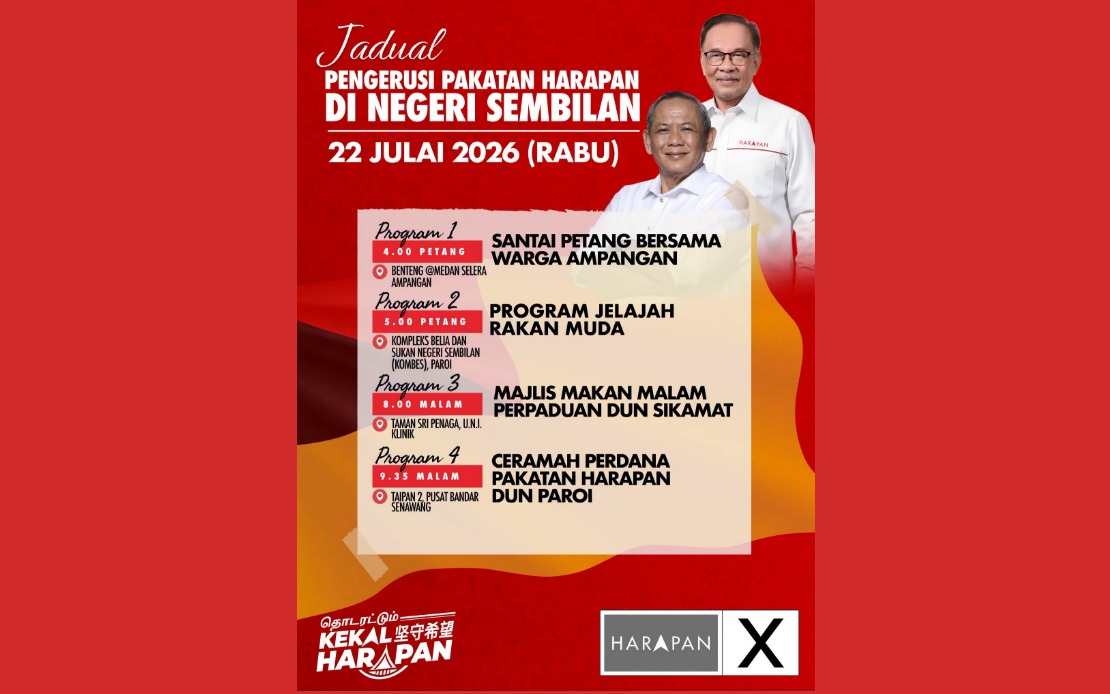
Prime Minister Datuk Seri Anwar Ibrahim will conduct an intensive campaign sweep across Negeri Sembilan this afternoon, marking the fifth day of the state election campaign and signalling Pakatan Harapan's determination to maintain control of the state administration. The PH chairman's direct involvement comes at a crucial juncture in the contest, as the coalition seeks to consolidate support among voters across diverse constituencies and demographic groups before the August 1 polling date.
The itinerary reflects a carefully structured approach designed to maximise Anwar's visibility and impact across strategically important areas. Beginning at 4 pm, he will participate in an engagement programme with residents at Benteng @ Medan Selera Ampangan, a grassroots activity intended to connect the federal leadership with everyday voters in that constituency. This format of informal gatherings has become a staple of PH's campaign methodology, allowing senior figures to address local concerns directly and project approachability beyond formal political messaging.
Following the Ampangan session, Anwar will move to the Negeri Sembilan Youth and Sports Complex in Paroi at 5 pm for the "Jelajah Rakan Muda" programme, deliberately targeting younger voters who are increasingly critical to electoral outcomes in Malaysian politics. Youth engagement has become a priority for PH, particularly given younger voters' divergent views on economic policy, social issues, and governance compared to older demographics. The choice of venue—a youth-focused facility—underscores the coalition's strategy to resonate with this segment.
The evening will culminate in two major engagements. Anwar will first attend a unity dinner in the Sikamat constituency, a format that emphasises community cohesion and party solidarity ahead of the election. This is followed by attendance at the Paroi PH mega ceramah—a large-scale political address—at Pusat Bandar Senawang, where he is expected to articulate the coalition's vision and campaign pledges to a broader audience.
Anwar's personal campaign contribution carries symbolic and practical weight for the Pakatan Harapan bid to preserve Negeri Sembilan as a PH-governed state. As both Prime Minister and PKR president, his presence validates the significance of the contest while leveraging the authority of his federal office. The underlying calculation is that voters may view a personal visit from the nation's leader as evidence that the state election genuinely matters at the national level, not merely a secondary electoral exercise.
The coalition's manifesto, unveiled on Monday, provides the substantive framework for Anwar's campaign messaging. The ten-point commitment document is pitched toward transforming Negeri Sembilan into a more economically advanced and socially inclusive jurisdiction, though the specific policy details and implementation timelines remain the subject of campaign debate. Anwar's presence lends credibility to these promises by placing the Prime Minister's personal stake in their realisation.
PH's candidate slate demonstrates a particular distribution of resources among its component parties. The coalition is contesting all 36 state seats, with PKR fielding 16 candidates, DAP presenting 11, and Amanah contributing nine. This allocation reflects internal party dynamics and historical performance in specific constituencies, though the unified campaign front suggests an attempt to project coalition unity despite the occasionally divergent interests of the three parties.
The incumbent state government, led by Datuk Seri Aminuddin Harun, faces the electoral task of securing voter confidence for another term. The campaign's intensity at this stage suggests both parties recognise Negeri Sembilan as genuinely competitive territory. The state's economic profile—blending industrial zones, agricultural areas, and growing urban centres—makes it a bellwether for broader trends in how Malaysian voters evaluate incumbent performance and opposition alternatives.
The Election Commission's scheduling has set early voting for July 28, providing a compressed campaign window that heightens the significance of each major candidate appearance. With polling day fixed for August 1, the campaign enters its final stretch with momentum and visibility becoming critical. Anwar's multi-constituency blitz exemplifies how PH intends to use its federal resources and leadership presence to maximise electoral impact in the final week before voting commences.
For Malaysian observers, the Negeri Sembilan contest offers an important data point on post-2023 general election dynamics and how federal-state political relationships are evolving. Voters' responses to PH's tenure and alternative offerings will shape expectations for future electoral contests and may indicate whether the coalition's federal victory has translated into durable support at the state level. The campaign's intensity reflects recognition that state elections are no longer merely local affairs but rather barometers of national political sentiment.
Anwar's decision to personally canvas four constituencies underscores PH's assessment that the election remains winnable but not inevitable. The coalition's retention of Negeri Sembilan would represent a significant statement about voter satisfaction with its governance record, while any loss would trigger considerable post-election analysis regarding coalition cohesion and electoral strategy. The afternoon's campaign activities will test whether the party's ground organisation and messaging resonates sufficiently to motivate voters across these constituencies during the critical final week of campaigning.

