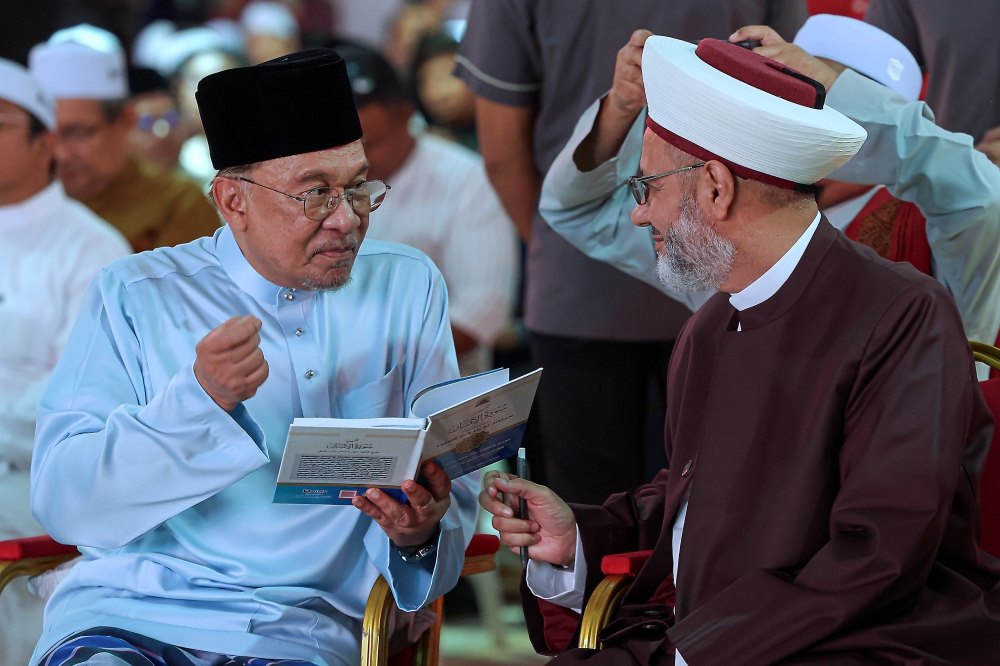
Prime Minister Datuk Seri Anwar Ibrahim has commended Grand Imam Ahmad Al-Tayyeb of Al-Azhar as a preeminent advocate for moderate Islamic principles on the world stage, underscoring the significance of his scholarly influence in advancing dialogue between faiths and contemporary Islamic interpretation. Anwar's recognition of the 79-year-old Egyptian religious figure reflects Malaysia's strategic alignment with moderate Islamic movements and its broader commitment to positioning itself as a gateway for progressive Muslim thought in Southeast Asia.
Al-Azhar University, one of Islam's oldest and most respected centres of learning, has for centuries shaped Islamic jurisprudence and theology across the Muslim world. The institution's Grand Imam serves as a pivotal authority in Islamic scholarship, wielding considerable sway over millions of Muslims globally. Al-Tayyeb's tenure has been characterised by efforts to bridge theological divides and counter extremist interpretations of Islamic doctrine, making him an influential figure in contemporary Islamic discourse.
Anwar's public appreciation carries particular weight given Malaysia's self-positioning as a model of moderate Islam in a region often scrutinised for religious tensions. By endorsing Al-Tayyeb's vision, the Prime Minister signals Malaysia's ideological alignment with reformist movements that emphasise Islam's compatibility with democratic governance, pluralism, and scientific advancement. This positioning becomes increasingly relevant as Southeast Asian nations navigate the intersection of religious identity and modern governance.
The Grand Imam has consistently advocated for interfaith understanding, engaging with Christian, Jewish, and other religious leaders to promote shared values of peace and coexistence. His willingness to dialogue with diverse communities stands in stark contrast to hardline interpretations that reject engagement with non-Muslims, making him a polarising but influential voice within global Islamic circles. Such initiatives resonate with Malaysia's own constitutional framework, which while establishing Islam's status as the federation's religion, also guarantees religious freedom for other faiths.
Al-Tayyeb's intellectual contributions extend to contemporary issues facing Muslim societies, including education, economic development, and women's rights. His scholarly output has addressed how Islamic principles can accommodate modern societal needs without compromising religious fundamentals—a balance that Anwar's administration has similarly attempted to strike domestically. This convergence of vision suggests potential avenues for deeper bilateral engagement on religious and educational matters between Malaysia and Egypt.
The public commendation also reflects broader geopolitical considerations in the Muslim world. Egypt, as home to Al-Azhar and a major Arab nation, holds significant cultural and religious influence. Malaysia's cultivation of ties with influential Egyptian religious figures enhances its diplomatic standing within Muslim-majority regions and positions it as a credible interlocutor on Islamic matters. Such soft power dimensions increasingly matter as nations compete for influence within global Islamic networks.
For Malaysian audiences, Anwar's remarks underscore the government's commitment to nurturing religious scholarship that bridges traditional Islamic learning with contemporary concerns. The emphasis on moderation and interfaith dialogue aligns with domestic policies aimed at strengthening social cohesion in a multi-religious society. By spotlighting Al-Tayyeb's work, Anwar reinforces the narrative that Islamic scholarship and progressive governance are not mutually exclusive.
Al-Tayyeb's influence extends through Al-Azhar's extensive network of religious schools, universities, and training programmes across the Middle East, Asia, and Africa. Clerics and scholars trained at the institution often carry its moderate theological approach back to their home countries, creating a distributed influence that shapes how Islam is practised and understood in diverse settings. This institutional reach makes his leadership particularly consequential for global Islamic thought.
Critically, while Al-Tayyeb commands respect among many Muslim intellectuals and reformers, he also faces criticism from both liberal reformers who demand more radical reinterpretation of Islamic law and conservative scholars who view his interfaith work as compromising Islamic principles. This contested status reflects deeper tensions within contemporary Islam about how the faith should engage with modernity. Anwar's endorsement implicitly positions Malaysia within the reformist camp, a stance that carries domestic political implications for managing diverse religious constituencies.
The recognition of Al-Tayyeb also signals Malaysia's interest in learning from Al-Azhar's institutional experience in balancing Islamic authority with intellectual freedom. As Malaysia grapples with questions about Islamic education curricula, the governance of religious institutions, and the role of Islamic scholars in public discourse, insights from an institution that has navigated these challenges across centuries could prove invaluable. The implicit invitation to deepen connections on such matters could yield collaborative initiatives in the near future.
Moving forward, Anwar's commendation may catalyse increased institutional exchanges between Malaysian Islamic universities and Al-Azhar, fostering scholarly collaboration and mutual learning. Such partnerships could strengthen Malaysia's intellectual capacity in Islamic studies while elevating the country's profile as a centre for moderate Islamic thought. The diplomatic overture also opens space for Malaysia to engage with Egypt more broadly on religious and cultural matters of mutual concern.

