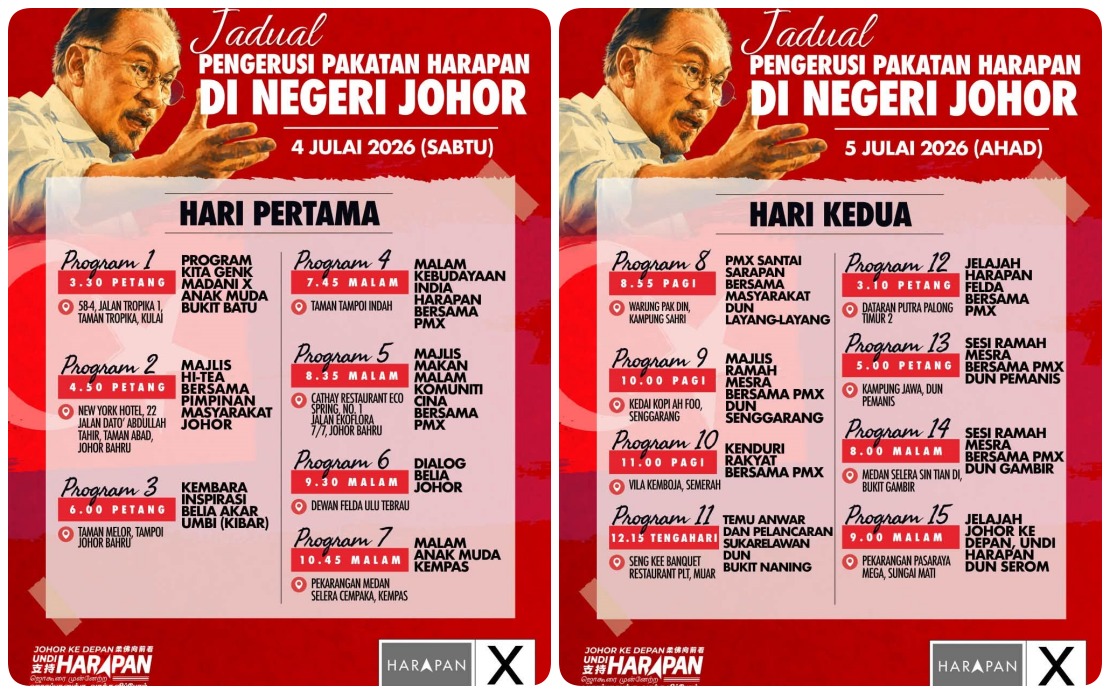
Prime Minister Anwar Ibrahim is doubling down on Pakatan Harapan's push in Johor, hitting the campaign trail with an ambitious schedule of seven public engagements today and a further eight programmes planned for tomorrow as polling day draws closer. The coordinated effort underscores the coalition's determination to consolidate momentum in a state where past electoral contests have proven fiercely competitive, with the 16th Johor state election scheduled for July 11 and early voting commencing on July 7.
The Pakatan Harapan chairman's itinerary reflects a deliberate strategy to reach across demographic divides within the state. Beyond the formal campaign rhetoric, today's schedule emphasises direct voter interaction, beginning with morning engagement at a community level before transitioning to a high tea reception with Johor community leaders at a hotel here by late afternoon. Such events allow the coalition to present itself as accessible to ordinary Malaysians while simultaneously courting influential figures within their respective communities who can amplify the party's message through their networks.
A particular emphasis has been placed on cultivating support among younger voters, who historically represent a volatile electoral force capable of shifting outcomes. The Johor Youth Dialogue session scheduled for 9.30 pm at Felda Ulu Tebrau Hall signals recognition that the coalition must energise this demographic to secure victory. Youth engagement has become increasingly critical in Malaysian politics, as younger voters frequently demonstrate stronger preference for political change and anti-incumbency sentiment than their older counterparts, making their mobilisation essential to Pakatan Harapan's broader strategy.
The breadth of Anwar's personal involvement across consecutive days indicates the coalition views Johor as strategically significant to its broader political positioning. At the national level, Johor remains symbolically important as historically a stronghold of the United Malays National Organisation, making any breakthrough particularly symbolic. The state's 56 assembly seats represent meaningful parliamentary representation, and the composition of the state government carries implications for the balance of power within Malaysia's federalised political system.
Pakatan Harapan is contesting the entirety of available seats, with the coalition's three constituent parties dividing the candidate slate according to their established arrangement. PKR is fielding 20 candidates, Amanah is running 19, and the Democratic Action Party is presenting 17 candidates. This distribution reflects each party's estimated organisational capacity and electoral competitiveness in specific constituencies, refined through internal negotiations over preceding months. The decision to contest all seats signals confidence in the coalition's machinery while also projecting an image of comprehensive political engagement across the electorate.
The broader electoral contest has attracted significant participation, with a total of 172 candidates from various political parties vying for the 56 available positions. This crowded field means that constituencies will be fragmented across multiple contenders, potentially creating scenarios where plurality rather than majority support determines winners. Such fragmentation can work either to the advantage or disadvantage of Pakatan Harapan depending on how opposition votes distribute across competing candidates in individual seats.
Anwar's personal investment of time and political capital in the campaign reflects the high stakes involved. The Prime Minister's visibility and messaging directly influences voter perception of the coalition's viability and seriousness as an alternative administration. His presence at multiple events across diverse settings also serves to suppress internal party tensions that occasionally surface within multi-party coalitions, demonstrating unified leadership commitment to the electoral campaign.
The campaign intensity also reflects competitive pressure from other political forces. The Barisan Nasional, which governed Johor for most of the post-independence period, remains a formidable competitor with established organisational networks and brand recognition among certain voter segments. Meanwhile, Perikatan Nasional has been expanding its political presence in several states and cannot be discounted as a potential beneficiary of split opposition votes if Pakatan Harapan's messaging fails to resonate comprehensively.
For Malaysian voters and regional observers, the Johor election serves as an important barometer of public sentiment regarding the Anwar Ibrahim administration's performance since taking office in late 2022. Electoral outcomes will provide quantifiable data about whether the government's policy initiatives, economic management, and governance approach have gained sufficient traction to translate into expanded political support at the state level. State elections also frequently serve as dress rehearsals for national contests, offering both ruling coalitions and opposition movements opportunities to test campaign strategies and messaging before larger electoral cycles.
The concentration of Anwar's schedule across back-to-back days maximises media coverage while maintaining campaign momentum. Such sustained visibility prevents news cycles from moving away from favourable coverage, while repeated exposure to the Prime Minister across diverse settings reinforces a consistent narrative about coalition commitment and accessibility. The strategy of engaging community leaders, youth voters, and ordinary constituents simultaneously addresses multiple audience segments with tailored messaging delivered through a unified figurehead.
For Pakatan Harapan, strong performance in Johor would represent significant progress in a state where the coalition's footprint has traditionally been limited compared to peninsular strongholds in Selangor and Penang. Conversely, a disappointing result would raise questions about the coalition's expansion capacity and the durability of national support levels established at the 2022 general election. Either outcome will shape political calculations regarding the timing and viability of future national elections, influencing strategic planning across all major political forces over the coming months and years.

