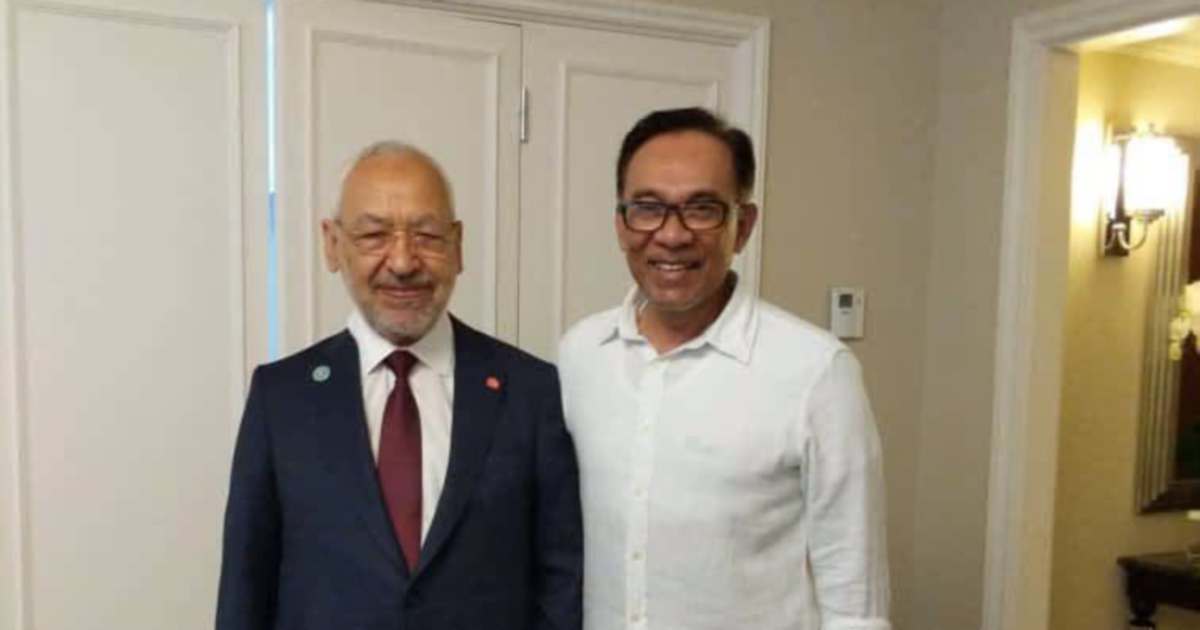
Prime Minister Datuk Seri Anwar Ibrahim has taken the diplomatic step of writing directly to Tunisian President Kais Saied with a request to free prominent political detainee Sheikh Rached Ghannouchi, citing humanitarian considerations as the basis for his intervention. The move reflects Malaysia's ongoing commitment to advocating for democratic freedoms and the protection of political figures across the broader Muslim-majority world, positioning Anwar as a voice for civil liberties on the international stage.
Ghannouchi, whose detention has drawn scrutiny from regional and international observers, carries significant symbolic weight as a founding figure of Tunisia's Ennahda Movement, which played a central role in the country's political transition following the 2011 revolution. His incarceration represents a point of tension in Tunisia's internal political landscape, where questions about judicial independence and the treatment of opposition voices have become increasingly contentious. The underlying dispute reflects broader regional debates about the balance between security concerns and political pluralism.
Anwar's intervention comes at a moment when Malaysia maintains an active diplomatic presence in Middle Eastern and North African affairs, seeking to influence outcomes that align with Malaysia's stated values around human rights and democratic participation. By framing his appeal in humanitarian terms rather than overtly political ones, the Prime Minister has chosen an approach that carries moral weight while maintaining diplomatic tact. This strategy allows Malaysia to advocate without appearing to interfere directly in Tunisia's internal governance.
Tunisia's political situation has grown increasingly complicated under President Saied's leadership, particularly following his consolidation of executive power through constitutional measures in 2021 and subsequent actions. The detention of Ghannouchi forms part of a broader pattern of legal proceedings against opposition figures that has raised concerns among democracy advocates and regional partners. The fragility of Tunisia's democratic institutions, which once served as a model for post-Arab Spring transitions, has become a source of regional anxiety.
The timing of Anwar's letter carries significance given Malaysia's own experience with political detention and questions around judicial independence. The Prime Minister himself faced incarceration in the past under contested circumstances, lending personal credibility to his advocacy on behalf of those held in political circumstances. This historical parallel strengthens his moral authority to appeal to other leaders on such matters, though it may also create tension in bilateral relations.
Ghannouchi's case has transcended purely Tunisian concerns, attracting attention from international human rights organizations and regional governments concerned with the trajectory of democratic governance in the Maghreb. His detention on charges that opponents characterize as politically motivated has become emblematic of concerns about Tunisia's direction under Saied's presidency. The uncertainty surrounding both the evidence against him and the trajectory of his legal proceedings has only intensified scrutiny.
Malaysia's approach to regional diplomacy traditionally emphasizes consensus-building and dialogue within the Muslim world, a principle that underpins Anwar's appeal. By reaching out on humanitarian grounds, Malaysia positions itself as a mediating voice rather than a confrontational actor, which may increase the likelihood of receptiveness from Tunisia's government. The appeal reflects Malaysia's broader strategy of maintaining influence through soft power and moral suasion rather than coercive measures.
Anwar's intervention also signals Malaysia's willingness to engage with contentious issues affecting Muslim-majority nations, suggesting a vision of Islamic leadership that prioritizes individual rights and democratic protections. This stands in contrast to purely geopolitical calculations and marks Anwar's personal stamp on Malaysia's foreign policy orientation. The letter demonstrates a commitment to transnational advocacy that extends beyond immediate bilateral interests.
The response from Tunisia's government remains to be seen, though diplomatic precedent suggests that direct appeals from fellow Muslim-majority nations' leaders typically receive serious consideration. President Saied's receptiveness may depend on his assessment of political costs and international pressure. The situation underscores the complex interplay between regional solidarity and domestic political imperatives that characterize contemporary Middle Eastern and North African politics.
For Malaysia, Anwar's initiative reinforces the country's positioning as a voice for democratic values and humanitarian concerns within the Organisation of Islamic Cooperation and the broader developing world. Whether the appeal yields concrete results, the gesture itself carries implications for how Malaysia engages with regional crises and political transitions. The move reflects a distinctive approach to foreign policy that attempts to balance pragmatic state interests with principled advocacy for political freedoms.

