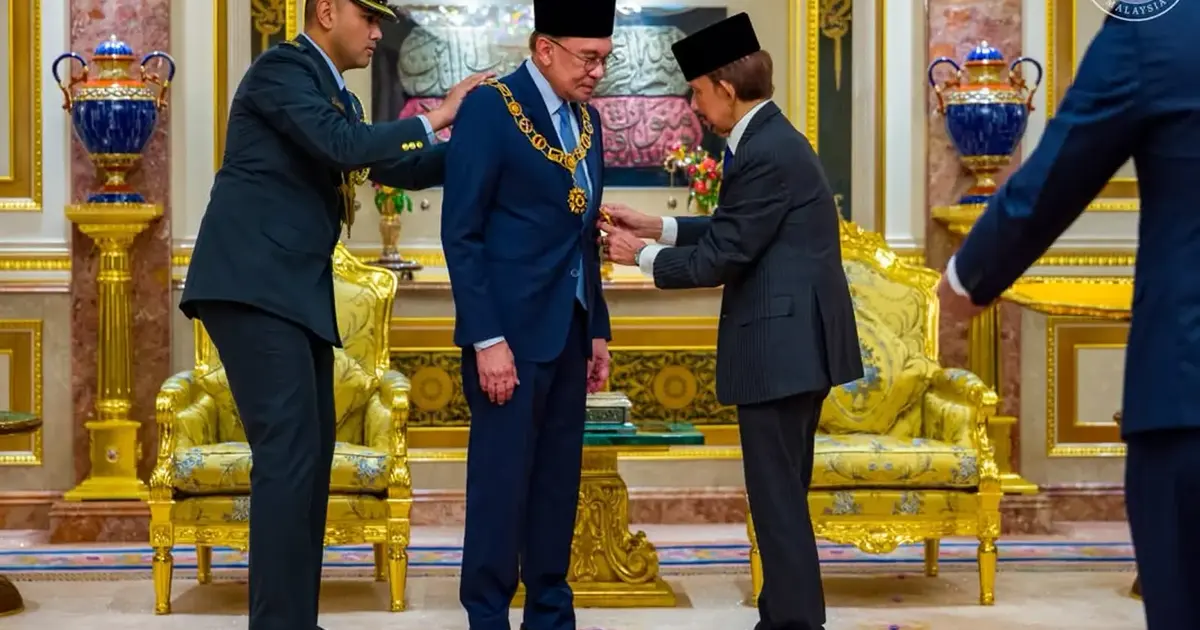
Prime Minister Anwar Ibrahim has received the Darjah Kerabat Laila Utama Yang Amat Dihormati (D.K.), one of the highest royal honours in Brunei Darussalam, from Sultan Hassanal Bolkiah. The prestigious recognition reflects the deepening relationship between Malaysia and its neighbouring sultanate, positioning both nations closer within the broader framework of ASEAN cooperation.
The conferment of this honour carries significant diplomatic weight within Southeast Asia's institutional landscape. Such recognitions between heads of government typically signal mutual respect and alignment on regional matters, particularly relevant given Malaysia's position as the largest economy in the region and Brunei's strategic location on the island of Borneo. The timing and nature of this award suggest continued effort to fortify high-level engagement between Kuala Lumpur and Bandar Seri Begawan.
Brunei's honours system operates with careful hierarchy and deliberate selectivity. The D.K. designation places Anwar among an exclusive circle of international recipients who have been deemed worthy of such recognition by the sultanate's royal institution. This is not a routine diplomatic gesture but rather reflects deliberate state-level decision-making that acknowledges the Malaysian Prime Minister's standing and his administration's approach to regional engagement.
The relationship between Malaysia and Brunei has historically been anchored in shared culture, Islamic heritage, and geographic proximity. Both nations navigate complex regional dynamics involving major powers, trade dependencies, and multilateral organisations. That Sultan Hassanal Bolkiah has extended this honour to Anwar suggests confidence in Malaysia's current political direction and its commitment to bilateral partnership and ASEAN solidarity.
For Malaysian readers, the significance extends beyond ceremonial recognition. Brunei, while smaller in population and landmass, maintains considerable economic influence through its petroleum and liquefied natural gas exports, and serves as a stable, conservative voice within ASEAN deliberations. Anwar's receipt of this honour indicates that Malaysia's diplomatic outreach under his leadership is yielding tangible recognition from neighbouring capitals, particularly those historically cautious about external affairs.
The award also carries implications for Malaysia's broader diplomatic agenda. Anwar has positioned his government as committed to rebuilding Malaysia's regional standing following years of geopolitical turbulence. Recognition from a respected regional figure like Sultan Hassanal Bolkiah strengthens Anwar's credentials as a leader capable of managing Malaysia's complex relationships and serving as a credible partner for other ASEAN nations.
Bilateral relations between Malaysia and Brunei encompass multiple dimensions—from trade and investment to maritime cooperation and people-to-people exchanges. Malaysian workers form a significant portion of Brunei's expatriate workforce, and cultural ties remain robust. Government-to-government honours like this one reinforce the institutional commitment to maintaining these linkages and exploring new areas of cooperation that benefit both populations.
Within ASEAN's framework, smaller member states like Brunei often act as important equilibrating forces, advocating for consensus-based decision-making and adherence to the regional bloc's foundational principles. By honouring Anwar, Sultan Hassanal Bolkiah signals that Malaysia under the Prime Minister's leadership aligns with these values and merits elevated partnership status in ASEAN forums where complex regional security and economic issues are negotiated.
The honour also comes against a backdrop of Malaysia's efforts to enhance its international profile and shore up relationships that may have experienced strain during previous administrations. Regional powers and smaller nations alike carefully calibrate their diplomatic gestures, and such high-level awards are typically reserved for leaders or officials who have demonstrated commitment to respectful, substantive engagement. That Anwar has received this recognition suggests his government's diplomatic initiatives are being received positively in regional capitals.
Looking forward, such symbolic recognitions often precede or accompany deeper institutional cooperation. Malaysian policymakers should view this honour as an opportunity to identify concrete areas where Malaysia and Brunei can expand collaboration—whether in border management, maritime resources, trade facilitation, or coordinated ASEAN positions on regional security challenges. The personal dimension of such honours can open doors for substantive bilateral negotiations that benefit both nations' populations and advance shared interests.
For the broader Southeast Asian context, the bestowal of this award by one respected Muslim-majority monarch on Malaysia's Muslim-majority nation's leader demonstrates that bilateral relations in the region remain constructive and that there continues to be appetite among ASEAN governments for closer cooperation. This stands in contrast to more fractious regional dynamics elsewhere and underscores the potential for managed, dignified diplomacy to advance mutual interests.

