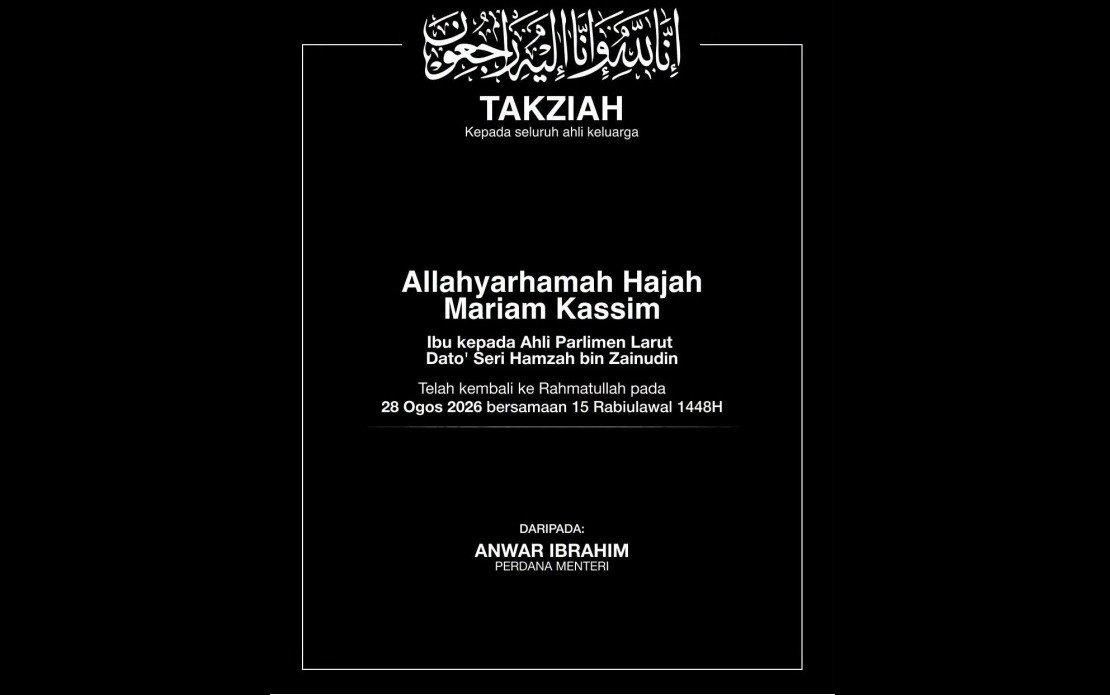
Prime Minister Datuk Seri Anwar Ibrahim has publicly extended his sympathies to Opposition Leader Datuk Seri Hamzah Zainudin following the passing of the latter's mother, Mariam Kassim, who was 90 years old. The gesture, announced through a social media post on August 28, reflects a moment of cross-partisan recognition of shared human experience, transcending the political divisions that typically characterise their relationship at the highest levels of Malaysian governance.
In his message, Anwar conveyed both his personal sentiments and those of his wife, Datuk Seri Dr Wan Azizah Wan Ismail, indicating that the couple had offered prayers for Hamzah and his entire family during this period of mourning. The Prime Minister's explicit invocation of Islamic prayers and blessings underscored the religious dimensions of condolence in Malaysian public life, where faith-based expressions of sympathy carry particular weight and authenticity within the nation's Muslim-majority context.
The specific language employed by Anwar—invoking Allah's mercy upon Mariam's soul, the forgiveness of her transgressions, and her placement among the righteous in the afterlife—reflects conventional Islamic funeral etiquette and demonstrates the Prime Minister's adherence to cultural and religious protocols. Such formulations are deeply embedded in Malaysian funeral practices and resonate powerfully with families experiencing loss, particularly within Malay-Muslim communities where such blessings carry profound spiritual significance.
Mariam Kassim's funeral rites were conducted according to Islamic tradition, with her body laid to rest at the USJ 22 Muslim Cemetery in Subang, a location in the Selangor region that serves as the final resting place for many prominent and ordinary Malaysians alike. The cemetery's selection reflects the family's choice of burial within the Klang Valley metropolitan area, where many extended family members and community connections likely reside.
The expression of condolences by Anwar to Hamzah, despite their opposing positions in Parliament, illuminates an important dimension of Malaysian political culture. While Hamzah leads the opposition benches, he maintains a role as a senior statesman with decades of political experience, having previously held ministerial positions. This continuity of respect across partisan lines reflects the maturity of Malaysia's democratic institutions, where personal relationships and shared national identity frequently coexist alongside substantive policy disagreements.
Hamzah Zainudin himself represents a significant force within opposition politics, having been appointed as Opposition Leader following the 2022 general election. His trajectory through Malaysian politics demonstrates the complex dynamics of a political system where personalities, factional alignments, and coalition mechanics shift considerably over time. The loss of a parent at an advanced age remains a universally significant event, regardless of one's political station, and Anwar's acknowledgment of this reality speaks to the human dimensions that underpin political relationships.
The timing and method of Anwar's condolence—through a direct post on X (formerly Twitter)—reflects contemporary approaches to political communication in Malaysia, where social media platforms have become primary channels for leaders to engage with both the public and their political counterparts. This digital medium allows for immediate, widespread dissemination of messages while maintaining a personal tone that might feel more authentic than traditional press statements.
Within the broader context of Malaysian politics, such gestures of cross-party solidarity during moments of personal loss serve important functions beyond mere courtesy. They reinforce the notion that despite fierce parliamentary debates and policy disagreements, Malaysian leaders remain bound by common cultural values and shared understanding of human dignity. This is particularly significant in a nation where religious and cultural unity remain central to political messaging and national cohesion.
The incident also reflects the generational dynamics within Malaysia's political establishment, where senior figures like Hamzah—whose mother lived to 90 years—represent continuity with earlier phases of the nation's political development. As Malaysia's population ages and demographic shifts accelerate, such moments of intergenerational reflection within political leadership become increasingly visible and relevant to broader national conversations about legacy, continuity, and the passage of time.
Furthermore, Anwar's gesture exemplifies how moments of personal grief can create temporary zones of political truce within intensely competitive environments. The Malaysian Parliament, while occasionally contentious, operates within frameworks that permit and even expect such demonstrations of mutual respect when members face personal tragedies. This institutional maturity distinguishes Malaysian democracy from political systems where partisan animosity prevents such acknowledgments.
The specific invocation of family strength and resilience in Anwar's message speaks to broader Malaysian values surrounding kinship networks and the extended family's role in supporting individuals through crisis. In Malaysian society, the death of an elderly parent triggers complex processes of mourning, ceremonial obligation, and familial restructuring that extend well beyond the immediate funeral period, encompassing Islamic religious observances and social commitments that often span weeks or months.

