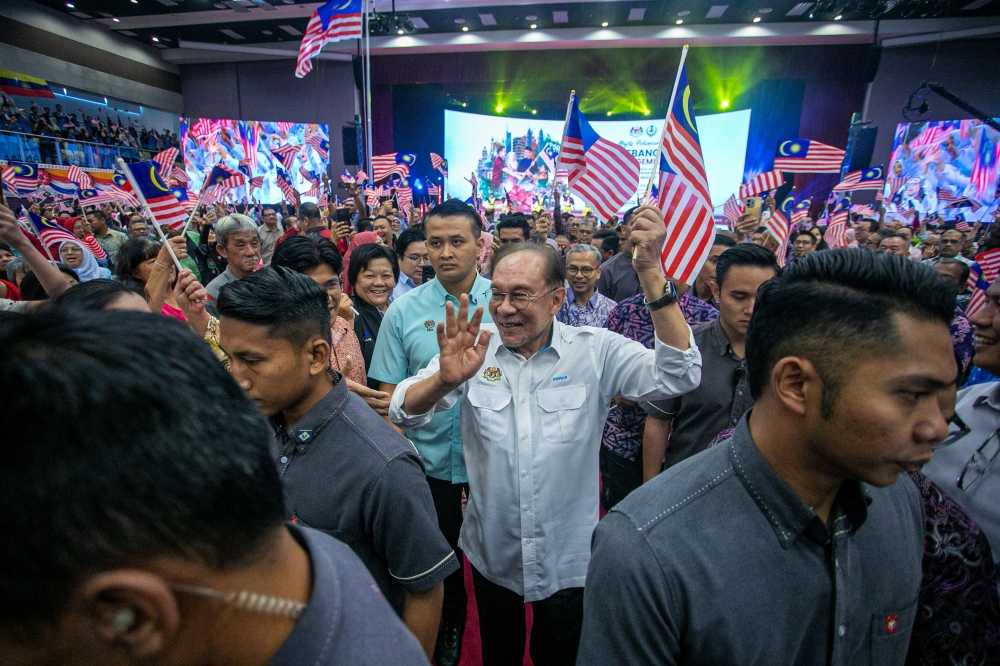
Prime Minister Datuk Seri Anwar Ibrahim has issued a cautious message to government ministers and leaders, permitting them to engage in political campaigning while drawing a clear demarcation around acceptable conduct. Speaking in Ipoh on July 19, Anwar emphasised that those holding executive positions within the administration possess the freedom to participate in electoral activities, yet must scrupulously avoid deploying government machinery, finances, or assets to advance their political interests.
The prime minister's guidance addresses a recurring tension within Malaysian politics, where the blurred intersection of official duties and party politics frequently generates controversy and raises questions about the impartiality of state institutions. By articulating these boundaries explicitly, Anwar appears intent on establishing clearer norms for his cabinet and senior officials, signalling that his administration expects adherence to democratic principles and administrative propriety.
Anwar's remarks reflect a broader international concern about the misuse of state apparatus during electoral periods. In many democracies, governments and opposition parties operate under established codes of conduct designed to ensure that public resources remain neutral instruments serving all citizens, regardless of their political allegiances. Malaysia has experienced recurring incidents where incumbent politicians have leveraged government vehicles, personnel, or funds to buttress campaign operations, prompting civil society groups and international observers to question the fairness of electoral contests.
The distinction Anwar articulates—between permissible campaigning and impermissible resource abuse—carries particular significance for Southeast Asian democracies grappling with similar challenges. Thailand, Indonesia, and the Philippines have all witnessed debates about the boundaries between legitimate political activity and the misappropriation of state capacity. By publicly delineating these limits, Anwar positions Malaysia as a jurisdiction conscious of maintaining democratic standards, though implementation and enforcement remain critical tests of sincerity.
For Malaysian ministers and government-linked officials, the directive creates a framework requiring them to segregate their roles as public servants from their identities as party members and campaigners. This separation demands discipline and institutional culture change, particularly when politicians operate within systems accustomed to treating state resources as extensions of political power. Anwar's emphasis suggests he recognises that electoral integrity depends substantially on preventing the state apparatus from becoming partisan machinery.
The timing of this reminder is significant within Malaysia's political calendar and factional landscape. Periodic elections inevitably trigger competition among government leaders and their supporters, creating pressure to utilise every available advantage. By preemptively cautioning against resource misuse, Anwar signals his administration's commitment to restraint and ethical governance, potentially differentiating his leadership approach from predecessors who faced repeated allegations of improper conduct during campaigns.
Implementing these standards effectively requires more than rhetorical commitment. Government agencies must establish clear protocols governing the use of official vehicles, communication channels, and public spaces during campaign seasons. Election commission oversight becomes essential, as does willingness among ruling coalition members to report and investigate breaches. Without institutional mechanisms to enforce these boundaries, ministerial statements alone risk becoming hollow assertions.
The directive also addresses concerns within civil society and opposition quarters about unequal electoral conditions. When government resources amplify ruling coalition campaigns, competing parties operate at inherent disadvantage, potentially distorting electoral outcomes and public perception of democratic legitimacy. Anwar's explicit warning acknowledges these concerns and indicates receptiveness to arguments about fair political competition.
For Southeast Asian observers, Anwar's position reflects growing recognition that democracies function most effectively when political leaders voluntarily constrain their own behaviour, rather than relying entirely on external regulation. Self-imposed ethical standards, publicly articulated and consistently observed, strengthen democratic institutions more durable than rules enforced only through coercion or legal consequences.
Nevertheless, critics will scrutinise whether Anwar's administration actually observes these principles in practice. Previous Malaysian governments have issued similar pronouncements while simultaneously deploying state resources to partisan advantage. The credibility of Anwar's directive depends entirely on consistent, visible adherence across his cabinet and affiliated state entities. Any perception that ministers ignore these boundaries while facing no consequences will confirm suspicions that such statements serve primarily as public relations exercises.
Moreover, defining precisely where the line between permitted campaigning and prohibited resource misuse lies presents genuine practical challenges. Does a minister's attendance at a government event automatically constitute campaign activity if media coverage occurs? How should officials manage public responsibilities during campaign periods? These ambiguities require clear guidance and good-faith interpretation to avoid creating bureaucratic paralysis or arbitrary enforcement.
Looking forward, Anwar's challenge involves translating his stated principles into demonstrable institutional change and cultural norms within his government. Should his administration maintain these boundaries rigorously, it may establish Malaysia as a regional exemplar of disciplined democratic practice. Conversely, if ministerial conduct systematically contradicts the prime minister's directive, public cynicism about government integrity will deepen, potentially undermining broader faith in Malaysian democratic institutions among both domestic and international audiences.

