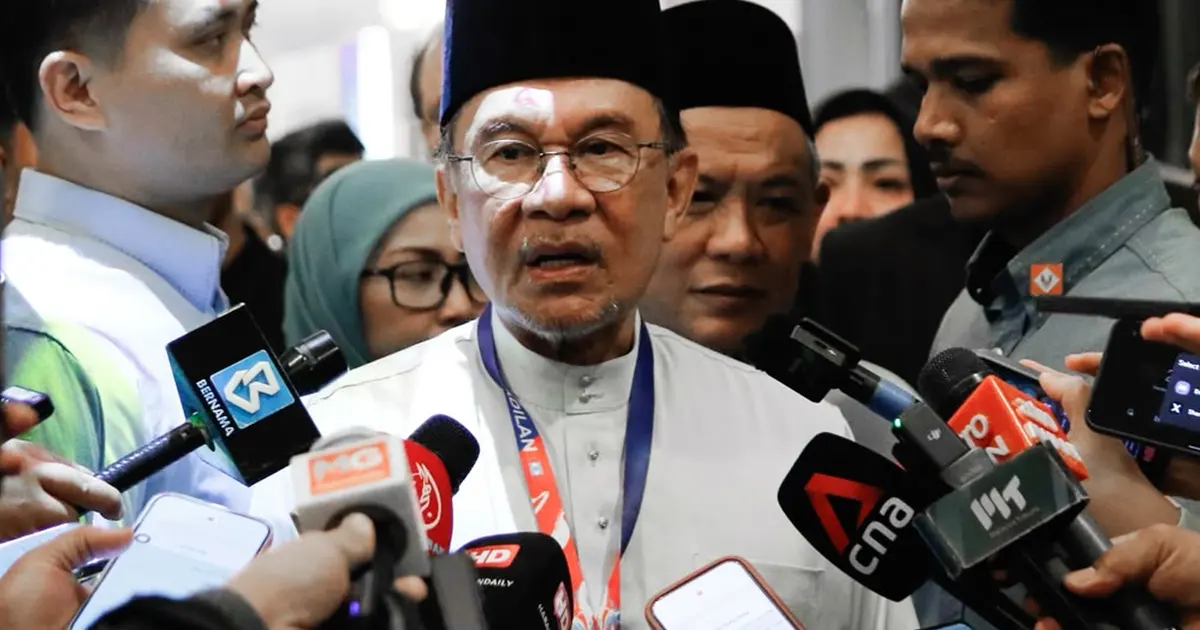
Prime Minister Anwar Ibrahim moved swiftly on Tuesday to defuse emerging tensions within the ruling coalition, pointedly rejecting any suggestion that his working relationship with Deputy Prime Minister Zahid Hamidi has deteriorated. The clarification came in response to remarks made by Khairy Jamaluddin, the former Umno Youth chief, during a recent podcast appearance in which the senior party figure raised concerns about confidence within the leadership structure.
Anwar's statement represents a tactical effort to contain political friction that could undermine the stability of his administration, which relies on a complex coalition spanning Pakatan Harapan, Umno, and other parties. Coalition governments in Malaysia have historically faced challenges when public disagreements between senior figures suggest deeper fractures in consensus-building mechanisms. By personally addressing Khairy's comments, the Prime Minister sought to signal that individual perspectives within the coalition do not necessarily reflect cabinet-level confidence or operational coherence.
The Prime Minister characterised the divergence as stemming from different interpretive frameworks rather than substantive disagreements on governance or policy direction. This framing is strategically important because it allows all parties involved to maintain their positions without forcing a confrontation that could widen existing fissures within Umno itself. Khairy, as a former youth leader and senior party voice, carries considerable influence in shaping perceptions among the party's middle-ranking members and grassroots supporters.
Zahid's position as Deputy Prime Minister places him at the centre of discussions around government operations and ministerial coordination. As Home Minister in previous administrations and now in the second-highest executive post, his portfolio spans critical national security, economic, and administrative functions. The health of working relationships at this level directly impacts how effectively the government can execute policy initiatives and respond to emerging challenges across defence, immigration, internal security, and development priorities.
The podcast comments by Khairy touched on broader questions about intra-coalition harmony during a period when Malaysia faces multiple policy pressures. From economic restructuring to regional security considerations involving South China Sea tensions, infrastructure investment requirements, and domestic political positioning ahead of state elections, the government's capacity to maintain unified messaging becomes increasingly valuable. Public instances where senior figures appear to question one another's trustworthiness can create openings for opposition parties to exploit perceptions of weakness or disunity.
Anwar's intervention underscores the delicate balancing act required in managing a coalition that brings together parties with fundamentally different organisational structures, membership bases, and historical trajectories. Pakatan Harapan, built largely on civil society movements and younger party bases in urban areas, operates differently from Umno, which has deep roots in rural constituencies and a hierarchical structure spanning decades. When representatives of these distinct political cultures make public statements that appear to question one another, coalition managers must quickly contextualise such remarks to prevent them from hardening into entrenched positions.
Khairy's podcast intervention may also reflect internal Umno dynamics worth considering. As a prominent figure who has navigated complex relationships within his party, his comments could represent either a genuine concern genuinely held by a faction within Umno, or a calculated statement designed to position him in relation to ongoing leadership questions and power balances within the party structure. Whether intentional positioning or authentic concern, Anwar's response needed to acknowledge the comment without validating its central claims about fractured relationships.
The Prime Minister's characterisation of differing perspectives as natural in a coalition environment speaks to a broader governance philosophy. In Malaysia's political context, where coalitions have become the norm rather than exceptions, leaders increasingly frame disagreement as pluralism rather than dysfunction. This rhetorical strategy allows for the acknowledgement of diverse viewpoints while maintaining the fiction of unified decision-making authority at the apex of government.
Looking ahead, this episode highlights why coalition stability depends on effective relationship management at multiple levels. While Anwar and Zahid may indeed maintain a functional working relationship focused on delivering government priorities, public perceptions matter equally in Malaysian politics. If Umno members increasingly perceive that their party's leadership position within the coalition is weakening or that their concerns are dismissed, this could gradually erode the coalition's coherence from within.
The incident also demonstrates how media formats like podcasts have transformed political communication in Malaysia. Unlike carefully controlled press conferences or official statements, podcasts allow senior figures to express more candid views that can reverberate through political networks quickly. The difficulty for coalition managers lies in distinguishing between genuine policy disagreements, personal positioning within parties, and comments that genuinely reflect broader organizational concerns that require substantive engagement rather than rhetorical dismissal.

