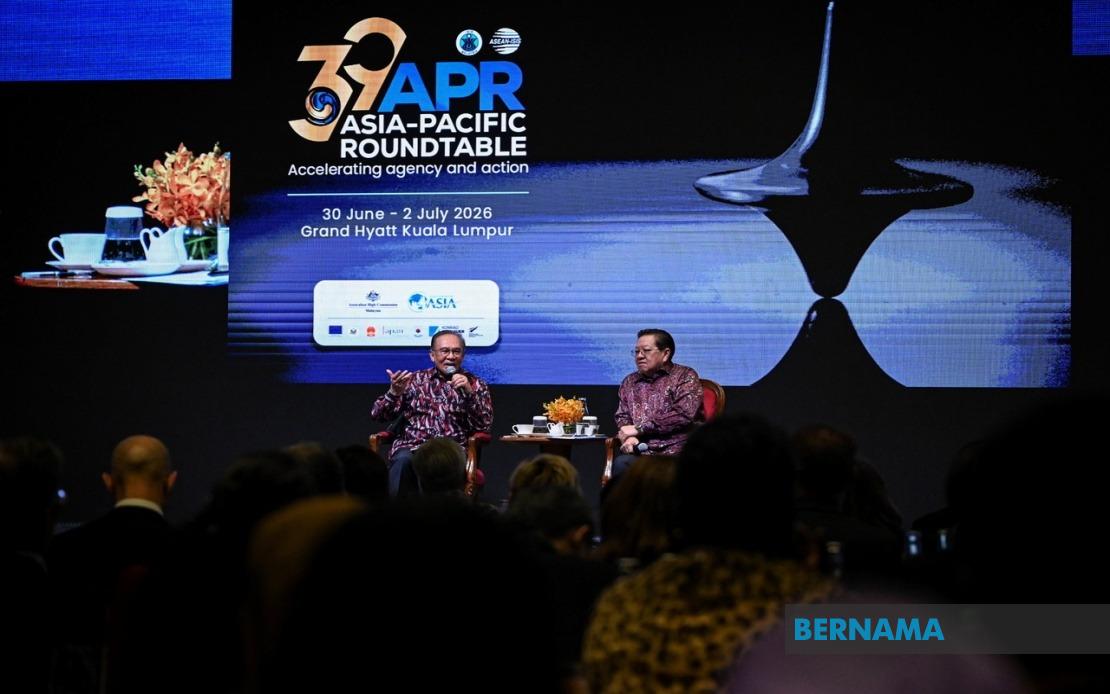
Malaysia's Prime Minister Datuk Seri Anwar Ibrahim has firmly rejected the notion that armed conflict in the South China Sea represents an inevitable outcome, arguing instead that sustained dialogue, confidence-building measures, and respect for international legal frameworks provide the genuine pathway to preserving regional peace. Speaking during the 39th Asia-Pacific Roundtable in Kuala Lumpur on Thursday, Anwar positioned himself as a counterweight to alarmist predictions, suggesting that overheated narratives about military confrontation in Southeast Asia's strategic waterway may themselves become self-fulfilling prophecies if allowed to dominate policy discussions.
The Prime Minister's remarks reflected Malaysia's distinct diplomatic positioning within ASEAN, where competing interests and security concerns create pressure for more confrontational stances. Anwar pointed to Malaysia's own experience as evidence that constructive engagement remains viable even where genuine maritime disputes exist. He outlined his personal interactions with Chinese leadership, including conversations with President Xi Jinping and Premier Li Qiang, characterizing these exchanges as substantive and productive rather than fraught with underlying tension. This experience, he suggested, contradicts the doom-laden scenarios frequently presented in international commentary about great power competition in Southeast Asia.
Critically, Anwar emphasized that acknowledging maritime issues in the South China Sea need not entail accepting conflict as inevitable. Malaysia recognizes genuine disputes over overlapping territorial claims and resource rights in contested waters, yet the Prime Minister argued that these disagreements remain manageable through established diplomatic channels and mutual commitment to lawful resolution. His argument carries particular weight given Malaysia's own claims to portions of the South China Sea, meaning his rejection of conflict narratives cannot be dismissed as indifference to the region's geopolitical complexities.
The multilateral framework underpinning Malaysia's approach centres on the United Nations Convention on the Law of the Sea, which both Malaysia and China have ratified, and the still-negotiating ASEAN-China Code of Conduct. Anwar noted that China has publicly affirmed its support for UNCLOS and the ongoing code negotiations, suggesting that shared commitment to these legal instruments provides common ground for dispute resolution. The code, which has undergone years of preliminary discussions, aims to establish behavioral guidelines for maritime activities in the South China Sea without prejudicing any nation's ultimate territorial claims. Completion of this framework could significantly reduce the risk of accidental escalation stemming from military-to-military encounters in crowded waters.
Anwar's caution against excessive focus on war scenarios in Southeast Asia reflects a broader diplomatic strategy by Malaysia to prevent international rhetoric from constraining regional agency. When external powers emphasize the imminence of conflict, they can inadvertently push regional states toward more defensive postures or arms buildups, creating genuine insecurity where none previously existed. By rejecting this narrative framework, Anwar positioned ASEAN as capable of managing its own affairs through deliberate engagement and mutual respect, rather than relying on external security guarantees or military alliances to manage regional tensions.
The Prime Minister underscored ASEAN's historical achievement in maintaining stability over decades, attributing this success to the organization's culture of direct leadership communication and consensus-building. This institutional approach, developed through decades of practice, creates mechanisms for addressing disagreements before they harden into formal disputes. ASEAN's emphasis on non-interference in internal affairs, while sometimes criticized as limiting joint action, has paradoxically enabled member states to coexist despite profound differences in political systems, alliance preferences, and strategic interests. This institutional identity, Anwar suggested, should be preserved and strengthened rather than abandoned in favor of more confrontational regional alignments.
Beyond maritime disputes, Anwar referenced the long-standing Cambodia-Thailand border tensions as another example where dialogue and patience can eventually yield resolution. He welcomed both countries' commitment to continued negotiations, noting that many of Southeast Asia's boundary disputes represent colonial-era legacies rather than contemporary sources of fundamental incompatibility. This perspective implies that sufficient time, good faith engagement, and willingness to accept compromise solutions can address even entrenched territorial questions. The success of various border settlements throughout ASEAN history demonstrates that such outcomes, while difficult and lengthy, remain achievable.
Anwar's remarks also carried implicit criticism of international pressure on ASEAN states to choose sides in great power competition. By emphasizing Malaysia's independent relationship with China and ASEAN's collective commitment to managing regional affairs, the Prime Minister signaled resistance to external powers' efforts to instrumentalize Southeast Asian states as proxy actors. This stance reflects Malaysia's broader foreign policy orientation, which seeks to benefit from relationships with multiple major powers while preserving decision-making autonomy regarding regional security arrangements.
The Prime Minister furthermore advocated for institutional reforms within the United Nations and World Trade Organization systems, arguing that more representative and responsive global institutions would reduce the underlying tensions that fuel regional conflicts. This perspective acknowledges that maritime disputes in the South China Sea cannot be entirely divorced from broader questions about the international order's legitimacy and inclusiveness. Malaysia's advocacy for multilateral institutional reform, coupled with its commitment to ASEAN-driven solutions for regional problems, reflects an attempt to navigate between accepting the existing international system and pushing for changes that better reflect contemporary global power distributions.
Anwar's emphasis on dialogue and mutual trust represents a conscious choice to prioritize preventive diplomacy over worst-case scenario planning. While this approach requires that all major regional actors genuinely commit to peaceful resolution, the Prime Minister's confidence that such commitment exists among ASEAN members and China reflects both optimism about regional relationships and a calculated judgment that conflict serves no party's interests. For Malaysian readers, understanding this diplomatic position illuminates how national leadership balances acknowledgment of real maritime disputes with strategic choices about rhetoric and engagement approaches that either escalate or contain tensions.
The broader implications for Southeast Asia rest on whether Anwar's optimistic assessment of dialogue's potential can be sustained as great power competition intensifies in the region. Malaysia's ability to maintain productive relationships with multiple powers while advocating for ASEAN unity around peaceful dispute resolution mechanisms may offer a model for other regional states navigating similar pressures. However, the success of this approach depends fundamentally on whether major powers, particularly those with significant interests in the South China Sea, remain committed to the same dialogue-first principles that Anwar advocates.

