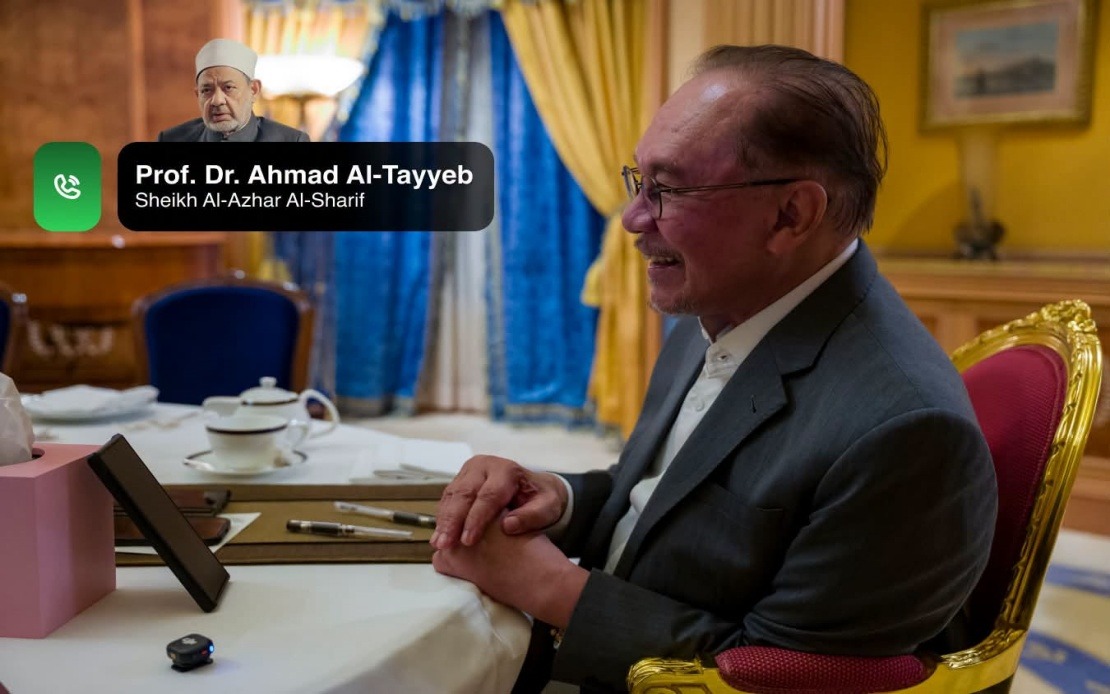
Prime Minister Datuk Seri Anwar Ibrahim has engaged in high-level dialogue with Sheikh al-Azhar al-Sharif Prof Dr Ahmad al-Tayyeb, the Grand Imam of Al-Azhar, regarding collaborative initiatives to deepen Islamic understanding across Malaysian society. The phone conversation, initiated by the prominent cleric, centred on sustaining dakwah—Islamic missionary—efforts and promoting scholarly advancement in religious education, underscoring Malaysia's growing engagement with one of Islam's most respected institutional authorities.
The call took place as Anwar continues his recovery from recent surgery. Sheikh al-Azhar al-Sharif reached out personally to inquire about the Prime Minister's health and convey prayers for his wellbeing, a gesture Anwar acknowledged with considerable warmth. The surgery, according to the Prime Minister, proceeded without complication, and the recuperation process has progressed favourably. This exchange highlights the significance placed by international Islamic leadership on Anwar's personal welfare, reflecting his standing within global Muslim circles.
Beyond expressions of concern, the conversation revealed substantive collaboration plans between Malaysia and Al-Azhar University, one of the Muslim world's oldest and most influential institutions. Anwar emphasised that the views and guidance from Sheikh al-Azhar al-Sharif would serve as an anchor point in preserving the integrity of Islamic scholarship and extending the positive influence of Islam throughout Malaysian communities. The framing suggests Anwar's administration views such engagement as integral to its broader religious and social agenda.
During the discussion, Anwar recalled Sheikh al-Azhar al-Sharif's previous visit to Malaysia, describing it as having made a profound and lasting impression on Malaysian Muslims. This reference underscores the symbolic and educational weight attached to such exchanges. The Prime Minister expressed optimism about future in-person meetings, proposing either Cairo or Kuala Lumpur as venues to advance their collaborative dakwah and knowledge-sharing initiatives. Such reciprocal arrangements strengthen institutional ties and position Malaysia as a serious partner in contemporary Islamic intellectual dialogue.
In tandem with this engagement, Anwar also held separate discussions with Mohamed Abdelsalam, Secretary-General of the Council of Muslim Elders (Majlis Hukama Muslimin), another influential body within international Islamic circles. Mohamed similarly extended well-wishes following Anwar's surgery. The conversation extended to personal concerns, with Anwar inquiring about the health of Mohamed's wife, who is currently hospitalised, and offering prayers for her recovery. Such expressions of personal solidarity and mutual care reinforce diplomatic warmth and human connection underlying these institutional relationships.
The exchange with Mohamed Abdelsalam also touched on practical next steps for Malaysia's engagement with Al-Azhar and the broader Islamic scholarly community. Notably, discussions included Sheikh al-Azhar al-Sharif's eagerness to revisit Malaysia, signalling sustained interest in strengthening ties. Anwar referenced emerging initiatives aimed at fortifying Malaysia's relationship with Al-Azhar while promoting what he characterised as a straightforward, unburdened, and authoritative understanding of Islam—language that suggests an ideological orientation toward Islamic moderation and intellectual rigour.
The Prime Minister's public articulation of these conversations carries significance for Malaysia's domestic religious landscape. By highlighting collaboration with Al-Azhar, a Sunni institution of global standing, Anwar's administration signals its commitment to anchoring Malaysian Islam within mainstream, internationally recognised scholarly frameworks. This has implications for how religious authority and Islamic education are perceived and structured within Malaysia, particularly as the country navigates competing interpretations of Islamic practice and belief.
Anwar also extended public appreciation to his wife, Datuk Seri Dr Wan Azizah Wan Ismail, commending her as an exemplary woman whose steadfastness, loyalty, and sacrifice have sustained him throughout his political journey. This inclusion reflects a pattern whereby Anwar publicly acknowledges spousal support, reinforcing the personal dimensions of political life alongside the institutional and religious dimensions discussed in the calls with international Islamic figures.
The broader context for these engagements reflects Malaysia's multi-faceted approach to Islam under Anwar's leadership. By cultivating relationships with authoritative international Islamic institutions like Al-Azhar, the government seeks to position Malaysian Islam as intellectually robust and globally connected. This contrasts with narratives of insularity or extremism, instead projecting an image of Islam that is scholarly, moderate, and engaged in transnational networks of knowledge and faith.
Looking ahead, Anwar has expressed confidence that these collaborative efforts will deepen and yield tangible benefits for Malaysian society and the broader Muslim world. The emphasis on continued cooperation suggests that visits, exchange programmes, and joint scholarly initiatives may become more formalised. For Malaysian Islamic scholars and students, increased institutional ties with Al-Azhar could provide expanded educational and networking opportunities, indirectly strengthening Malaysia's position within global Islamic intellectual circles.
The timing of these discussions—occurring during Anwar's recovery—also carries symbolic weight. By discussing substantive matters of religious education and international Islamic cooperation while recuperating, Anwar projects an image of undiminished engagement with national and global concerns. This messaging reassures stakeholders that his temporary medical absence has not diminished his commitment to advancing Malaysia's Islamic and international agenda.
These exchanges ultimately reflect a deliberate strategy to align Malaysia's Islamic framework with globally recognised scholarly authority and institutional legitimacy. As Malaysia continues evolving its religious policies and educational approaches, partnership with institutions like Al-Azhar provides intellectual grounding and international validation. For Southeast Asian observers, such engagement demonstrates how Malaysia situates itself within broader Islamic intellectual geography, with implications extending beyond Malaysian borders to regional perceptions of Islam and Islamic governance.

