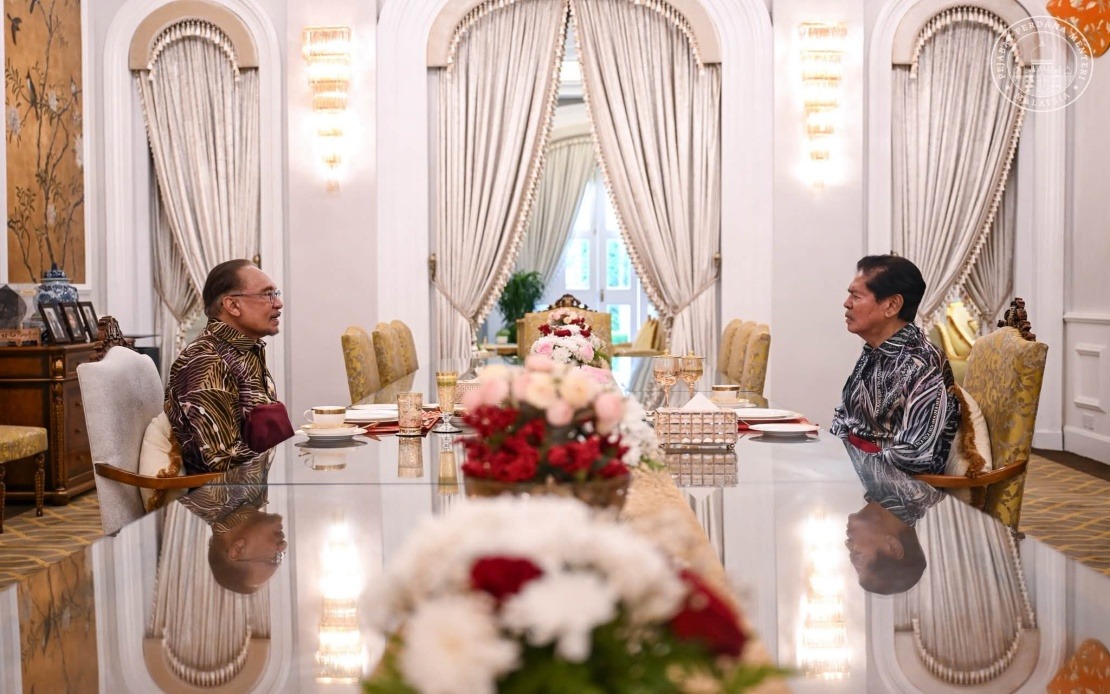
Prime Minister Datuk Seri Anwar Ibrahim brought his two-day working visit to Penang to a close on Thursday with a formal tea reception hosted by Governor Tun Ramli Ngah Talib at the governor's official residence, Seri Mutiara, in George Town. The occasion provided both leaders with an opportunity to reflect on their collaborative efforts and reaffirm their commitment to advancing the state's economic and social agenda.
In remarks posted on social media, Anwar emphasised that the gathering had deepened the working relationship between the Federal Government and Penang's state administration. He highlighted their mutual dedication to spurring development initiatives across the state and ensuring that residents benefit from improved infrastructure, business opportunities, and quality-of-life improvements. The tone of his statement underscored the importance of maintaining strong institutional ties between Putrajaya and George Town, particularly as both tiers of government pursue their respective development roadmaps.
Governor Tun Ramli Ngah Talib reciprocated the sentiment, describing the Prime Minister's visit as a valuable moment for both leaders to discuss emerging issues and policy challenges affecting Penang and Malaysia more broadly. The Governor's appreciation for the meeting reflected a broader pattern of political courtesy and substantive engagement between federal and state administrations, which has become increasingly central to Malaysia's approach to governance and collaborative federalism. His willingness to host Anwar at the official residence signalled the significance Penang's leadership places on direct dialogue with the national government.
A particularly human touch emerged from Tun Ramli's account of the gathering. He noted that his grandson, Aldrey Alfi, was present and took the opportunity to interact with the Prime Minister, who graciously entertained the young boy's questions and curiosity. This moment, captured in the Governor's social media post, reflects a more personal dimension to high-level political engagement and offers a glimpse into the informal side of statecraft that often goes unrecorded. The Governor expressed gratitude for Anwar's warmth and accessibility during the encounter.
Anwar's visit to Penang was notably packed with substantive commitments and public-facing activities over the two-day period. Among the key engagements was his attendance at the Permatang Pauh Entrepreneur Revival Programme, which aligns with the government's broader economic agenda to support small and medium-sized enterprises and foster entrepreneurial activity in the constituency. This programme reflects efforts to revitalise business ecosystems at the grassroots level, particularly in areas that have faced economic headwinds.
The Prime Minister also participated in the 15th Malaysia Scout Jamboree, a significant event in the scouting calendar that draws youth from across the nation. Scout jamborees serve as important platforms for youth development, leadership training, and national integration, bringing together young people from diverse backgrounds. Anwar's presence at this event underscored the government's commitment to investing in youth and ensuring that Malaysian young people have access to developmental opportunities beyond the conventional education system.
Additionally, Anwar attended the MADANI Sahabat 2026 National Day Countdown Programme, an initiative connected to Malaysia's broader development framework. This programme appears designed to build momentum and public engagement in the lead-up to the 2026 milestone, mobilising community participation in nation-building activities. The MADANI agenda, which underpins much of the current administration's policy direction, emphasises inclusive growth, democratic strengthening, and people-centred governance.
The cumulative effect of Anwar's itinerary demonstrates a deliberate strategy to balance high-level diplomatic engagements with direct public outreach and community connection. By combining formal state-level meetings with the Governor with participation in youth-oriented and entrepreneurship-focused programmes, the Prime Minister sends a signal that his administration is attending to diverse constituencies and age groups across Malaysian society. This multi-layered approach to constituency engagement has become characteristic of contemporary political leadership in Malaysia, particularly among senior figures seeking to maintain broad legitimacy.
From Penang's perspective, the visit represents continued affirmation that the state remains a priority in the Federal Government's development calculus. Penang's role as a manufacturing and services hub, combined with its historical and cultural significance, positions it as a crucial node in Malaysia's economic architecture. The state has been navigating its own governance transitions and policy priorities, making the regular engagement with federal leadership important for ensuring alignment on infrastructure investment, industrial policy, and social programmes.
The tea reception itself, while ceremonial in nature, carries symbolic weight in Malaysia's political culture. Official residences serve not merely as administrative centres but as spaces where institutional relationships are nurtured and diplomatic courtesies observed. The choice to conclude his Penang visit in this manner suggests that Anwar views the state administration as a valued partner rather than a subordinate entity, a framing that has potential implications for federal-state relations going forward.
Looking ahead, the pattern of engagement demonstrated during this visit may establish benchmarks for how the Federal Government and state administrations interact, particularly in states where the governing coalition maintains coherence. The relationships forged and reinforced during such visits often provide the foundation for smoother implementation of national programmes at the state level and more effective coordination on shared priorities such as infrastructure development, business promotion, and social welfare delivery.

