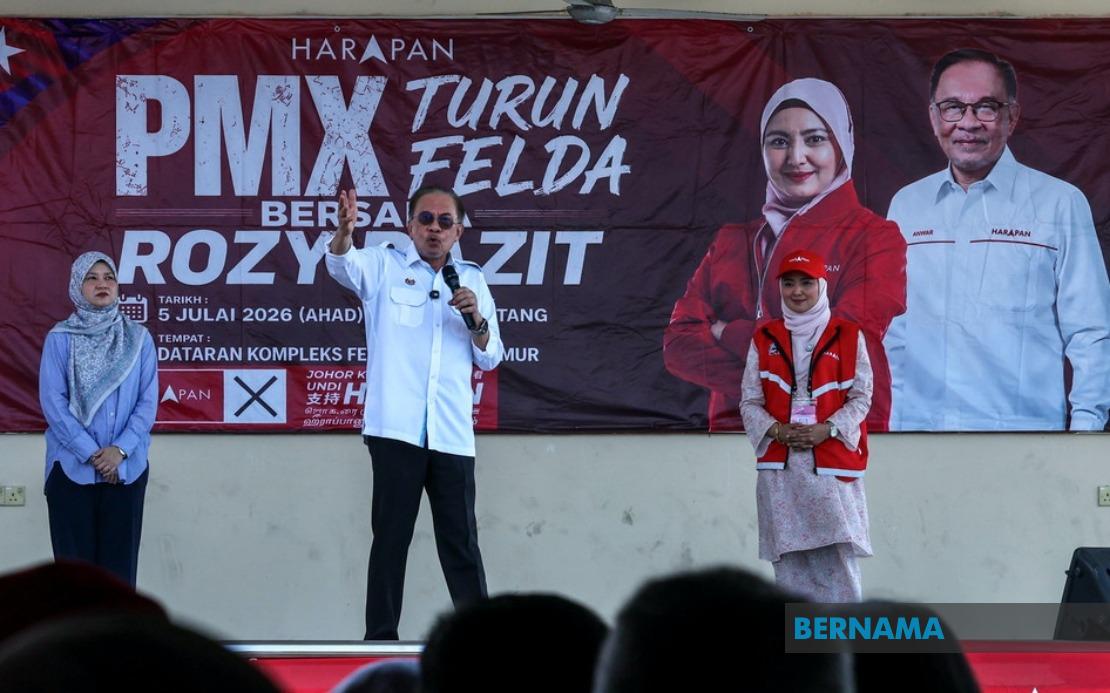
Prime Minister Datuk Seri Anwar Ibrahim has made a high-profile pledge to tackle one of Malaysia's most persistent agricultural settlement challenges: ensuring that the second generation of Federal Land Development Authority (FELDA) settlers receive adequate housing sites. Speaking at a public engagement in Segamat on July 5, Anwar positioned the issue as a priority for his administration, signalling that resolving this multi-decade stalemate forms part of his broader governance agenda.
The housing shortage facing FELDA's second generation represents far more than a simple infrastructure gap. Since FELDA's inception in the 1950s, the scheme has resettled hundreds of thousands of rural Malaysians and their families on smallholdings, primarily engaged in palm oil and rubber cultivation. However, as original settlers aged and their children came of age, the scheme failed to provide adequate mechanisms for succession or alternative housing arrangements. Many second-generation FELDA residents now find themselves caught between limited economic mobility within the scheme and an inability to secure formal land ownership or housing development within FELDA schemes themselves.
Acknowledging the complexity of the problem, Anwar noted that while his government's policy position is unambiguous—to guarantee and protect housing site allocations for second-generation settlers—actual delivery requires substantial coordination with state authorities. Land administration, planning approvals, and the provision of essential infrastructure including water, electricity, and roads remain under state jurisdiction across Malaysia's federal system. This structural reality means that even a Prime Minister's commitment must navigate the bureaucratic and political landscape of thirteen different state governments, each with varying fiscal capacity and developmental priorities.
The Prime Minister's remarks came during a meet-the-people session at Dataran Putra FELDA Palong Timur in the Buloh Kasap state constituency, lending the announcement local political significance. His emphasis that he wishes to see these long-dormant issues resolved during his tenure carries an implicit timeline pressure. For a government that has faced criticism over the pace of promised reforms and infrastructure development, delivering tangible results on FELDA matters could strengthen its standing among rural constituents who have historically supported the scheme.
The gathering included several figures instrumental to implementation: Selangor Menteri Besar Datuk Seri Amirudin Shari, who holds significant sway over one of Malaysia's most economically dynamic states where FELDA settlements remain economically important; Education Minister Fadhlina Sidek, whose portfolio touches community development; and Segamat Member of Parliament R. Yuneswaran, who serves as Deputy National Unity Minister. This cross-sectional attendance underscored that addressing FELDA challenges is being framed as a whole-of-government endeavour rather than the exclusive responsibility of the ministry overseeing FELDA affairs.
For Malaysia's broader rural development strategy, resolving the FELDA second-generation housing problem carries symbolic weight beyond Segamat. FELDA schemes span multiple states and house hundreds of thousands of Malaysians whose economic fortunes are intertwined with commodity price cycles and global agricultural markets. Many younger FELDA residents have migrated to urban areas for employment, yet maintain family ties and property interests in their home schemes. Formalising housing arrangements could facilitate intergenerational wealth transfer, enable economic diversification within schemes, and potentially unlock development potential in FELDA areas that currently remains dormant due to unclear land tenure.
The historical roots of this impasse trace partly to FELDA's original design, which prioritised establishing viable agricultural communities rather than anticipating demographic succession. As smallholdings were typically allocated to individual settlers rather than families, the framework never adequately addressed what would occur when settlers retired or passed away. Second-generation members who had grown up on FELDA land often lacked formal title, making them ineligible for conventional banking finance and unable to develop property independently. This created an intergenerational equity problem that has festered through multiple administrations.
State cooperation is essential but not guaranteed. Different states face different fiscal pressures and may prioritise competing development needs. Selangor, where Anwar's coalition government controls state politics through Amirudin Shari's leadership, may prove more receptive to FELDA initiatives. However, other states with significant FELDA presence—including Pahang, Johor, and Perak—may require negotiation or incentives to commit resources. The federal government could potentially leverage conditional grants or development funds to encourage state participation, though such mechanisms themselves require political consensus and budgetary headroom.
The practical mechanics of implementation remain underspecified. Questions linger about whether the scheme would entail providing new housing sites within existing FELDA areas, facilitating individual plot development for settlers' children, offering compensation mechanisms, or some combination thereof. Different approaches carry vastly different cost implications and timeframes. Whether the government intends to fund site development directly, enable settler self-financing through improved access to credit, or create mixed outcomes remains unclear from the Prime Minister's public statements.
For Malaysian and Southeast Asian observers of land reform and rural development, the FELDA second-generation challenge illuminates broader tensions in managing agricultural settlements across demographic change. Thailand, Indonesia, and the Philippines have grappled with comparable issues in their own land schemes and cooperative systems. How Malaysia resolves this problem could inform regional conversations about sustainable land redistribution and the long-term viability of government-sponsored agricultural communities in rapidly urbanising economies.
Anwar's commitment, while welcome to affected communities, ultimately represents the beginning rather than the conclusion of a complex policy negotiation. Translating electoral promises and administrative pledges into tangible housing developments requires sustained political will, budgetary allocation, and genuine inter-agency coordination across levels of government. The next phase will test whether the coalition government's internal cohesion and fiscal position permit meaningful progress on an issue that has accumulated decades of unmet expectations.

