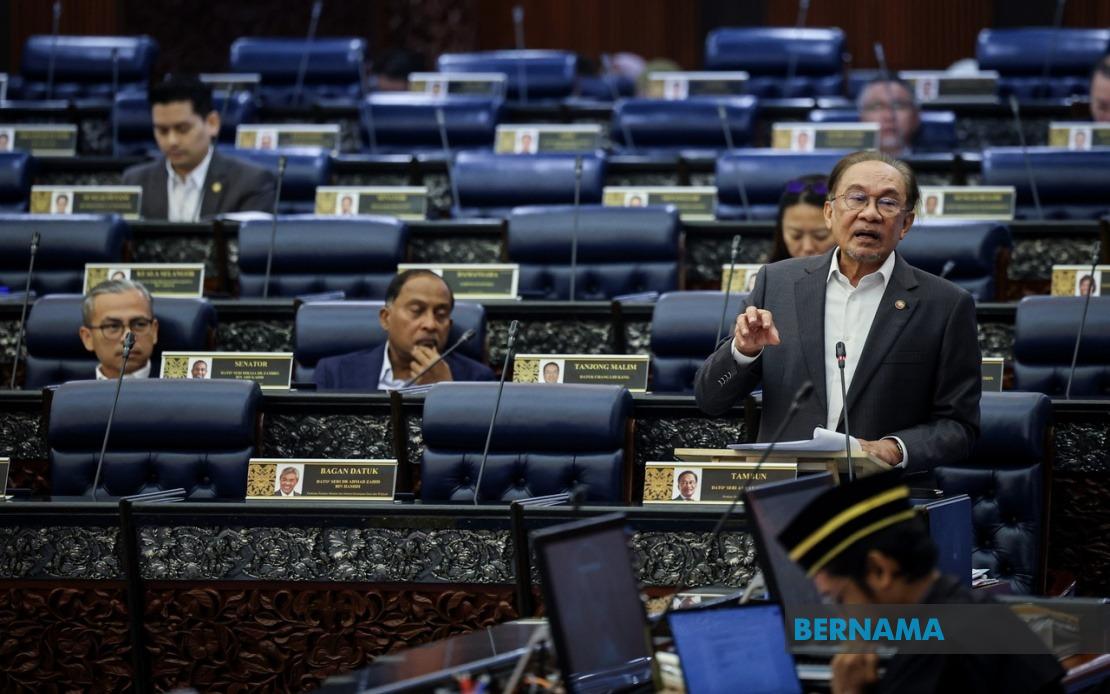
Prime Minister Datuk Seri Anwar Ibrahim has moved to defuse political tension surrounding his public comments on the Johor state election polling date, asserting during parliamentary proceedings that his observations were motivated purely by considerations of voter accessibility and should not be interpreted as pressure on the independent Election Commission. Speaking during Minister's Question Time in the Dewan Rakyat on July 7, Anwar stressed the EC's constitutional autonomy while explaining the reasoning behind his earlier remarks about the advantages of Sunday voting over Saturday polling.
The clarification came after PN-Pasir Mas representative Ahmad Fadhli Shaari pressed Anwar to address media coverage of comments made during the Johor campaign period. The PM's intervention in the electoral scheduling debate had drawn scrutiny from opposition quarters, who questioned whether such interventions crossed the boundary between offering perspectives and attempting to influence regulatory bodies responsible for upholding electoral integrity. By characterizing his position as contextual rather than prescriptive, Anwar sought to distinguish between personal opinion and official interference.
The underlying issue centers on practical considerations affecting Malaysia's cross-border workforce. Anwar highlighted that substantial numbers of Malaysians maintain employment in Singapore, where Saturday schedules frequently include half-day work commitments. A Sunday election would theoretically provide these workers with full weekend flexibility to return across the Johor Bahru crossing and participate in voting. This constituency, while geographically dispersed, represents a politically meaningful group whose participation levels can influence electoral outcomes in constituencies with significant commuter populations.
Anwar emphasized that despite the EC ultimately selecting Saturday as the polling date, his earlier commentary carried no binding intention and should be understood within this humanitarian framework. He reiterated that the EC functions as a constitutionally independent institution possessing sole legitimacy to establish electoral calendars, acknowledging that if the commission determined Saturday represented the appropriate choice, such a decision commands respect regardless of his personal preferences. This formulation allowed him to maintain his position while simultaneously affirming institutional boundaries.
A separate parliamentary question from PH-Hulu Langat member Mohd Sany Hamzan raised the prospect of bilateral coordination with Singapore to ease voter participation. This suggestion implied potential diplomatic engagement to facilitate cross-border movement during the election period. Anwar firmly rejected any intention to approach Singapore's Prime Minister Lawrence Wong regarding electoral logistics, establishing that Malaysia maintains principled separation between electoral processes and international diplomacy, even with neighboring nations maintaining cordial relations.
The Prime Minister's response underscores Malaysia's commitment to electoral sovereignty and non-interference protocols, principles that extend reciprocally to foreign governments. While acknowledging his established personal rapport with Wong and broader strategic cooperation between the two nations, Anwar made explicit that such relationships do not extend into electoral administration. He characterized voting arrangements as quintessentially internal matters where external coordination, even with closest partners, would represent a fundamental departure from democratic principles both nations uphold.
Anwar did acknowledge that Malaysian companies operating in Singapore had received informal guidance to accommodate employees seeking to return for voting whenever elections occurred. This distinction—between private sector facilitation through employers and official government-to-government coordination—preserved recognition of practical realities affecting workers while maintaining that no formal state-level negotiation had taken place or would occur. Companies could reasonably accommodate time-off requests without this constituting diplomatic intervention in Singapore's or Malaysia's internal affairs.
The episode illuminates tensions inherent in Malaysian electoral governance when federal leadership attempts to influence outcomes through public commentary on procedural matters. While Anwar's remarks about voter convenience carried reasonable justification, the intervention highlighted how prime ministerial visibility inevitably carries weight disproportionate to formal authority. His clarification attempt essentially acknowledges this asymmetry by reframing his position as personal rather than governmental, though such distinctions often prove difficult to maintain in practical political discourse.
For Malaysian readers, particularly those working across borders or living in states with significant commuter populations, the exchange demonstrates how scheduling decisions that might appear purely technical carry genuine implications for participation. The Johor elections serve as a microcosm of broader Southeast Asian patterns where economic integration creates complex electoral constituencies spanning multiple jurisdictions. Future polling scheduling in border states will likely continue balancing such logistical considerations against EC independence and the principle that electoral bodies must remain insulated from political pressure.
The parliamentary exchange also reflects evolving norms around government leaders' relationship with independent regulatory institutions. Anwar's willingness to publicly advocate for particular scheduling outcomes—even when framed as personal preference—raises questions about whether such interventions, however carefully characterized, subtly influence institutional decision-making processes. The distinction he drew between expressing views and exercising pressure depends significantly on how downstream actors interpret and respond to prime ministerial commentary, a distinction that becomes increasingly blurred in hierarchical governance contexts.
Moving forward, the Johor precedent suggests Malaysian political actors will likely continue navigating the delicate territory between participating in public discourse about electoral administration and respecting institutional independence. Anwar's clarification provides some framework for such engagement, though its practical utility depends on consistent application across different electoral contexts and by different political actors. The underlying challenge remains ensuring that independent bodies like the EC retain genuine autonomy even when senior leaders express preferences about their decisions.
For Singapore, the episode confirms Malaysia's sensitivity about any suggestion of cross-border coordination affecting electoral processes. Despite the obvious economic ties and shared governance challenges involving Malaysian workers, electoral administration remains firmly within nationalist boundaries. This reflects broader Southeast Asian commitments to territorial sovereignty that, while sometimes complicating practical governance, serve important protective functions against external pressure on democratic institutions.

