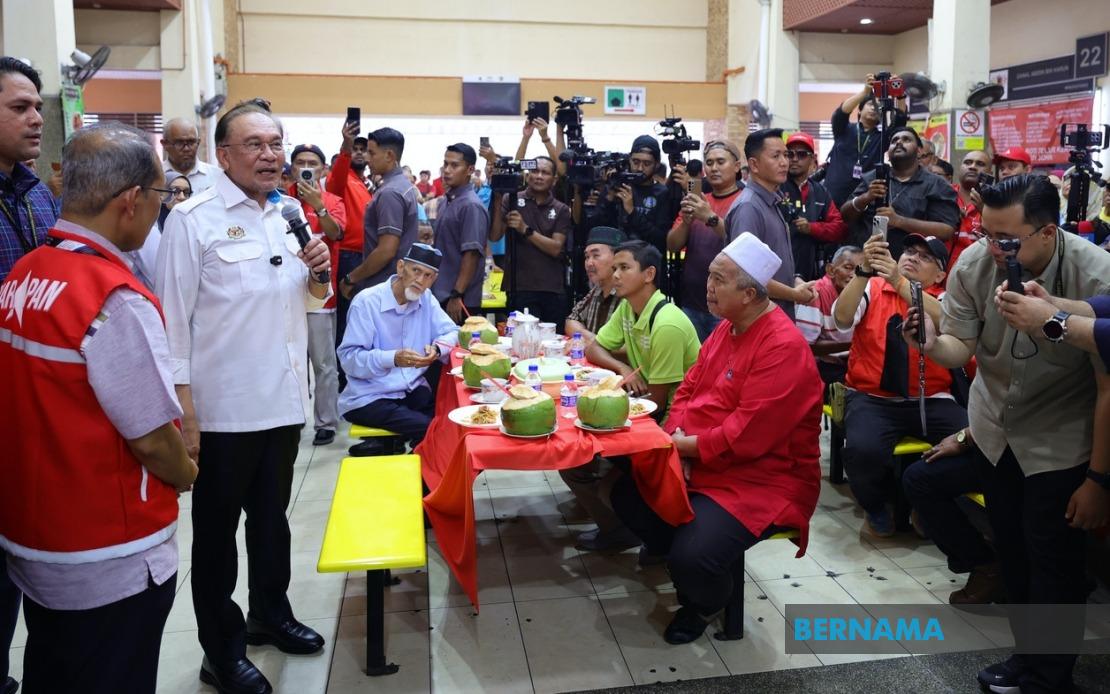
Prime Minister Datuk Seri Anwar Ibrahim has made a direct appeal to voters in Negeri Sembilan to retain their confidence in Pakatan Harapan, framing the upcoming state election as a choice between continuity and uncertainty. Speaking during campaign events in Seremban on July 22, Anwar stressed that a strengthened mandate for the coalition would provide the political foundation necessary to sustain governance efforts and deliver tangible improvements to people's lives across the state.
Anwar's emphasis on political stability reflects broader concerns within the PH leadership about the fragility of Malaysia's coalition politics. The argument put forward during his Negeri Sembilan campaign connects state-level governance directly to federal coordination, suggesting that voters should consider how their choice affects the country's wider policy implementation. By positioning a strong PH showing as beneficial for both Negeri Sembilan and national development, the Prime Minister has sought to elevate the state election beyond local concerns into a referendum on the current administration's performance.
The coalition's track record in Negeri Sembilan under Menteri Besar Datuk Seri Aminuddin Harun became a central pillar of this messaging. Anwar highlighted the three years of relative stability achieved under PH stewardship, contrasting the current era with the political turbulence that characterised earlier periods. This historical framing serves a dual purpose: reminding voters of previous instability while suggesting that further changes could disrupt the progress made so far. The emphasis on Aminuddin's leadership indicates that PH is running the election substantially as an endorsement of the sitting state administration.
Anwar's acknowledgement that not all government policies are flawless represents a calculated admission of imperfection designed to appear candid rather than defensive. Rather than claiming complete success, the Prime Minister invited voters to view continued PH governance as a process of iterative improvement based on public feedback. This rhetorical strategy attempts to address frustrations without conceding fundamental failure, positioning the government as responsive while maintaining that continuity serves the public interest better than a change in direction.
The composition of PH's candidate slate reflects the coalition's internal power dynamics heading into the election. Pakatan Keadilan Rakyat holds the largest allocation with 16 of 36 seats, followed by the Democratic Action Party with 11 seats and Amanah with nine. This distribution maintains PKR's dominance within the coalition structure while ensuring the other component parties retain meaningful representation. For Malaysian observers, this candidate division demonstrates how national coalition arithmetic translates into state-level positioning, with each partner careful to protect its electoral footprint.
The Election Commission's announcement that polling would occur on August 1, with early voting on July 28, established a defined campaign window during which PH conducted its persuasion efforts. Anwar's direct involvement in multiple campaign events underscores the national significance attached to the Negeri Sembilan result. A Prime Minister's personal presence in state campaigns typically signals either confidence in victory or anxiety about the result, and the frequency of his Negeri Sembilan appearances suggested the leadership viewed the outcome as consequential for the coalition's trajectory.
For Southeast Asian political observers, the Negeri Sembilan campaign illustrated how Malaysian coalitions must continuously renew their mandate to sustain power, given the country's volatile electoral landscape. Unlike systems with dominant-party politics, Malaysia's recent history involves regular shifting coalitions and the need for winning alliances to periodically convince voters anew of their competence. This constant requirement for revalidation creates both instability and accountability mechanisms that shape governance behaviour.
The implicit comparison in Anwar's messaging between political unity and political division carries particular weight in Malaysia's context. The country has experienced multiple coalition recalibrations and defections that destabilised governments at both state and federal levels. By framing a PH victory as a vote for stability rather than simply for policy change, Anwar positioned political continuity itself as a public good worth preserving. This focus on institutional coherence reflects lessons learned from previous administrations that fragmented under internal pressures.
Anwar's campaign language also addressed the psychological dimension of voter choice. By asking voters to "give our candidate the chance to serve" and inviting them to participate in a feedback process about policy improvements, the Prime Minister attempted to transform electoral participation into partnership. This framing suggested that voters who support PH become stakeholders in governance improvement rather than passive consumers of policy outcomes, potentially motivating higher turnout among coalition supporters.
The regional implications of Negeri Sembilan's election deserve consideration alongside the national context. As a relatively developed state with diverse economic interests, Negeri Sembilan's political direction influences policy discussions about economic development, investor confidence, and infrastructure spending across Malaysia. A PH victory would reinforce the coalition's control over multiple state governments, potentially enabling more coordinated policy implementation across different jurisdictions.
Looking forward, the result would signal whether PH's governance record has convinced voters that political stability under its direction outweighs potential alternatives. Anwar's campaign message ultimately rested on the proposition that institutional continuity and demonstrated competence matter more than ideological alternatives or protest votes. Whether Negeri Sembilan voters accepted this framing would offer insight into PH's electoral prospects beyond the immediate campaign and the Malaysian electorate's appetite for political change versus stability.

