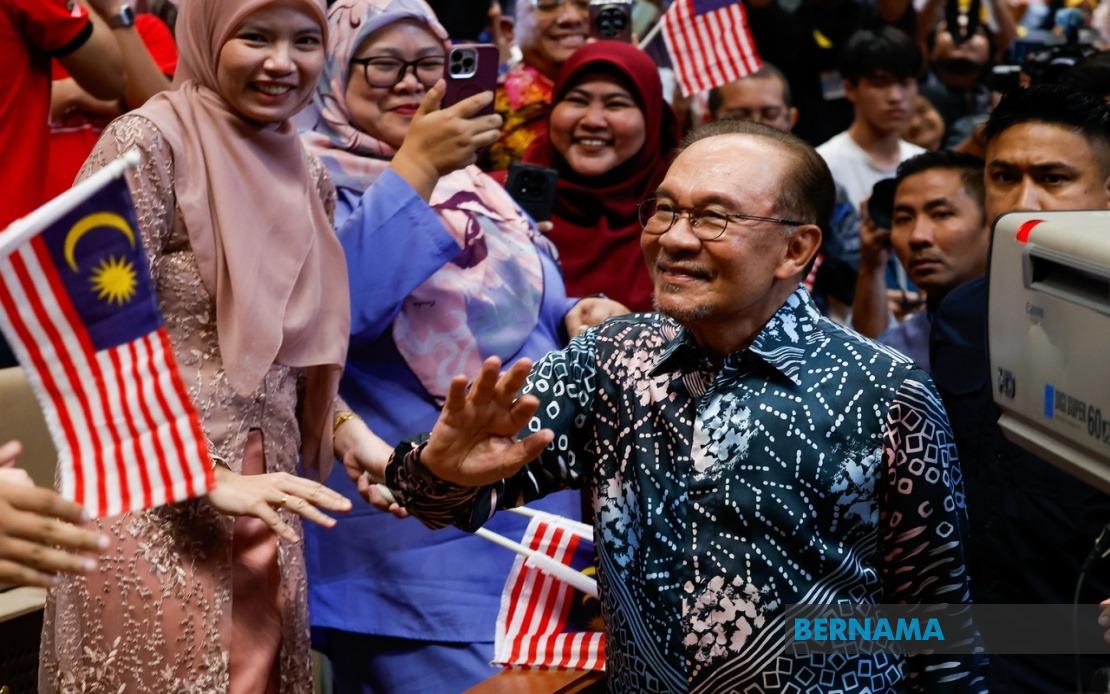
Prime Minister Datuk Seri Anwar Ibrahim has emphasised that the true essence of independence lies not in political structures or territorial boundaries, but in cultivating a collective mindset of self-determination and resilience across Malaysia's diverse population. Speaking at the Putrajaya International Convention Centre during his National Day address, Anwar articulated a vision of independence that goes beyond ceremonial commemoration, instead positioning it as an active, ongoing commitment that must animate the consciousness of every citizen regardless of background.
Anwar's remarks signal a departure from conventional independence narratives that focus predominantly on historical milestones or institutional frameworks. Instead, he has reframed the concept as fundamentally psychological and social, suggesting that Malaysia's greatest contemporary challenge lies in maintaining and revitalising this intangible yet crucial dimension of nationhood. The Prime Minister's framing implies that material progress, economic development, and institutional stability remain hollow without the underlying ethos of independence that should guide collective decision-making and individual conduct.
The emphasis on unity across all communities represents a deliberate broadening of the national consensus beyond traditional power structures. Anwar's invocation of the vision established by Malaysia's founding generation—that unity must encompass every single generation and every citizen rather than being fragmented along ethnic, geographic, or sectarian lines—attempts to anchor contemporary politics to foundational principles. This rhetorical move positions his government as a custodian of these principles rather than merely a contemporary administration.
An important subtext within Anwar's address concerns the notion of reconstruction following national challenges. His reference to rebuilding from ruins suggests an acknowledgment that Malaysia faces circumstances requiring fundamental renewal, whether understood in political, economic, or institutional terms. By tethering this reconstructive project to the spirit of independence, Anwar implies that technical solutions or policy adjustments alone prove insufficient without a renewal of shared values and national purpose among Malaysians.
The specification of Malays and Bumiputera as the core while simultaneously calling for all communities to play active roles reflects the delicate constitutional and political balances that Malaysian governance must navigate. This formulation preserves recognition of constitutionally enshrined special positions while explicitly rejecting a zero-sum framework in which community advancement necessarily diminishes others. The call for unified defence of rights and justice suggests aspirations toward impartial institutions and equitable treatment as binding principles.
For Malaysian readers, Anwar's rhetoric raises questions about what practical manifestations of this renewed independence spirit might entail in contemporary governance. The invocation of the spirit serves as both inspirational and diagnostic—suggesting that current challenges reflect erosion or distortion of independence principles that once animated the polity. This diagnosis carries implications for how citizens evaluate their government's actions, corporate sector responsibilities, and personal civic obligations.
Regionally, Malaysia's National Day address carries significance beyond domestic audiences. Southeast Asian observers note how different governments frame independence narratives—some emphasising military strength, others economic resilience, still others cultural continuity. Anwar's emphasis on psychological and moral dimensions reflects particular assumptions about what underpins stable, prosperous nation-states. This philosophical approach may influence how Malaysia positions itself within ASEAN discussions concerning regional stability, economic integration, and responses to external pressures.
The presence of senior government figures including Deputy Prime Minister Datuk Seri Dr Ahmad Zahid Hamidi, Communications Minister Datuk Seri Fahmi Fadzil, and Chief Secretary to the Government Tan Sri Shamsul Azri Abu Bakar underscored the formal significance of these remarks within the administration's priorities. Their attendance signalled that the independence spirit narrative represents not merely ceremonial rhetoric but a substantive policy orientation intended to shape governmental action and public discourse.
Anwar's articulation of independence as a generational project rather than a static achievement implies that each cohort bears responsibility for refreshing and reinterpreting these principles. This perspective has implications for educational curricula, media narratives, and institutional cultures throughout Malaysia. The notion that independence must be continuously nurtured suggests vulnerability to erosion through complacency, competing loyalties, or institutional decay—concerns that resonate across democracies and developing nations grappling with questions of national cohesion.
The Prime Minister's call for Malaysian consciousness to embody independence alongside justice and rights defence establishes normative standards against which citizens and institutions can evaluate their conduct. By coupling independence with these additional commitments, Anwar suggests an integrated framework wherein genuine independence necessarily encompasses accountability, rule of law, and equitable treatment—a formulation that shapes expectations for governance quality and institutional performance.
Looking forward, the success of Anwar's independence revival project depends substantially on whether government actions and policies demonstrably reflect these principles. Public perception of alignment or misalignment between rhetoric and governmental conduct will determine whether such addresses galvanise national renewal or become relegated to ceremonial pronouncements. The sustainability of this narrative framework will likely influence Malaysian politics through subsequent electoral cycles and policy debates.

