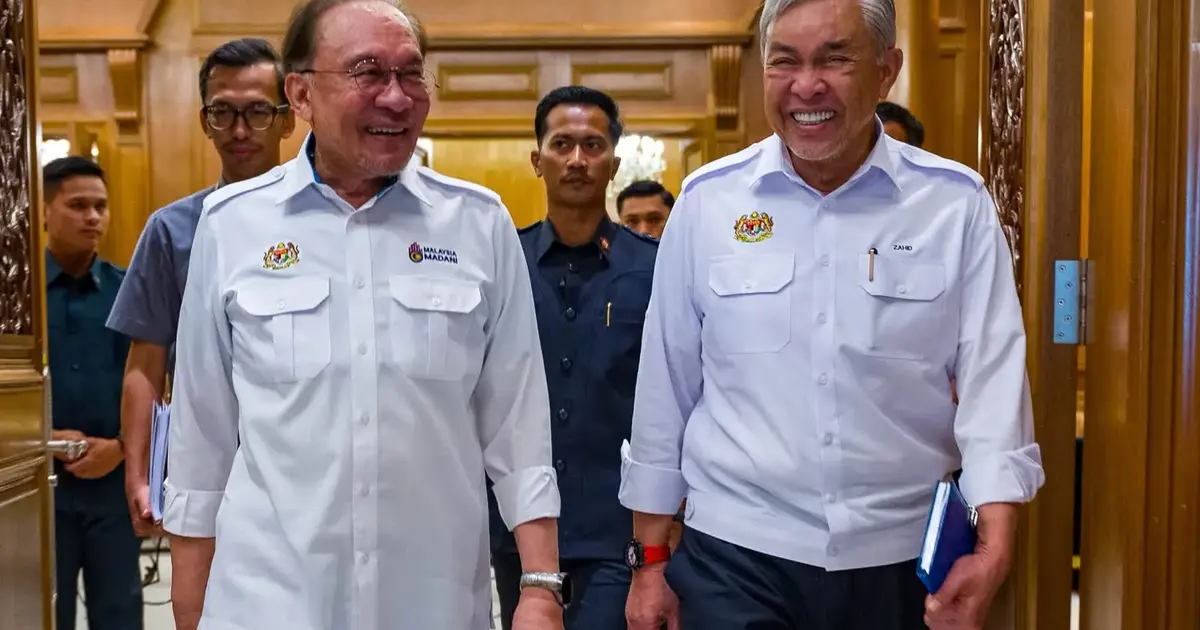
Prime Minister Anwar Ibrahim and Barisan Nasional chairman Ahmad Zahid Hamidi demonstrated surprising cordiality at a public appearance, effectively downplaying tensions that had surfaced within their governing coalition just hours earlier. The warm interaction between the two leaders underscored their mutual interest in maintaining the stability of Malaysia's political establishment, despite underlying disagreements over ministerial representation and portfolio allocation.
The apparent reconciliation came shortly after Ahmad Zahid Hamidi had made pointed comments suggesting that the prime minister retained the authority to dismiss the eight ministers serving from the Barisan Nasional component. Such a statement, delivered with unmistakable sharpness, represented a thinly veiled reminder of the coalition's fragile power dynamics and the formal prerogatives available to the chief executive. Zahid's remarks signalled growing frustration within BN circles over how ministerial positions were being distributed and whether the coalition's interests were being adequately represented in government decision-making.
The timing and nature of these comments reflected the constant negotiation required to manage Malaysia's complex coalition politics. As the largest and most established component of the ruling government, Barisan Nasional has long expected substantial influence over cabinet composition. The suggestion that ministers could be removed at the prime minister's discretion, while technically accurate, carried an implicit challenge to Anwar's authority and appeared designed to test his willingness to respond to pressure from his coalition partners.
However, the subsequent display of camaraderie between Anwar and Zahid suggested that both leaders recognised the danger of prolonged public conflict. For Anwar's government, losing the support of Barisan Nasional's parliamentary votes would seriously jeopardise its legislative agenda and majority position. For Zahid, pushing confrontation too far risked isolating BN from key decisions and undermining its relevance within the broader coalition structure. The handshakes and smiles exchanged by the two men therefore represented pragmatic calculation rather than genuine resolution of underlying tensions.
This pattern of escalation followed by rapid de-escalation has become characteristic of Malaysian coalition governance. Opposition parties, observing from the sidelines, scrutinised these interactions carefully for signs of genuine fracture that might create openings for political advancement. The appearance of unity, even if superficial, denies such opportunities and maintains the coalition's defensive posture against challenge from outside.
The ministerial appointment issue itself touches on deeper questions about power-sharing within Malaysia's governing arrangements. Barisan Nasional brings significant parliamentary seats to the coalition, earned through its performances in different electoral cycles and the constituency-level strength of its component parties. The party's leadership has grown increasingly vocal about ensuring that this numerical contribution translates into commensurate cabinet representation and policy influence. Any perception that BN ministers are marginalised or excluded from significant decisions generates friction that threatens coalition cohesion.
Anwar's government, meanwhile, must balance competing claims from multiple coalition partners while exercising its prerogative to determine the composition and priorities of its cabinet. The Prime Minister's office wields considerable formal authority over ministerial appointments, but exercising this power too unilaterally risks provoking resentment and triggering withdrawal of coalition support. This structural tension between presidential authority and coalition dependency defines much of contemporary Malaysian politics.
The public reconciliation between Anwar and Zahid thus masks rather than resolves the underlying friction. Both leaders have electoral and factional interests to protect within their respective organisations. Zahid must demonstrate to BN members and supporters that he is vigorously defending their interests and pursuing their advancement. Anwar, meanwhile, needs to preserve the prerogatives of his office while maintaining sufficient goodwill among coalition partners to secure continued parliamentary support.
Looking ahead, similar flash-points are likely to emerge as the government approaches routine reshuffles, responds to performance concerns, or adjusts its ministerial structure to address new priorities. Each such moment will recreate the dynamic observed this week: calculated provocation by coalition partners, followed by negotiated settlement and renewed public displays of unity. The Malaysian political system has become sufficiently accustomed to this choreography that it seldom indicates genuine threat to government stability, though observers must remain attentive to signs that tactical disagreement might crystallise into substantive breakdown.
For ordinary Malaysians, these behind-the-scenes negotiations and public theatrical gestures matter primarily insofar as they affect policy implementation and government effectiveness. A coalition under constant internal strain may struggle to deliver coherent economic management, infrastructure development, or social programmes. Conversely, if these tensions remain purely performative and do not impede decision-making, the government can continue functioning despite underlying friction. The coming weeks will provide further evidence of which pattern is actually unfolding within Anwar's administration.

