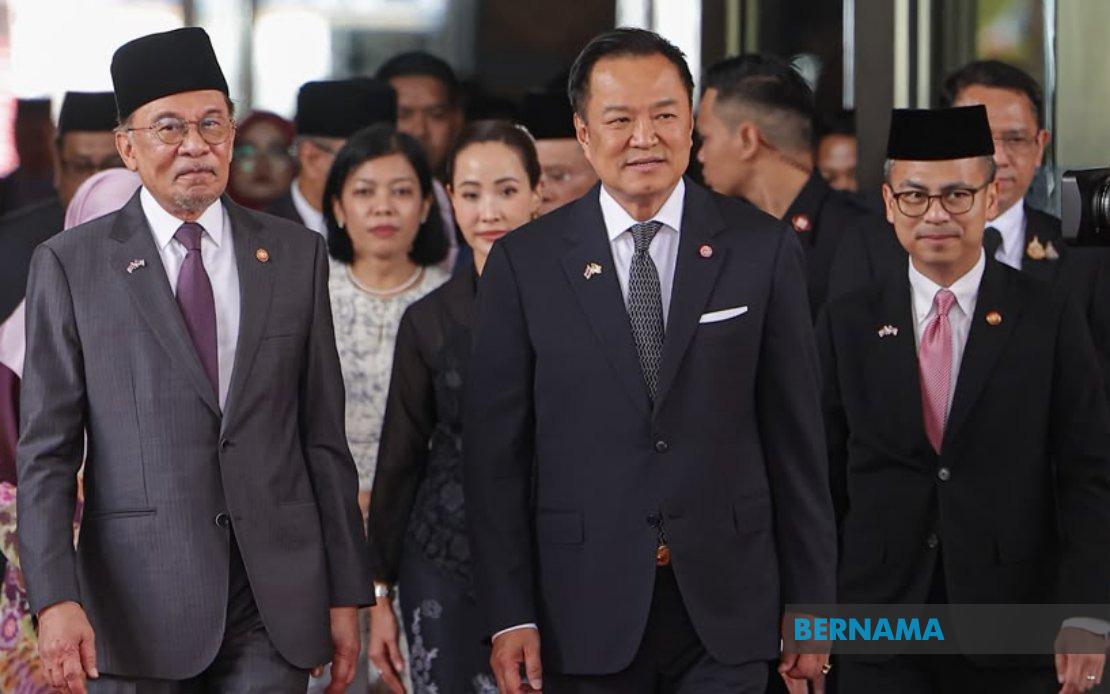
Prime Minister Datuk Seri Anwar Ibrahim and Thailand's Prime Minister Anutin Charnvirakul convened for high-level bilateral discussions at the Perdana Putra Complex in Putrajaya on July 9, marking a significant moment in Malaysia-Thailand relations. The meeting, held during Anutin's two-day official visit, brought together senior decision-makers from both governments to evaluate existing cooperation frameworks and identify fresh avenues for strengthening ties across multiple sectors critical to regional stability and economic growth.
Anutin's arrival at Kuala Lumpur International Airport at 11.11 am was marked by formal protocol, with Anwar receiving his Thai counterpart at the Bunga Raya Complex before the two leaders proceeded directly to the national administrative headquarters. The ceremonial nature of the reception underscored the significance Malaysia places on its relationship with Thailand, a crucial neighbour that shares not only geographical proximity but also deep historical and cultural bonds with the country.
The bilateral agenda encompassed a comprehensive range of cooperation mechanisms reflecting the complexity and depth of modern Malaysia-Thailand engagement. Trade and investment topped the discussion list, an area where both nations recognise untapped potential given their complementary economic structures and regional positioning. Border connectivity emerged as another priority, acknowledging the practical challenges and opportunities inherent in managing one of Southeast Asia's busiest cross-border zones. The Bukit Kayu Hitam-Sadao and Kota Bharu-Rantau Panjang corridors, which facilitate hundreds of thousands of crossings annually, require continuous coordination to optimise efficiency while maintaining security standards.
Security cooperation formed a cornerstone of the talks, reflecting shared concerns about transnational challenges including human trafficking, drug smuggling, and maritime piracy in the Straits of Malacca. Agricultural collaboration featured prominently, given Thailand's position as a regional food production powerhouse and Malaysia's interest in enhancing food security through diversified sourcing and technology transfer. Tourism and education were identified as vehicles for people-to-people exchanges, sectors where both nations possess considerable comparative advantages and where expanded cooperation could yield substantial economic multipliers throughout Southeast Asia.
The composition of the delegations testified to the talks' breadth and strategic importance. Malaysia's representation encompassed Deputy Prime Minister Datuk Seri Fadillah Yusof, Foreign Minister Datuk Seri Mohamad Hasan, Transport Minister Anthony Loke, and ministers responsible for agriculture, home affairs, investment, human resources, and the economy. This cross-sectoral ministerial presence enabled substantive discussion of intricate policy issues without requiring constant reference back to capitals for clarification or authorisation.
Thailand's delegation matched Malaysia's in seniority and scope, including three deputy prime ministers overseeing foreign affairs, transport, and finance respectively. The inclusion of Thailand's Defence Minister Lt. General Adul Boonthumjaroen signalled serious intent regarding security cooperation and defence industry collaboration, areas where Malaysia and Thailand have increasingly coordinated positions. The presence of Thailand's Minister of Agriculture and Cooperatives, Suriya Juangroongruangkit, indicated readiness to move beyond rhetorical commitments on agricultural cooperation toward concrete institutional arrangements.
The broader geopolitical context surrounding these bilateral discussions carried weight for both ASEAN partners. The talks occurred against a backdrop of evolving great power competition in Southeast Asia, where middle powers like Malaysia and Thailand sought to strengthen intra-regional mechanisms as anchors of stability and prosperity. By emphasising cooperation through ASEAN and other regional frameworks, both governments signalled commitment to multilateral approaches even as bilateral interests were pursued.
A particularly significant outcome materialised through the scheduled signing of a Memorandum of Understanding focused specifically on agricultural cooperation. This instrument represented more than ceremonial acknowledgement; it institutionalised commitments regarding knowledge exchange, technology transfer, joint research initiatives, and potentially collaborative agricultural ventures in third countries. For Malaysia, enhanced agricultural cooperation with Thailand addresses persistent concerns about supply chain resilience and food price volatility, challenges that intensified during global disruptions in recent years.
The downstream implications of this bilateral engagement extended beyond immediate bilateral gains to shape Malaysia's broader regional positioning. Strengthened Malaysia-Thailand coordination could enhance ASEAN's internal cohesion on issues ranging from development disparity reduction to coordinated responses to transnational challenges. As ASEAN navigates tensions arising from South China Sea disputes and competing great power influences, robust partnerships between established members provide ballast against external pressures that might otherwise fracture the association's unity.
Anwar's hosting of an official luncheon following the bilateral meeting reflected diplomatic convention while also providing informal settings for candid discussion of sensitive topics. Such moments, away from formal record-taking, frequently yield the most productive exchanges on thorny issues where official positions require careful calibration. The social dimensions of high-level diplomatic engagement should not be underestimated; they build personal relationships among leaders that facilitate problem-solving during subsequent crises or disagreements.
For Malaysian stakeholders across business, agriculture, education, and tourism sectors, this bilateral engagement signalled government commitment to creating enabling environments for expanded cross-border activity. Businesses operating in both markets could anticipate potential regulatory harmonisation and reduced transaction costs flowing from enhanced governmental coordination. Educational institutions in Malaysia stood to benefit from increased student and academic exchange opportunities, while tourism boards on both sides could develop joint marketing strategies targeting regional and international visitors.
The strategic convergence demonstrated through this bilateral meeting reinforced Malaysia's role as an active and pragmatic player in regional affairs rather than a passive observer of great power competition. By cultivating deep partnerships with immediate neighbours like Thailand while maintaining balanced relationships with distant powers, Malaysia pursued a hedging strategy consistent with ASEAN's founding principles of non-alignment and mutual respect for sovereignty. The pattern of regular high-level exchanges between Putrajaya and Bangkok, of which this meeting formed one component, created institutional momentum toward ever-deeper cooperation while maintaining flexibility to respond to shifting regional circumstances.

