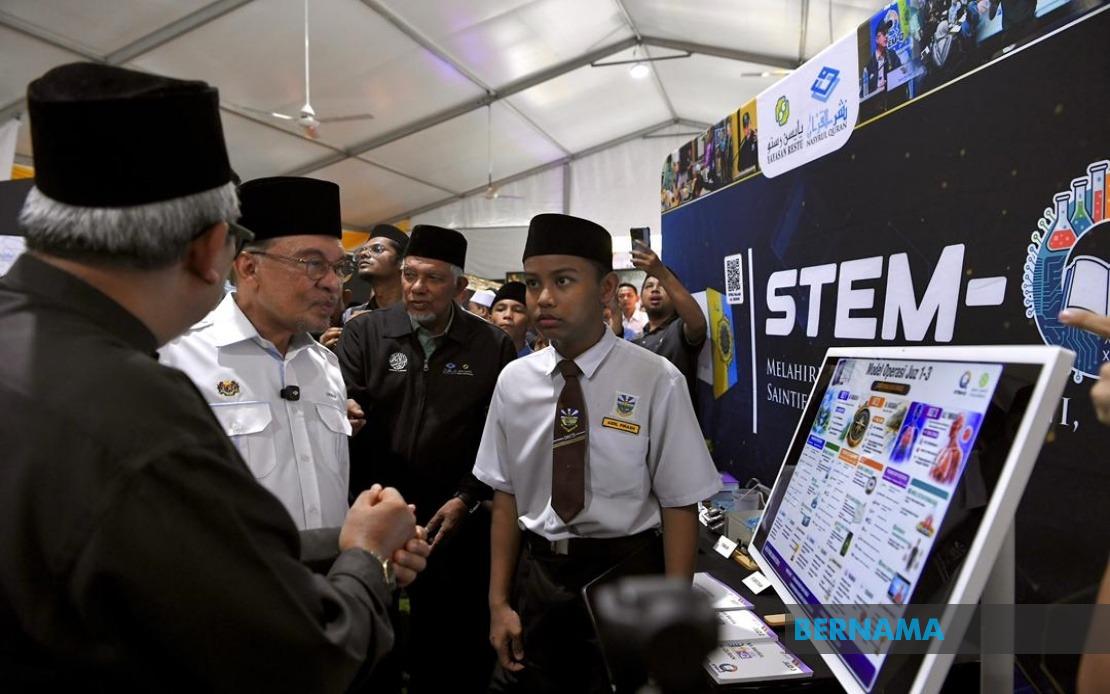
Prime Minister Datuk Seri Anwar Ibrahim has sanctioned an additional RM4.6 million in government funding this year to strengthen basic infrastructure at 27 Islamic educational institutions across Penang. The allocation represents a substantial increase from the RM2.11 million channelled to upgrade 11 similar facilities in the state during 2023, signalling a renewed commitment to bolstering religious educational infrastructure in Malaysia's second-largest state by population.
Anwar, who simultaneously serves as Finance Minister, outlined the scope of the funding during the National Tadabbur Perdana and Maidah Wanita MADANI Permatang Pauh programmes held at Masjid Muhajirin in Butterworth. The monies will be deployed across a range of critical maintenance and expansion projects, spanning wall and fence repairs, madrasah facilities, school buildings, newly constructed kindergarten structures, and tahfiz academy improvements. This diversified approach reflects the administration's recognition that Islamic education encompasses multiple institutional forms and age groups, requiring tailored infrastructure solutions.
The year-on-year doubling of funding allocation to Penang's Islamic institutions underscores a strategic policy shift within the current federal administration. Beyond mere numerical growth, the expansion demonstrates responsiveness to ground-level needs within the religious education sector, which has historically operated with constrained resources. For Malaysian policymakers, the pattern indicates that central government is gradually recalibrating budgetary priorities towards community-based religious facilities, a politically significant move given Islam's constitutional position and its importance to the Muslim-majority population.
Anwar emphasised that sustained government support for religious education constitutes a foundational pillar of national development. He reiterated the administration's intention to maintain focused attention on the institutional and material requirements of pesantren-style schools and broader Islamic educational ecosystems. This framing positions religious education not as a peripheral concern but as integral to Malaysia's social cohesion and moral foundation—a perspective that carries particular weight in a nation where Islam holds special constitutional status.
A notable dimension of Anwar's remarks centred on integrating technological innovation within Islamic pedagogy. He advocated for incorporating artificial intelligence and digital tools into Quranic and Islamic studies curricula, arguing that religious education must evolve alongside global technological trends. This modernising impulse reflects awareness that Malaysia's younger Muslim population expects educational institutions to harness contemporary tools, even within traditionally conservative spaces. However, Anwar tempered this technological enthusiasm with a stern moral caveat, insisting that AI deployment must remain anchored in ethical frameworks and Islamic values rather than pursuing capability development divorced from moral grounding.
The Prime Minister's caution regarding artificial intelligence in religious contexts carries broader significance for Southeast Asian discourse. As AI adoption accelerates across the region, Malaysia's largest Muslim-majority nation faces questions about how to integrate advanced technologies responsibly within faith-based education. Anwar's articulation—that technology demands values-based guidance rather than value-neutral implementation—provides philosophical clarity for educators and technology developers navigating this intersection. The statement implicitly warns against uncritical technological transplantation and instead advocates for deliberate, values-conscious adaptation.
Beyond infrastructure and technology, Anwar called upon Malaysian communities to leverage existing freedoms to organise and expand religious programming. He encouraged continuous scheduling of Quran study circles, tadabbur (reflection) sessions, and religious discourse forums as mechanisms for deepening public comprehension of Islamic teachings. This devolution of responsibility towards community-level action complements the government's infrastructure investments, creating a two-pronged strategy where state funding enables facility improvements while grassroots engagement generates intellectual and spiritual momentum.
The Penang allocation carries particular resonance within Malaysia's complex federalism. As a state historically governed by opposition coalitions, the federal government's targeted funding for religious institutions may carry subtle political implications, signalling willingness to support religious infrastructure regardless of state-level political alignment. For Penang's substantial Muslim population and the broader Malaysian electorate, such gestures communicate inclusivity and equitable resource distribution across partisan boundaries—a message amplified through direct ministerial announcements in the state itself.
The expansion of Islamic educational infrastructure funding also reflects Malaysia's positioning within regional and global contexts. As Southeast Asian nations grapple with questions of religious education quality and relevance, Malaysia's government investments signal that addressing these concerns requires sustained capital expenditure rather than rhetoric alone. The differentiation between hard infrastructure (buildings, walls, facilities) and soft capacity (curriculum development, teacher training) suggests evolving recognition that improving Islamic education requires multi-dimensional intervention strategies.
Looking forward, the trajectory evident in the Penang funding pattern—doubling allocations year-on-year—suggests potential for significant cumulative investment in Islamic educational institutions nationwide. If replicated across other states, this approach could materially transform the physical and pedagogical landscape of Islamic schools and pesantrens, particularly in less-developed areas where infrastructure deficits remain acute. However, the sustainability of such spending growth will depend on broader macroeconomic conditions and competing budgetary pressures within Malaysia's federal finances, areas where the Finance Minister's dual role positions Anwar as arbiter of competing national priorities.

