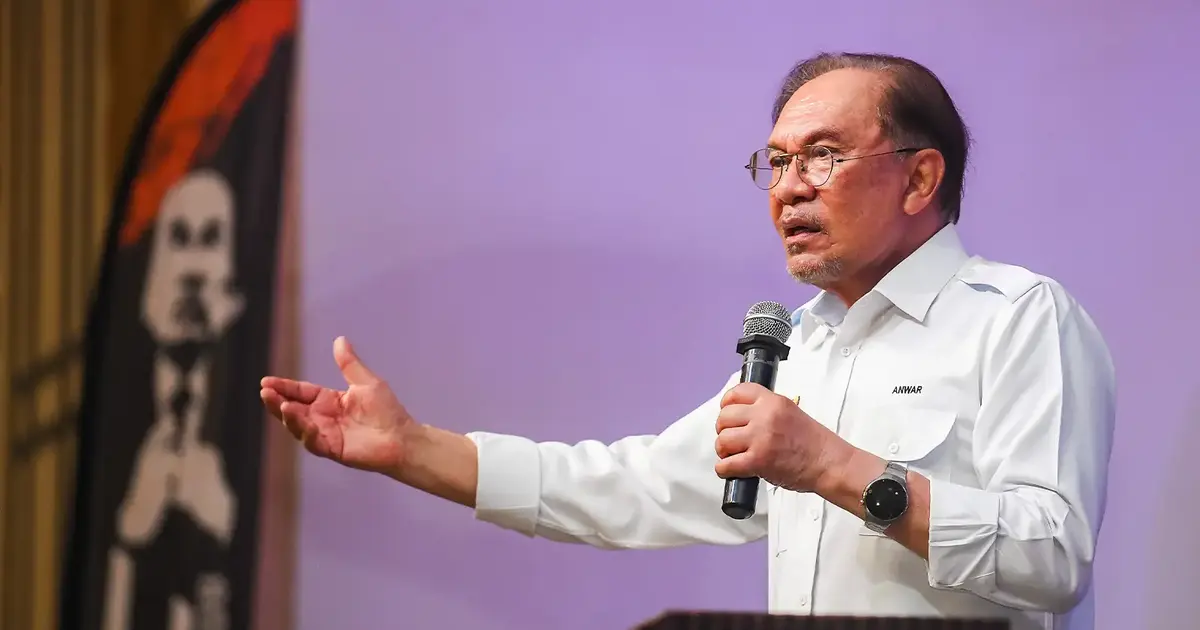
Prime Minister Anwar Ibrahim has levelled accusations at the 'Free Najib' movement, asserting that the group deliberately pulled Pakatan Harapan into an early election in Johor without any proper justification. The Pakatan Harapan chairman's remarks point to growing friction within the coalition over the timing and necessity of the state polls, revealing deeper political tensions that extend beyond the formal structures of government.
Anwar's statement challenges the narrative surrounding why Johor's election was advanced from its scheduled date. The Prime Minister's position suggests that Pakatan Harapan felt compelled to participate in polls that the coalition leadership deemed premature and strategically disadvantageous. This accusation underscores the reality that state elections in Malaysia frequently become entangled with extra-parliamentary movements and pressure groups that operate outside conventional democratic channels.
The 'Free Najib' movement has emerged as a significant force within Malaysian politics, particularly among constituencies sympathetic to former Prime Minister Najib Razak. The group's mobilisation capacity and apparent influence over electoral timing reveals how civil society movements, regardless of their stated objectives, can shape the political calendar and force the hand of major political coalitions. For Pakatan Harapan, which has positioned itself as a reformist alternative, the situation presents a dilemma: defending democratic participation while simultaneously arguing against what it views as politically motivated electoral engineering.
Johor's political significance cannot be understated in the Malaysian context. The state has historically served as a bellwether for national political trends, and its electoral outcome carries implications that ripple through the broader federation. The early calling of polls in this strategically important state carries ramifications for federal-level politics, coalition stability, and the balance of power between competing political blocs. Anwar's framing of events suggests that Pakatan Harapan viewed the early election as a setback rather than an opportunity, casting doubt on the coalition's confidence in its electoral standing at the time.
The involvement of movements centred on a single political figure—in this case, Najib—highlights a persistent feature of Malaysian politics: the personalisation of political struggle around prominent individuals. Rather than ideological competition or programmatic differentiation, much of Malaysian electoral politics orbits around key personalities and their sympathisers. The 'Free Najib' movement's apparent capacity to trigger state elections demonstrates how personality-driven politics can override institutional procedures and derail carefully laid political strategies.
Anwar's criticism also reflects frustration within Pakatan Harapan's leadership regarding their ability to control their own political calendar. The coalition, which came to power with significant popular support and a mandate for reform, finds itself responding to pressures from movements it considers destabilising. This dynamic reverses the expected hierarchy in which governing coalitions set the terms of political competition rather than reacting to external agitation.
For Malaysian voters, particularly those in Johor, this dispute illuminates the complex calculations underlying state elections. Rather than being opportunities for citizens to exercise democratic choice in isolation, state polls become pressure points through which various groups attempt to advance national political agendas. Johor's election thus becomes a theatre where federal-level conflicts play out, potentially obscuring state-specific issues and governance questions that should dominate local political discourse.
The timing controversy also raises questions about political maturity and democratic norms in Malaysia. While movements have every right to advocate for causes, including the release or exoneration of particular figures, using electoral pressure to force the hand of governing coalitions raises concerns about whether majoritarian will is being properly respected. Anwar's position, while self-serving, points to a genuine tension between allowing civil society voice and maintaining institutional integrity in the electoral process.
The 'Free Najib' movement's apparent success in influencing Johor's electoral calendar may embolden similar efforts by other groups seeking to reshape Malaysia's political landscape through extra-parliamentary pressure. If movements aligned with particular politicians can successfully force early elections, this could establish a precedent that destabilises state governments and makes long-term political planning increasingly difficult for any coalition holding office.
For observers in Southeast Asia watching Malaysian political developments, this episode underscores how far-reaching the consequences of a single high-profile political case can be. Najib's legal situation continues to dominate Malaysian politics even years after his government's conclusion, demonstrating how personalised justice and legal matters can become entangled with broader struggles for political power. The intersection of law, politics, and public sympathy remains a defining characteristic of Malaysian governance.
Moving forward, Anwar's comments signal that Pakatan Harapan may attempt to manage similar pressures more deliberately, whether through legislative changes to electoral procedures or through building stronger political consensus around the timing of state polls. However, the reality remains that movements outside formal party structures have proven capable of disrupting political calculations, suggesting that no coalition can entirely insulate itself from extra-parliamentary forces in Malaysia's dynamic political environment.

