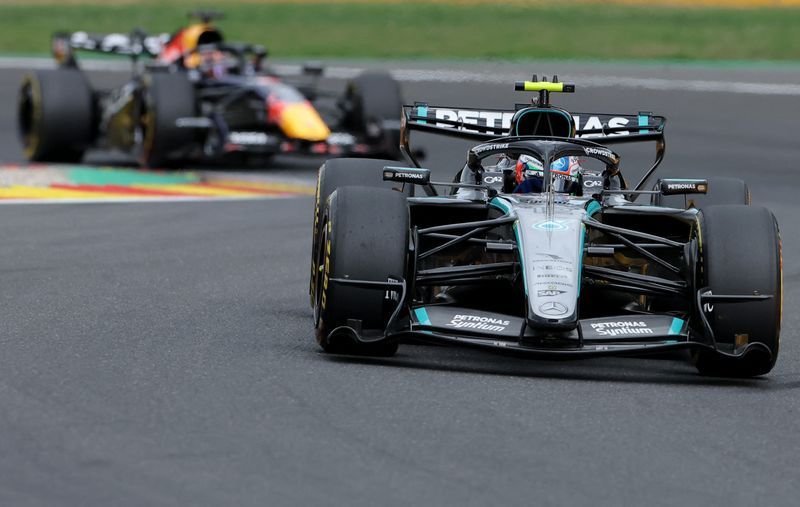
Kimi Antonelli claimed his sixth victory of the season at Spa-Francorchamps on Sunday, securing a dominant performance that has fundamentally shifted the dynamics of the 2024 Formula One championship race. The 19-year-old Italian Mercedes driver extended his points tally to 45 ahead of Ferrari's Lewis Hamilton, effectively seizing control of the title battle with his consistent run of strong results. For Mercedes, the victory represents a crucial consolidation of their technical advantage, as the team continues to demonstrate superior pace across the majority of circuits on the calendar.
The race proved catastrophic for George Russell, whose pre-race status as Antonelli's closest challenger evaporated dramatically in the opening moments of the 44-lap contest. Russell, the Briton who had entered the weekend as the obvious threat to his teammate's supremacy, found himself spun off the racing surface and deposited into the gravel trap after tangling with Hamilton on the first lap. The collision occurred as both drivers jostled for position following a difficult start for the Ferrari contingent, but Russell's aggressive manoeuvre proved costly when contact with the championship leader sent him out of contention immediately. The incident served as a stark reminder of how quickly a title challenge can unravel through a single moment of misjudgement or misfortune on the opening lap.
Hamilton's involvement in the clash with Russell added another layer of complexity to the day's unfolding narrative. The Ferrari driver finished fourth despite accepting a five-second penalty for the collision, but his day was subsequently overshadowed by an ongoing investigation into an unsafe release from his pit crew. Should the stewards' deliberations result in additional penalties, Hamilton could find himself demoted to fifth position, which would further extend Antonelli's commanding advantage in the championship standings. This development underscores how modern Formula One races are frequently decided not just on track performance, but through the cumulative effect of penalties, safety car deployments, and pit crew efficiency.
Charles Leclerc secured second place for Ferrari, trailing Antonelli by 1.952 seconds in a respectable but ultimately unsuccessful bid to challenge the leader. Leclerc's performance was bolstered by astute tactical pit strategy, which capitalised on a virtual safety car period to vault him temporarily into the lead before Antonelli's superior pace ultimately prevailed. The Monegasque driver's second-place finish maintains Ferrari's relevance in the championship hunt, yet the growing gap between the Scuderia and Mercedes suggests the Italian team may struggle to mount a sustained challenge in the remaining rounds. Leclerc's effort represented a silver lining for Ferrari on a day when their championship ambitions took a step backward.
Max Verstappen's third-place finish added another milestone to Red Bull's storied Formula One history, as the result represented the team's 300th podium finish across all seasons of competition. The achievement demonstrates the Austrian team's longevity and consistent competitiveness since their entry into the sport, though the current season has seen them fall behind both Mercedes and Ferrari in the constructors' championship battle. Verstappen's presence on the podium, while respectable, masks the reality that Red Bull has failed to recapture the dominant form that characterised previous seasons, with their car development trajectory appearing to lag behind the front-runners at present.
Antonelli's pole position at Spa-Francorchamps extended Mercedes' remarkable run of securing the first grid slot at every qualifying session this season, a statistic that starkly illustrates the team's technical superiority. The young Italian has now won six races from the opening ten rounds, a strike rate that places him firmly on course for a potentially dominant championship campaign. His previous blank in two of the last three races—a rare blemish on his otherwise flawless record—made Sunday's victory particularly significant, as he demonstrated the mental resilience required to return immediately to winning form. Antonelli's post-race comments reflected a pragmatic understanding of motorsport's unpredictability, acknowledging the fortunate circumstances that contributed to his victory whilst emphasising the importance of capitalising on such opportunities.
The remainder of the finishing order showcased the competitive depth of the current grid structure, though with notable fluctuations in team performance. Oscar Piastri guided his McLaren to fifth position, extending his team's points tally despite being unable to replicate the race-winning pace demonstrated by their Mercedes competitors. Lando Norris, the reigning world champion, salvaged seventh place for McLaren despite serving a ten-place grid penalty that had relegated him to 13th on the starting grid, a penalty incurred due to gearbox changes during the preceding week. This recovery drive underscores Norris's quality as a race driver, yet also highlights McLaren's difficulty in matching Mercedes and Ferrari in terms of outright performance.
The lesser-known protagonists further down the order provided their own narratives of success and survival. Gabriel Bortoleto's eighth-place finish offered Audi meaningful points toward their constructors' championship ambitions, as the German manufacturer seeks to establish itself as a competitive force in Formula One. Arvid Lindblad claimed ninth position for Racing Bulls, whilst Argentine driver Franco Colapinto rounded out the points with a tenth-place finish for Alpine, the Renault-owned team that continues to navigate the complexities of midfield competition. These results illustrated the competitive nature of the grid beyond the headline battles between the sport's established giants.
The implications of Spa-Francorchamps extend well beyond the immediate championship mathematics. Mercedes' comprehensive dominance suggests they have resolved the structural and aerodynamic challenges that afflicted the team during previous seasons, positioning them favourably for a championship assault. Antonelli's emergence as a championship contender at such a young age raises questions about the future of the sport and the generation of drivers who will define Formula One for the next decade. For Malaysian and Southeast Asian motorsport enthusiasts, the success of the European-based teams highlights the continued dominance of established racing nations, though the sport's global expansion efforts continue to seek new markets for expansion and development.
Looking ahead, the championship battle appears increasingly to favour Antonelli and Mercedes, with the 45-point lead over Hamilton suggesting that only a significant reversal in competitive fortunes could permit either Hamilton or the other rivals to mount a credible challenge. The remaining races will test whether Mercedes can maintain their technical advantage and whether Antonelli possesses the consistency required to translate his current dominance into a maiden world championship. For teams like Ferrari, Red Bull, and McLaren, the challenge now becomes one of rapid development and innovation to close the gap before the season concludes.

