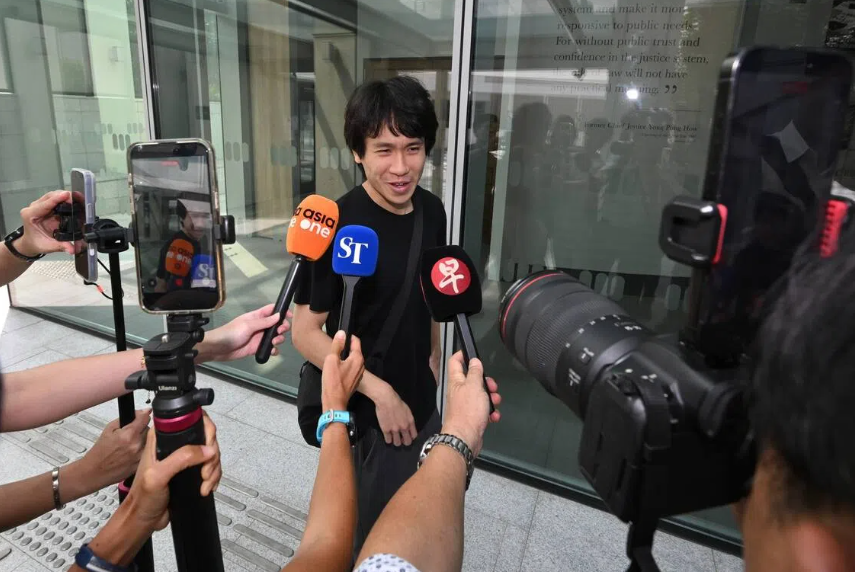
Former child actor Amos Yee appeared in Singapore's District Court on August 26 to face four fresh charges, expanding his legal troubles to a total of seven counts that span multiple serious offences from inciting racial tension to advocating child exploitation. The 27-year-old's latest courtroom appearance marks an escalating legal drama that has drawn attention across Southeast Asia, where concerns about online speech, national security, and child protection intersect with growing debates about digital freedoms.
The new charges centre on two primary concerns that have occupied Singapore's law enforcement authorities. First, Yee stands accused of knowingly attempting to promote racial disharmony through blog posts published on April 7 and April 11, in which he allegedly claimed that Malays and Indians faced systematic discrimination at the hands of Singapore's Chinese majority and subsequently called upon these communities to mount organised protests against the Government. This allegation reflects Singapore's longstanding sensitivity to speech that could fracture its delicate multi-ethnic social fabric, a vulnerability that has shaped the city-state's strict regulations on racial and religious content since independence.
Compounding these allegations, Yee uploaded a video on May 27 in which he purportedly made further claims regarding the supposed discrimination faced by the Malay and Muslim communities in Singapore at the hands of ethnic Chinese residents. The cumulative effect of these posts and videos appears to have triggered the intervention of Singapore's law enforcement apparatus, which received multiple complaints between April and July 2026 regarding Yee's online activities. For those familiar with Singapore's approach to maintaining social cohesion, the emphasis on these specific charges underscores how seriously authorities treat speech that touches upon ethnicity and communal relations.
Yet the charges extend far beyond matters of racial harmony into far more disturbing territory. Two additional counts under the Protection from Harassment Act relate to videos Yee created in 2021 in which he allegedly advocated for free speech protections for paedophiles and contended that infants and children possessed the capacity to consent to sexual relations. These allegations have provoked particular revulsion, as they strike at fundamental protections for society's most vulnerable members. The charges further allege that Yee called for the abolishment of laws prohibiting the creation and storage of child abuse material, a position that places him at odds with virtually every jurisdiction's child protection framework.
The offensive material appears to have extended beyond videos into written form as well. Yee allegedly published a post on June 30 that reiterated the statements he had made regarding paedophilia and the consent of children, suggesting a pattern of deliberate promotion rather than isolated commentary. The persistence of this messaging across multiple dates and formats points to what authorities view as a calculated effort to normalise perspectives that society has roundly rejected. For Malaysian readers concerned about the broader Southeast Asian information ecosystem, the case demonstrates how online platforms can amplify harmful ideologies that threaten regional values around child protection and social stability.
When Yee returned to court on August 26, the judge imposed a bail of S$15,000 with strict conditions that reveal the seriousness with which the judicial system is treating his conduct. Notably, Yee has been prohibited from posting anything online relating to his views on paedophilia or any content that might incite negative feelings between racial communities. These restrictions effectively silence significant swathes of his potential online expression, a measure that speaks both to judicial concerns about his future behaviour and the capacity of Singapore's legal system to regulate digital speech. He will return for a pre-trial conference on September 18.
The conviction thresholds for these offences carry substantial penalties that underscore the gravity of the allegations. Should Yee be found guilty of knowingly attempting to promote racial disharmony, he faces potential imprisonment of up to three years alongside possible fines. The harassment charges carry maximum fines of S$5,000 per count, penalties that mount quickly given the number of separate videos and posts involved. These sentencing frameworks reflect Singapore's determination to deter individuals from using digital platforms to corrode social cohesion or endanger children.
Beyond the racial and child protection charges, Yee confronts three separate charges under the Enlistment Act, offences that add a distinctly Singaporean dimension to his legal predicament. He allegedly failed to attend mandatory pre-enlistment medical screening for national service and departed Singapore on multiple occasions without obtaining the required exit permits. Specifically, authorities allege that Yee left the country from December 13, 2015, to April 19, 2016, and again from December 15, 2016, to March 19, 2026, each time without proper authorisation. Additionally, he purportedly failed to report for his national service medical examination between April 26, 2016, and March 19, 2026.
These Enlistment Act violations carry their own substantial penalties, with offenders facing fines up to S$10,000, imprisonment for up to three years, or both. For Malaysian observers, the Enlistment Act charges highlight a distinction in Singapore's legal framework that has no direct parallel in Malaysia, reflecting the mandatory national service system that defines citizenship obligations in the city-state. The combination of fleeing the country and dodging medical screening suggests a pattern of deliberate evasion rather than mere oversight, a distinction that likely influences how prosecutors view his overall conduct.
To suppress Yee's online presence, authorities have leveraged Singapore's evolving digital governance framework. The Singapore Police Force issued a disabling direction under the Online Criminal Harms Act on August 18, which prompted the social media platform X to remove his video content. Yee has also received stop communication directions requiring him to delete the offending posts from his blog. These administrative interventions represent Singapore's growing toolkit for managing harmful online content and demonstrate the coordination between law enforcement and major digital platforms in restricting speech deemed dangerous to public order.
The Amos Yee case carries implications that extend beyond Singapore's borders into the broader Southeast Asian discourse around online speech, child protection, and national security. For Malaysia and other regional states grappling with similar tensions between free expression and social stability, Yee's prosecution offers a template of how authorities can mobilise multiple legal statutes to address conduct spanning racial incitement, child exploitation advocacy, and enlistment evasion. The case also raises enduring questions about the relationship between digital platforms and national governments, questions that will continue reverberating through Southeast Asian policy debates as societies attempt to balance openness with protection against harm.
Yee's journey from child actor to defendant facing multiple serious charges represents a dramatic fall that has captivated observers across the region. As he awaits his pre-trial conference in mid-September, the case remains emblematic of broader struggles that Singapore and its neighbours face in governing digital spaces where speech can reach millions instantaneously and where protection of vulnerable populations must somehow coexist with preserving space for legitimate discourse.

