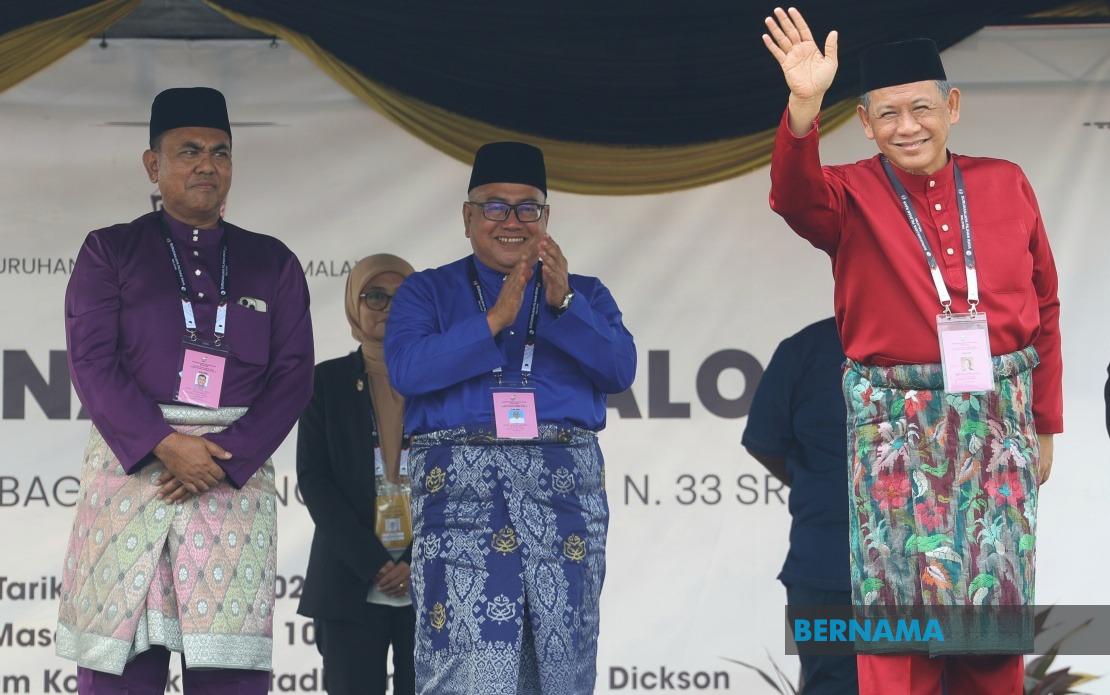
Negeri Sembilan's political landscape has grown considerably more fragmented ahead of the state election on August 1, with Menteri Besar Datuk Seri Aminuddin Harun of Pakatan Harapan confronting an unexpectedly competitive three-cornered battle in the Linggi constituency. The Pakatan Harapan stalwart must simultaneously fend off challenges from Barisan Nasional incumbent Datuk Mohd Faizal Ramli, who is seeking to reclaim the seat for the traditional ruling coalition, and Bersatu candidate Datuk Zamri Md Said, signalling how effectively the Mahathir-led party has fractured opposition unity at the state level. The nomination process concluded on July 18 at the Port Dickson District Administration Complex, cementing the battle lines for what observers view as one of the most closely watched contests in this electoral cycle.
The emergence of a three-way fight in Linggi reflects broader dynamics unfolding across Negeri Sembilan, where Bersatu has carved out space as a meaningful third force, challenging both the Pakatan Harapan-led government and the Barisan Nasional opposition. This fragmentation potentially benefits the incumbent if opposition votes split effectively, yet it also exposes vulnerabilities within the government coalition should either challenger consolidate anti-establishment sentiment. For Malaysian political analysts, the Linggi contest exemplifies how federal political realignments—particularly the rise of Bersatu as an autonomous player—are translating into genuine electoral consequences at the state and local level, no longer merely symbolic but capable of determining seat outcomes.
Aminuddin's position as Menteri Besar gives him institutional advantages, including the machinery of state government and visibility in the Linggi constituency. However, his requirement to contest rather than run unopposed underscores that even senior Pakatan figures cannot take their electoral strongholds for granted in the current political climate. The challenge from Faizal, representing Barisan Nasional, carries particular weight because the traditional coalition retains deep organizational networks and voter loyalty in rural and semi-urban areas where Linggi is rooted. Simultaneously, Zamri's Bersatu candidacy suggests that local sentiment may favour alternatives to both the incumbent government and the conventional opposition, a sentiment that has gained traction nationwide since 2020.
Beyond the headline Linggi race, other constituencies present similarly competitive scenarios. In Sri Tanjung, Pakatan Harapan incumbent Dr G. Rajassekaran confronts opposition from both Barisan Nasional's A. Achutan and Bersatu newcomer Leevineshwaraan Murugan, indicating that the three-way pattern is not isolated but reflects a statewide trend. The Lukut seat sees Pakatan incumbent Choo Ken Hwa battling Perikatan Nasional's Sathes Kumar Nilameham and independent candidate Teo Seng Lee, adding a wild card element through independent candidacy. Meanwhile, Bagan Pinang showcases a different dynamic, where PAS incumbent Abd Fatah Zakaria defends his seat against Pakatan's Nasir Raman and Bersatu's Sheikh Junaidy Jamaludin, revealing tensions within religious constituencies and Islamist-oriented politics.
The Chuah seat remains the sole exception, featuring a straight contest between Pakatan incumbent Yew Boon Lye and Barisan Nasional's Pau Jeou Ching, suggesting that not all constituencies have experienced the same degree of fragmentation. This variance across seats implies that local conditions, candidate profiles, and community-level political dynamics continue to exert considerable influence over electoral outcomes, preventing any uniform swing. The Election Commission's designation of August 1 as polling day, coupled with early voting scheduled for July 28, reflects standard electoral procedures, yet the compressed campaign timeline may disadvantage parties struggling to establish ground presence in less familiar constituencies.
Negeri Sembilan's electorate comprises 889,490 eligible voters, substantially concentrated among the 867,151 ordinary voters who form the backbone of state electoral contests. The inclusion of 16,884 military personnel and their spouses, plus 5,455 police personnel and their spouses, introduces a demographic element traditionally viewed as inclined toward establishment-aligned parties, though contemporary voting patterns have demonstrated greater unpredictability. The size of the military and police contingents, while numerically modest relative to the ordinary voter base, can prove decisive in closely contested seats where margins are narrow, as appears likely across several constituencies.
For Malaysian political observers, the Negeri Sembilan election serves as an early indicator of whether the three-way competition pattern evident at federal level has meaningfully taken root at state governance level. The performance of Bersatu specifically—whether it translates organization and candidate quality into actual seat wins or whether it merely fragments opposition without capturing power—will signal the party's viability as a genuine political force beyond its parliamentary foothold. Should Bersatu perform strongly, particularly in threatening sitting Pakatan members like Aminuddin, it would validate the notion that Malaysian electoral politics has fundamentally shifted toward a three-bloc structure rather than the bipolar Pakatan-Barisan framework of recent years.
The incumbent Pakatan government faces complex incentives. Aminuddin's need to contest competitively in Linggi, rather than enjoying a walkover, represents a tangible erosion of what might have been assumed as secure political territory. If the Menteri Besar loses Linggi, it would constitute a significant symbolic blow to Pakatan's state leadership, regardless of overall election outcomes. Conversely, if Aminuddin and other Pakatan incumbents successfully retain seats despite three-way contests, it would suggest the base remains sufficiently loyal and organized to withstand both traditional opposition and Bersatu competition. The August 1 vote will accordingly carry ramifications well beyond Negeri Sembilan, influencing how national political forces calibrate their strategies as Malaysia approaches future electoral contests.

