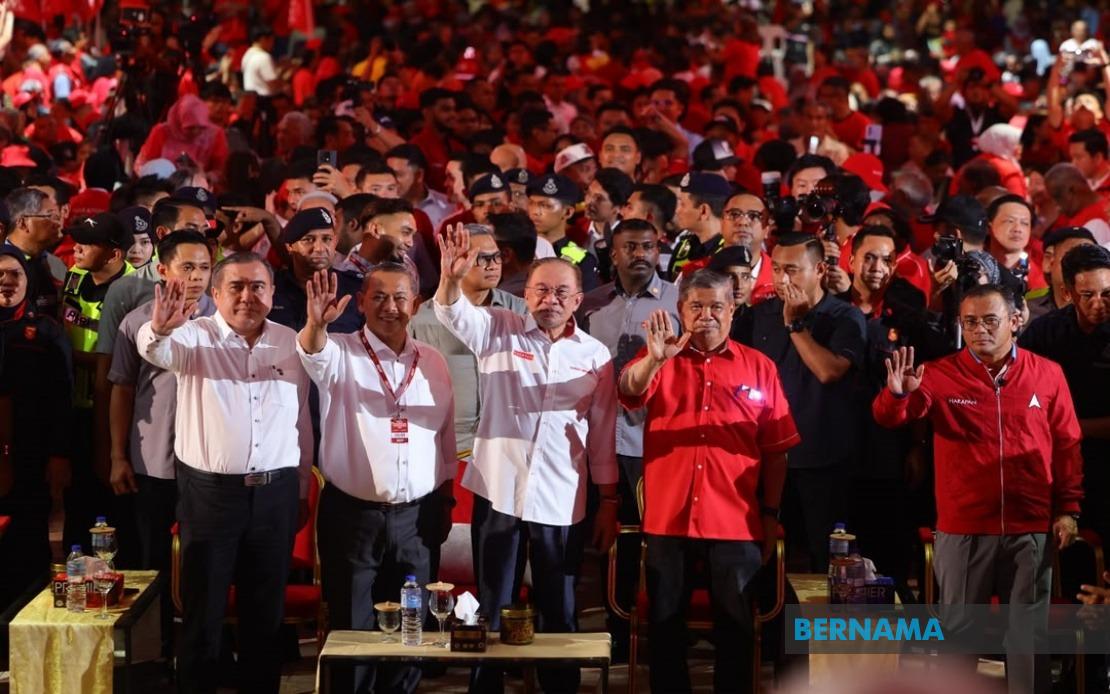
Negeri Sembilan's Pakatan Harapan leadership has formally launched its campaign for the upcoming state election, with coalition chairman Datuk Seri Aminuddin Harun making an appeal to voters centred on the need for political continuity and macroeconomic stability. Speaking at the candidate announcement ceremony in Kuala Pilah, Aminuddin presented the coalition's argument that only a stable state government can maintain the confidence of investors and sustain the welfare initiatives and development programmes that have been implemented since PH took power in 2018.
The case for continuity rests significantly on Negeri Sembilan's recent economic performance, which Aminuddin highlighted as evidence of successful administration under the PH government. The state has attracted RM19.1 billion in investments during his tenure, a figure he deployed to demonstrate that private capital flows reflect genuine investor confidence in the coalition's governance. This metric carries particular weight in Malaysia's competitive interstate landscape, where economic performance directly influences the ability of state governments to fund development projects and expand employment opportunities. For Malaysian readers accustomed to evaluating political promises against tangible results, the investment figure provides a concrete benchmark against which voters can assess claims of effective stewardship.
Beyond raw investment numbers, Aminuddin drew attention to improvements in the state's zakat collection system, which has grown from approximately RM80 million to nearly RM200 million under his administration. This expansion of Islamic alms collection reflects both increased economic activity and improved administrative efficiency in channelling resources to vulnerable populations. The near-tripling of zakat revenues demonstrates the coalition's argument that stable governance creates the conditions for both economic growth and enhanced social support, allowing the state to assist those in need more comprehensively. For many Malaysians, particularly those dependent on government welfare assistance, such figures translate directly into improved access to aid and support services.
The coalition's platform explicitly emphasises continuity of existing welfare programmes, including education assistance schemes, the provision of free tablets to students, and expanded cooperation with the federal government to accelerate development projects. These initiatives appeal to middle and lower-income households for whom such programmes provide material benefit, and their continuation depends on PH retaining control of the state apparatus. Aminuddin framed the election as a choice between maintaining these established programmes or risking disruption through a change in government, a messaging strategy designed to appeal to voters who have experienced tangible benefits from coalition rule.
The ceremonial presence of high-ranking coalition figures, including DAP secretary-general Anthony Loke, Amanah president Datuk Seri Mohamad Sabu, and federal-level officials, underscored the importance the national PH leadership attaches to the Negeri Sembilan contest. This concentration of senior party figures at a state-level campaign launch signals that the coalition views the election as strategically consequential, both for control of the state government and for PH's broader political momentum across Malaysia.
Loke's characterisation of the Negeri Sembilan election as PH's "second round" following the Johor state election carries significant psychological and strategic weight. The coalition's failure to retain Johor—traditionally a PH stronghold—represented a major setback to the coalition's national standing and created momentum for opposition forces. Loke explicitly acknowledged this defeat, stating that PH "did not succeed and the result was not in our favour," but framed the Negeri Sembilan contest as an opportunity to rebuild coalition momentum and demonstrate resilience. This messaging serves two audiences: supporters who might be demoralised by the Johor loss, and undecided voters who may view the coalition as either recovering or in irreversible decline depending on the Negeri Sembilan outcome.
The DAP leader's emphasis on conducting the campaign with proper decorum and respect for Negeri Sembilan's royal institutions reflects awareness that PH's coalition includes the secular-leaning DAP, which has historically faced criticism from opposition parties and conservative constituencies regarding its alleged stance toward Islamic institutions and Malay-Muslim concerns. By directing party members to maintain exemplary conduct and explicitly pledging loyalty to the Yang Dipertuan Besar of Negeri Sembilan and the Undang Yang Empat, Loke attempted to preempt attacks characterising PH as disrespectful toward traditional institutions. This defensive posture indicates that the coalition recognises vulnerabilities on cultural and religious grounds that the opposition may attempt to exploit.
Aminuddin's appeal for voters to grant PH a fresh mandate operates within a context of broader Malaysian political volatility, where state elections have become increasingly unpredictable. The coalition's loss of Johor demonstrated that historical voting patterns cannot be assumed, and that voter behaviour is shifting in ways that previous electoral models may not fully capture. For Negeri Sembilan, this unpredictability means that despite Aminuddin's enumeration of achievements and investment figures, the election outcome remains genuinely uncertain. Voters may prioritise issues not addressed in the coalition's campaign messaging, or may respond to local grievances and personalities in ways that national-level talking points cannot overcome.
The emphasis on coordination between state and federal governments reflects an understanding that development projects and their funding mechanisms depend on cooperation across these administrative levels. Aminuddin's suggestion that closer state-federal alignment can accelerate implementation acknowledges that even a state government controlled by the national ruling coalition faces bureaucratic and fiscal constraints that require careful navigation. For voters seeking tangible improvements in infrastructure, services, and economic opportunity, the coalition's message essentially argues that PH can deliver more effectively than an opposition state government would, given the current composition of federal power.
The mobilisation strategy outlined by Loke—deploying the entire election machinery as a unified team across component parties—addresses a known vulnerability for PH in Negeri Sembilan: maintaining cohesion among ideologically and organisationally distinct member parties. The emphasis on party unity serves to prevent fragmentation and competing campaign messages that could confuse voters or expose divisions that opposition parties might exploit. Aminuddin's confirmation as the coalition's Menteri Besar candidate and "commander" for the election establishes clear leadership and decision-making authority, reducing uncertainty about the coalition's direction should PH succeed.
As the campaign unfolds, the fundamental question voters in Negeri Sembilan will confront is whether the economic and welfare gains Aminuddin catalogued outweigh whatever grievances or alternative visions opposition parties present. The coalition's case rests substantially on quantifiable achievements and continuity, a messaging strategy that assumes voters prioritise material outcomes and stability. However, elections often turn on factors beyond such rational calculation—incumbent fatigue, local personalities, specific policy controversies, or broader narratives about competence and trustworthiness. The Negeri Sembilan result will provide important insight into whether PH can stabilise its position following the Johor setback, or whether the coalition faces a broader erosion of support that extends beyond individual state contests.

