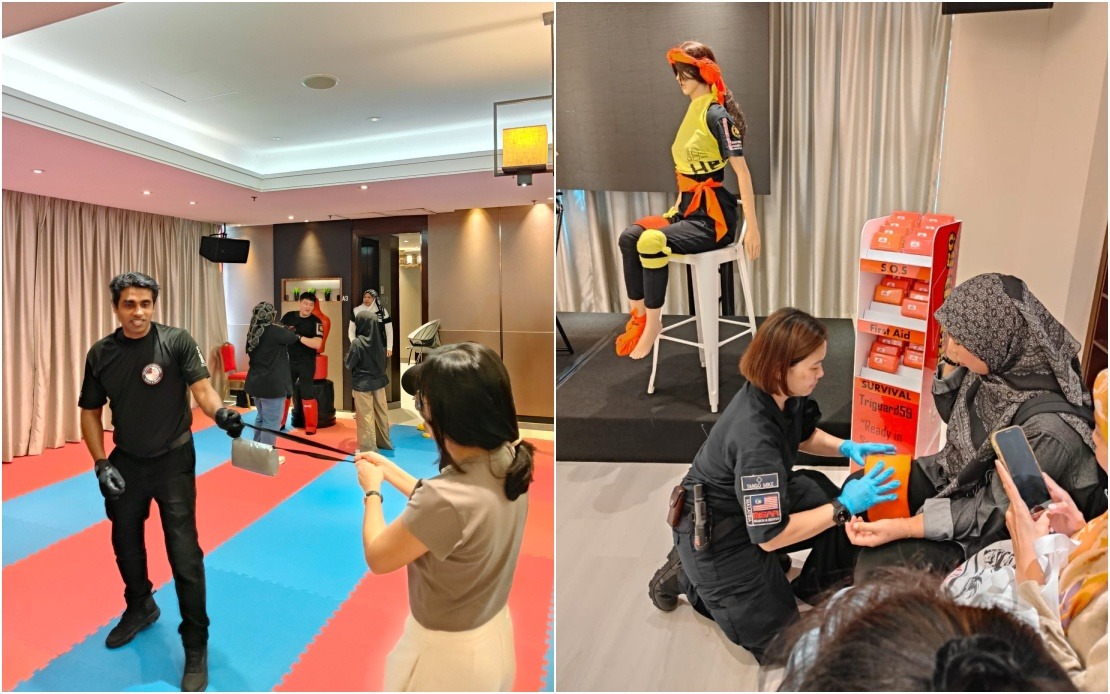
Allianz Malaysia and the Kelab Marshal Keselamatan Jalan Raya Kuala Lumpur (RSMC) have deepened their partnership by launching the ninth iteration of a targeted initiative designed to fortify women's awareness of street-based criminal threats and safety protocols. The latest programme convened 200 female participants at the Wisma Huazong YTL Hall in Seri Kembangan, Selangor, where attendees received comprehensive instruction in personal protection strategies, risk mitigation, and crisis management techniques. This longstanding collaboration between the insurance provider's corporate social responsibility division and the road safety advocacy body reflects a shared commitment to reducing vulnerability among a demographic consistently exposed to urban crime vectors.
The campaign's curriculum was deliberately structured to encompass the full spectrum of threats facing women in metropolitan and suburban environments. Educational sessions addressed home intrusion risks, the growing danger of handbag theft, elaborate road-based scams that target unsuspecting motorists, stalking behaviours, vehicle hijacking scenarios, and appropriate reactions to traffic accidents. Complementing these didactic elements were practical demonstrations that allowed participants to visualise threats and rehearse protective responses. The inclusive age threshold of 16 years and above reflected the organisers' recognition that safety vulnerabilities span adolescence through adulthood, with age-differentiated risk profiles requiring tailored guidance.
A notable evolution in this year's iteration was the introduction of structured dialogue sessions permitting direct exchange between participants and RSMC specialists. This interactive format moved beyond conventional awareness lecturing to create spaces where attendees could articulate personal safety anxieties and receive contextualised solutions from practitioners with operational experience in road safety and crime prevention. The shift acknowledges that generic safety messaging often fails to resonate without opportunity for clarifying questions and discussion of locally-relevant scenarios. By fostering this two-way engagement, the programme transformed from knowledge transmission into collaborative problem-solving.
Allianz Malaysia's Chief Executive Officer Sean Wang framed the initiative's success through a multiplication lens, emphasising that the 200 direct participants functioned as vectors for knowledge dissemination within their family units and residential communities. His assertion that impact transcends headcount metrics reflects a sophisticated understanding of social influence networks. When equipped with practical safety protocols, trained individuals become informal educators within their circles, multiplying the campaign's reach exponentially. This cascading effect particularly benefits lower-income neighbourhoods and migrant communities that may lack access to formal safety instruction through government channels or private training providers.
The interest demonstrated by community leaders in replicating the programme across their respective jurisdictions signals organic demand for structured safety education outside traditional institutional frameworks. This grassroots enthusiasm suggests that women perceive street crime and traffic-related dangers as sufficiently acute that they willingly invest time in targeted training. The enthusiasm also indicates that existing public safety communication channels—whether through police departments or municipal authorities—may be perceived as inadequate or inaccessible. The private sector's collaborative role in filling this perceived gap raises questions about whether government agencies should expand their own community safety programming to reduce reliance on corporate initiatives.
RSMC Founder and President Captain K. Balasupramaniam's framing of street crime awareness as an empowerment mechanism rather than a fear-amplification exercise reflects contemporary best practices in safety education. Rather than cultivating paranoia or hypervigilance, the programme aims to equip participants with cognitive frameworks for assessing threats and behavioural tools for navigating uncertainty with confidence. This psychological reorientation—from passive victimhood to active agency—carries broader implications for community resilience. Women who complete such training often report increased sense of control over their environments and improved mental wellbeing alongside tangible safety improvements.
The emphasis on converting awareness into action represents a critical distinction in public health and safety domains. Numerous campaigns achieve awareness objectives without translating knowledge into behavioural modification. The RSMC and Allianz approach deliberately constructed feedback mechanisms and follow-up engagement pathways intended to cement learning into habitual practice. Participants departing with discrete, actionable takeaways—specific self-defence techniques, memorised emergency numbers, recognised warning signs—are substantially more likely to apply training when encountering actual threat scenarios than those receiving abstract safety principles.
For Malaysian women navigating urban spaces, the programme addresses demonstrable crime concerns. Handbag snatching from motorcycles remains endemic in Kuala Lumpur and Klang Valley suburbs, while vehicular crime including carjacking and opportunistic vehicle break-ins persist despite police enforcement efforts. Road scams targeting solo female drivers have proliferated with increasing sophistication. By providing contextualised training on these specific threats, the programme achieves utility beyond theoretical safety frameworks. Participants can immediately identify vulnerability patterns in their daily routines and implement protective modifications.
The corporate-NGO partnership model exemplified by Allianz Malaysia and RSMC offers potential scalability across Southeast Asia's expanding urban centres. As regional cities experience rapid demographic growth and increasingly complex crime ecologies, formal safety education infrastructure has lagged institutional capacity. Private sector organisations with established community trust and training infrastructure can leverage corporate social responsibility mandates to supplement governmental capacity. The collaboration demonstrates that insurance companies—with inherent interest in reducing claims through loss prevention—possess natural incentives to invest in safety programming alongside philanthropic motivations.
Looking forward, the sustained engagement signals commitment beyond performative corporate responsibility. Nine iterations represent substantive institutional investment rather than opportunistic cause-marketing. The willingness to incorporate participant feedback and evolve programme design suggests adaptive learning cultures within both organisations. Should this partnership maintain momentum, documenting measurable safety outcomes—crime incident reductions among participants, behavioural adoption rates, secondary dissemination patterns—would strengthen evidence for expanding the model to other Malaysian states and Southeast Asian jurisdictions where women face comparable urban safety challenges.

