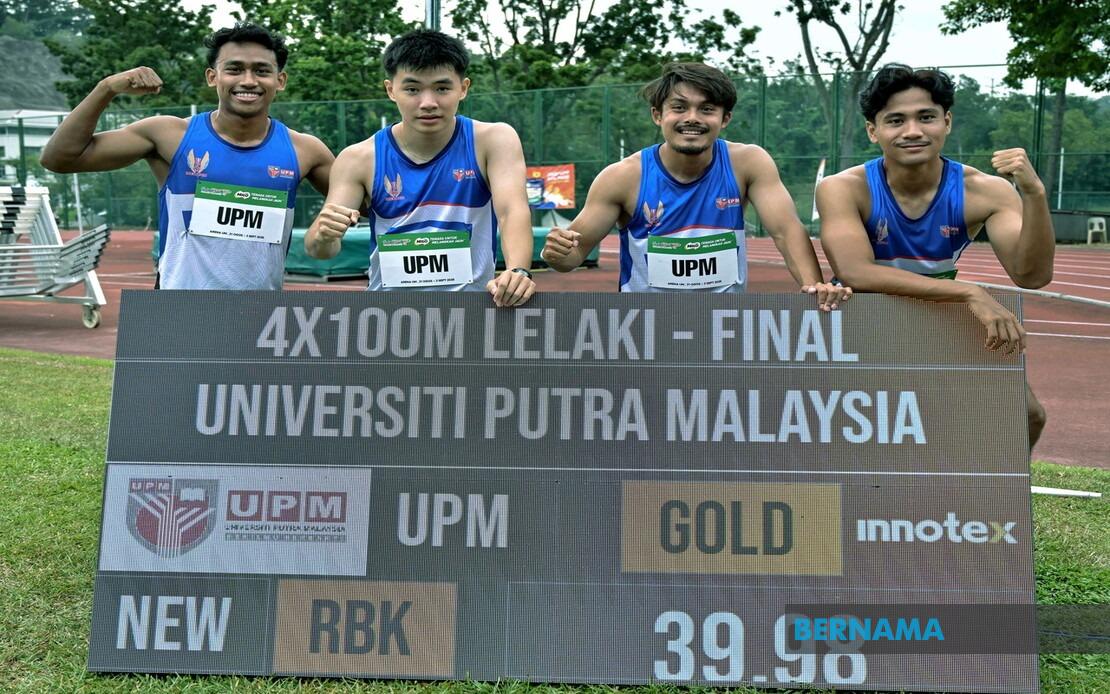
Universiti Putra Malaysia produced a scintillating relay performance at the 2026 Higher Education Institutions Sports Games (SUKIPT) when their men's 4x100-meter quartet shattered the longstanding games record with a time of 39.98 seconds to capture the gold medal on August 31. The achievement carries profound significance beyond the metal itself, signalling a successful generational transition in Malaysian university athletics as the institution methodically hands the baton from established competitors to an emerging cadre of sprinters hungry to make their own mark on the collegiate circuit.
The previous games record had stood at 40.98 seconds, making UPM's breakthrough a decisive statement that the university's athletics programme remains robust and competitive despite the inevitable cycle of retirements. The new benchmark demonstrates that investments in coaching, athlete development and competitive exposure have yielded tangible results, and suggests that UPM's dominance in relay events need not fade as veteran runners step back from the competitive stage. This performance arrives as an encouraging signal to Malaysian higher education institutions that carefully cultivated talent pipelines can sustain excellence across multiple Olympic cycles.
Aliff Iman Mohd Fahimi, the senior runner orchestrating the team's success, approached this championship with particular poignancy as it marked his final appearance at SUKIPT. Reflecting on the outcome at the UM Arena in Universiti Malaya, he characterised the accomplishment as emblematic of renewal rather than merely a valedictory triumph. His teammates—all competing at SUKIPT for the first time—embodied the future direction of UPM's sprinting programme, with Aliff Iman deliberately positioning himself as a custodian transmitting institutional knowledge and competitive standards to the next generation.
The responsibility of honouring UPM's relay legacy weighed considerably on Aliff Iman's shoulders. Previous luminaries of the programme, including Jonathan Nyepa and Zulfiqar Ismail, had established formidable benchmarks that subsequent athletes must aspire to match and surpass. Rather than viewing this as an intimidating burden, Aliff Iman reframed the challenge as an obligation to ensure that institutional continuity and competitive ambition remained inseparable. He recognised that legacy in university athletics depends fundamentally on mentorship, and that experienced runners must actively cultivate confidence in their juniors rather than passively hoping they prove capable.
The strategic foundation for success rested on meticulous assessment of individual capabilities. Aliff Iman had analysed his teammates' performance data across individual sprint distances, noting that they averaged 10.4 and 10.5 seconds in their respective specialties. From this baseline, he calculated that a coordinated team effort featuring baton exchanges executed with technical precision and aggressive pacing could plausibly crack the 40-second barrier. This evidence-based approach—combining individual metrics to project collective performance—illustrates how modern relay teams leverage quantitative analysis alongside traditional coaching wisdom to set ambitious yet achievable targets.
Reeve Kua, a member of the quartet, provided an unvarnished account of the adversities overcome en route to the podium. Battling a severe fever the previous evening, he had resigned himself to uncertainty about his race-day capacity. His recourse to basic remedies—rest and paracetamol—reflected the pragmatic resourcefulness that many university athletes must demonstrate when competing through minor illness. Remarkably, he managed to perform without pain, suggesting either that his symptoms had sufficiently abated or that adrenaline and competitive purpose had temporarily overcome physical discomfort.
The anchor leg presented its own psychological and tactical dimensions. Ahmad Amir Aiman Mohd Kamaruddin, entrusted with bringing home the baton in the critical final phase, demonstrated exemplary faith in his teammates' preparation and execution during the handoff. Relay racing imposes a unique psychological demand whereby individual sprinters must subordinate personal timing preferences to synchronise with their teammates' speed and positioning. Ahmad Amir Aiman's willingness to trust the trio passing the baton to him represented the interpersonal cohesion necessary for relay teams to function as unified organisms rather than collections of individual performers.
Close competition from Universiti Pendidikan Sultan Idris (UPSI) added competitive tension to the championship showdown. UPSI, augmented by national-level runner Danish Iftikhar Muhammad Roslee, concluded the race in second place with a respectable 40.16-second clocking. The narrow margin between first and second underscores the razor-thin tolerances at which elite collegiate relay racing operates—a difference of mere tenths of a second, often determined by marginal improvements in baton technique, leg placement or explosive power from any single athlete. Malaysian Polytechnics secured the bronze medal with a time of 41.75 seconds, establishing a three-tier competitive hierarchy within Malaysia's higher education athletics landscape.
The UPM triumph carries implications extending beyond institutional pride within the university system. Malaysian athletics continues efforts to establish credible domestic talent pipelines that feed into national teams, and university championships serve as crucial calibration points for identifying emerging athletes capable of representing the country internationally. A successful generational transition at UPM suggests that the institutional knowledge required to produce competitive sprinters and relay teams remains embedded within the coaching staff and established athlete networks. This structural resilience becomes increasingly important as Malaysia aims to remain competitive within Southeast Asian athletics, where neighbour nations like Thailand and Indonesia actively develop university-based talent identification systems.
Aliff Iman's emblematic gesture of wearing wristbands inscribed with 'Papa' and 'Mama'—symbols of his return to competition after six months of injury-enforced absence—added an emotional dimension to his final SUKIPT appearance. The inscription represented a deeply personal motivation, reminding viewers that even elite athletes operating within formal competitive structures carry intimate family connections that drive their ambitions. His willingness to return and contribute meaningfully to his team's championship effort, rather than simply ceasing participation upon recovery, exemplified the commitment that collegiate sports demand from senior competitors acting as institutional anchors.
The 39.98-second record does not merely represent a numerical milestone; it crystallises a moment when UPM's athletics programme successfully navigated the generational crossroads that confront every sporting institution. Young runners equipped with individual capabilities, veteran mentorship, and championship-tested methods have demonstrated their capacity to sustain competitive excellence. For Malaysian university athletics broadly, this performance signals that thoughtfully managed transitions need not trigger decline. Instead, properly structured knowledge transfer from departing champions to emerging talent creates conditions whereby programmes can continuously renew themselves whilst maintaining competitive standards across successive waves of student-athletes.

