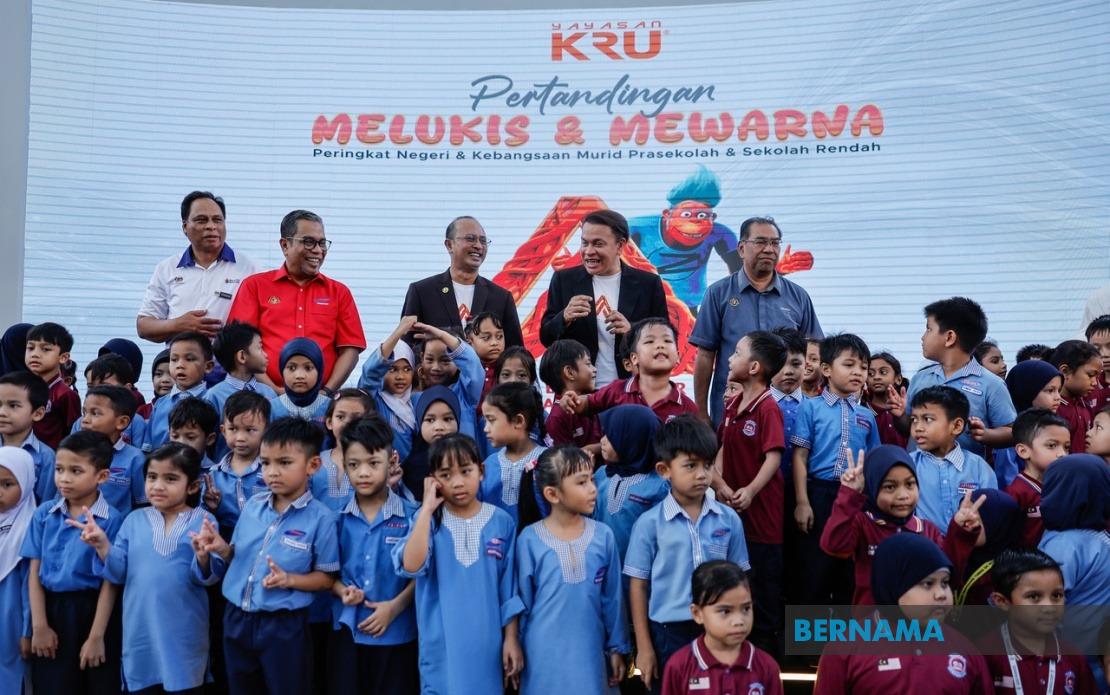
Yayasan KRU has achieved a significant national milestone with its AKAR 2026 colouring competition, earning recognition from the Malaysia Book of Records after mobilising over 153,000 preschool children across the country. The initiative represents a landmark moment in Malaysia's early childhood education sector, demonstrating the potential scale of coordinated programmes when government agencies and foundations align their efforts toward a common objective.
The competition drew participants exclusively from KEMAS and Unity kindergartens, with the contest executed simultaneously across all states to ensure fairness and accessibility. This nationwide coordination underscores the logistical complexity involved in managing such a large-scale undertaking at the preschool level, where consistency in execution across different regions and demographic contexts presents considerable operational challenges. The simultaneous format also served an important symbolic purpose, creating a unified national moment that emphasised collective participation in creative expression among Malaysia's youngest learners.
Datak Norman Abdul Halim, president of Yayasan KRU's Board of Trustees, framed the achievement within a broader developmental philosophy that extends beyond mere artistic expression. According to his remarks at the launch in Shah Alam, the programme balanced creative nurturing with environmental consciousness, anchored through an "I Love Orangutans" campaign component. This dual-objective approach reflects evolving perspectives on early childhood education in Malaysia, where foundational learning experiences increasingly incorporate sustainability messaging and ecological awareness alongside traditional skill-building.
The financial incentive structure designed for the competition merits particular attention as it addresses parental concerns around education financing. Prize winnings totalling approximately RM100,000 across state and national levels would be deposited directly into recipients' National Education Savings Scheme (SSPN) accounts rather than distributed as cash. This mechanism leverages the competition outcome to reinforce longer-term educational savings, effectively converting recognition and achievement into tangible financial support for continued schooling. The national finalists, selected through state-level competitions, would compete in Putrajaya on August 29 for the top prize of RM3,000, creating a tiered reward system that acknowledges excellence at multiple levels.
Government support across multiple agencies amplified the programme's reach and credibility. The National Higher Education Fund Corporation (PTPTN), typically associated with tertiary education financing, partnered alongside the Education Ministry, the Community Development Department (KEMAS), and the Department of National Unity and National Integration (JPNIN). This constellation of institutional backing suggests recognition within government circles that early childhood programmes serve functions extending beyond immediate educational outcomes, touching on national unity, social cohesion, and long-term human capital development.
KEMAS director-general Datuk Mohd Hanafiah Man positioned the initiative within Malaysia's evolving skills agenda, emphasising creativity as fundamental to competitive advantage in future economic contexts. His statement that "creativity is an essential skill in developing a competitive generation" reflects broader policy shifts recognising that rote learning and traditional pedagogical approaches increasingly require supplementation with creative problem-solving capabilities. For Malaysian policymakers concerned about workforce preparedness for a rapidly changing global economy, investments in creative capacity at preschool age represent preventative investment in future productivity.
The record-setting participation figure carries particular resonance for Malaysian stakeholders tracking the health and vitality of public education infrastructure. The successful mobilisation of 153,000 children through two kindergarten networks (KEMAS and Unity) provides tangible evidence that coordinated government initiatives can achieve substantial reach among vulnerable early-age populations. This outcome proves especially relevant for policymakers designing future large-scale programmes targeting young learners, as it demonstrates that infrastructure and institutional capacity exist to execute complex initiatives at scale.
The environmental messaging embedded within the competition through the orangutan campaign addresses Malaysia-specific conservation concerns in an age-appropriate medium. Rather than abstract messaging about biodiversity loss, preschoolers engaged with conservation themes through creative participation, potentially inculcating environmental values during formative developmental windows. Given Malaysia's role as steward of significant rainforest ecosystems and endangered megafauna, incorporating conservation messaging into early childhood programmes represents a coherent strategy for building long-term societal support for environmental protection.
The timing and institutional momentum surrounding AKAR 2026 also merit consideration within Malaysia's broader early childhood development priorities. The coincidence of high-profile government participation and Malaysia Book of Records recognition suggests deliberate elevation of preschool education within national discourse. For practitioners in the early childhood sector across Southeast Asia observing Malaysian policy trends, this programme signals official recognition that preschool interventions merit the same level of systematic attention and resource investment traditionally reserved for primary and secondary education.
Looking forward, the documented success of AKAR 2026 provides both a template and a baseline for future iterations and comparable initiatives. The establishment of a MBOR record creates institutional momentum for programme continuance and potential expansion, while the demonstrated capacity to coordinate across government agencies and multiple kindergarten networks offers lessons applicable to other nationwide initiatives targeting young learners. For stakeholders invested in early childhood development quality across Malaysia and the wider region, this achievement represents tangible progress toward systematising excellence in preschool education at scale.

