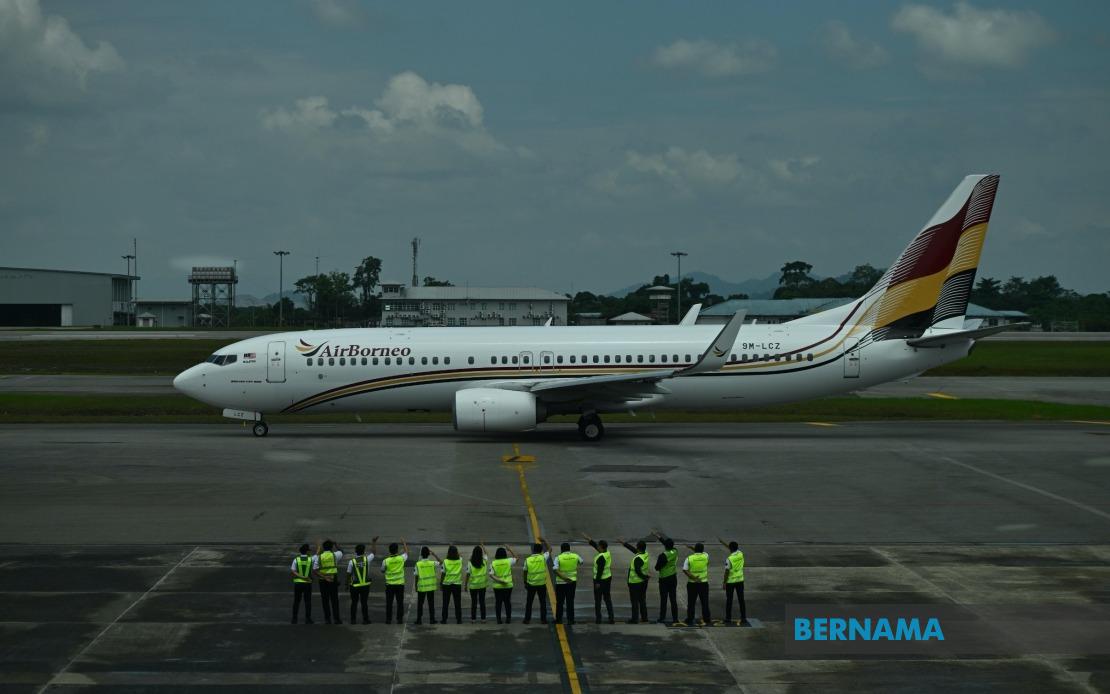
AirBorneo has reached a significant operational milestone by commencing its inaugural jet service on the Kuching–Kuala Lumpur route, positioning the Sarawak government-backed carrier as a growing player in Malaysia's domestic aviation landscape. The maiden flight, designated MY5005, departed Kuching International Airport at 1.20 pm on July 20, arriving at Kuala Lumpur International Airport with Sarawak Premier Tan Sri Abang Johari Tun Openg among its passengers, underscoring the political importance attached to this expansion.
The introduction of the Boeing 737-800 jet aircraft represents a strategic evolution for AirBorneo following its acquisition of MASwings Sdn Bhd's entire operations on January 1 this year. This transition marked a consolidation of Sarawak's regional aviation capabilities under a single umbrella, eliminating operational fragmentation and enabling the state to pursue a more cohesive air transport strategy. The absorption of MASwings assets provided AirBorneo with an expanded network and passenger base, allowing it to contemplate broader regional connectivity beyond Sarawak's borders.
Abang Johari used the occasion to articulate a broader economic vision for Sarawak, drawing historical parallels to Japan's post-war development strategy. The Premier emphasised that Japan's establishment of Japan Airlines represented a cornerstone decision in its subsequent industrialisation, arguing that geographic insularity necessitates robust air connectivity to facilitate trade and economic integration with global markets. This framing positions AirBorneo not merely as a commercial transport operator but as essential infrastructure for Sarawak's economic transformation and globalisation ambitions.
The underlying logic reflects a recognition that peripheral regions within federated states often depend on efficient transportation networks to overcome geographic disadvantage and participate meaningfully in broader economic ecosystems. Sarawak's position on Borneo island creates natural barriers to seamless integration with Peninsula Malaysia's markets and resources. By establishing reliable, frequent air connections through its own carrier, the state aims to reduce transaction costs, improve supply chain efficiency, and enhance the competitiveness of Sarawakian goods and services in external markets.
AirBorneo's pricing strategy for the new route signals its positioning within Malaysia's competitive domestic aviation market. Economy fares of RM375 and Business Class tickets at RM736, both inclusive of airport taxes and fuel surcharges, place the carrier competitively against existing operators on this high-demand corridor. These fares suggest AirBorneo intends to capture market share through value propositions rather than premium positioning, appealing to business travellers, leisure passengers, and connecting traffic between the peninsula and eastern Malaysia.
The twice-daily service frequency announced for the Kuching–Kuala Lumpur route indicates AirBorneo's confidence in sustained demand on this corridor. Kuala Lumpur's position as Malaysia's economic and financial hub makes it an essential connectivity node for Sarawakian businesses, government officials, and leisure travellers. Reciprocally, the route opens Sarawak as a destination for peninsula-based tourists, investors, and corporate visitors, potentially stimulating economic activity in the state's tourism and hospitality sectors.
Ticket sales commenced on July 7, allowing the airline to build passenger demand before launch operations. This advance booking window enabled AirBorneo to secure revenue commitments and gauge market response to its entry on a route where larger carriers with established networks already operate. The timing also allowed prospective passengers to plan travel and adjust schedules, reducing the risk of low initial load factors that could undermine the route's commercial viability.
From a regional perspective, AirBorneo's jet expansion reflects broader momentum in Southeast Asian aviation, where government-backed carriers increasingly undertake strategic roles in connecting regional hinterlands to economic centres. The airline's ability to absorb MASwings operations and subsequently transition to larger aircraft demonstrates institutional capability and financial backing from Sarawak's government resources. This stands in contrast to some struggling regional carriers across Southeast Asia that have faced operational or financial difficulties.
The implications for Malaysian aviation competition merit attention. AirBorneo's entry into the Kuching–Kuala Lumpur market introduces a state-owned competitor to routes currently dominated by Malaysia Airlines and low-cost carriers like AirAsia. While healthy competition typically benefits consumers through pricing pressure and service improvements, the airline's government ownership and backing raise questions about operational efficiency expectations and the basis of route selection. Will AirBorneo prioritise returns on investment or prioritise connectivity objectives aligned with government development policy?
Longer-term strategic considerations include AirBorneo's potential to expand beyond the peninsula-Sarawak corridor. Success on Kuching–Kuala Lumpur could justify fleet expansion and additional domestic routes linking Sarawak to other peninsula cities or further regional expansion toward Singapore, Brunei, or Indonesian destinations. Such expansion would require sustained financial performance and careful capacity planning to avoid overcapacity in competitive markets where yield pressures remain intense.
The airline's inaugural jet operation also carries symbolic weight for Sarawak's autonomy and economic aspirations. The state's ability to operate its own carrier with state-of-the-art aircraft projects confidence and self-sufficiency in critical infrastructure. This messaging extends beyond aviation to encompass broader conversations about resource management, economic diversification, and Sarawak's capacity to drive development independent of federal frameworks.
AirBorneo's transition from regional turboprop operations to jet-powered service marks a maturation milestone in the airline's institutional journey. The technical and operational complexities of jet operations differ substantially from smaller aircraft, requiring expanded maintenance capabilities, crew training, and infrastructure adaptations. AirBorneo's apparent readiness to undertake this transition suggests prior planning and capability building, though operational performance metrics over coming months will definitively demonstrate execution effectiveness.
As the airline settles into jet operations on its flagship route, industry observers will monitor load factors, on-time performance, and customer satisfaction metrics to assess whether this venture achieves its dual objectives of commercial viability and regional connectivity enhancement. The outcome will likely influence decisions about further network expansion and asset investment, determining whether AirBorneo emerges as a sustainable regional carrier or remains primarily a connector for essential Sarawak-peninsula traffic.

