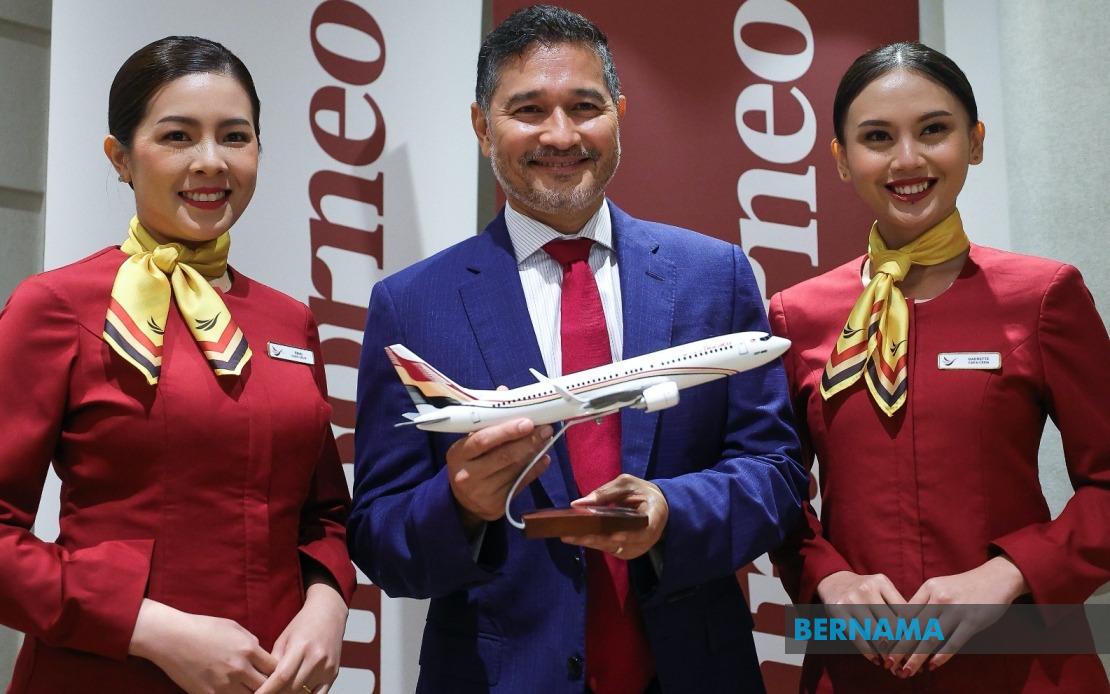
AirBorneo, Sarawak's state-owned carrier, is anchoring its newly launched Kuala Lumpur-Kuching service with a guaranteed RM375 all-in one-way Economy Class fare that will remain consistent across all seasons. The commitment represents a strategic decision to address longstanding complaints about volatile and expensive regional airfares, a persistent challenge for connectivity between Peninsular Malaysia and Sarawak. The airline unveiled this pricing structure as it officially commenced ticket sales for twice-daily operations between Kuching International Airport and Kuala Lumpur International Airport Terminal 1, marking a pivotal moment in the carrier's expansion plans.
Chief executive officer Megat Ardian Wira Mohd Aminuddin explained that the carrier arrived at the RM375 price point through rigorous analysis spanning six months of fare data, during which the region experienced notable fluctuations in jet fuel costs. The methodology incorporated direct comparison with competitor pricing on the same route, ensuring AirBorneo's offering sits competitively within the established market range. Rather than pursuing a race to the bottom with aggressive promotional fares that might prove unsustainable, the airline opted for price stability as a core value proposition. This approach contrasts sharply with industry practice, where carriers typically adjust fares seasonally and dynamically based on demand patterns.
The airline's Business Class offering is priced at RM736 all-in for the same one-way journey, with both fare categories incorporating airport taxes and fuel surcharges—a transparent pricing model that addresses transparency concerns frequently raised by Malaysian travellers. Industry observers note that some competitors advertise significantly lower base fares that expand substantially once ancillary charges are applied, creating consumer frustration and trust deficits. AirBorneo's bundled approach simplifies comparison shopping and removes ambiguity about total journey costs, potentially reshaping passenger expectations on regional routes.
Megat Ardian Wira identified airfare volatility between Peninsular Malaysia and Sarawak as a critical problem the airline intends to systematically solve through consistent pricing regardless of season or demand cycles. This fixed-rate strategy holds particular significance for Sarawakian business travellers, students pursuing education on the peninsula, and families maintaining cross-regional connections. The state's geographic position, distance from major population centres, and limited historical competition have historically resulted in premium pricing that burdens residents disproportionately. By removing seasonal surcharges and promotional variability, AirBorneo positions itself as a stabilising force in a market historically characterised by price spikes during peak periods.
The airline's expansion trajectory extends well beyond the KL-Kuching corridor. AirBorneo has publicly expressed ambitions to become the official carrier for the 2027 SEA Games, which Sarawak will co-host alongside the Federal Territories. Achieving this designation would require substantial network development and operational capacity to manage athlete movements, official delegations, and supporter charters. The carrier currently targets launching scheduled services to two or three ASEAN destinations by early next year, reflecting methodical preparation for the Games and positioning Sarawak as a competitive Southeast Asian aviation hub.
The Games co-hosting responsibility creates unique leverage for AirBorneo's growth strategy. Beyond transporting Games-related personnel, the carrier could establish lasting regional connections that generate sustained traffic flows. Neighbouring ASEAN markets including Indonesia, the Philippines, Thailand, and Vietnam represent logical expansion targets given geographic proximity and tourism potential. Successfully executing these routes would validate AirBorneo's operational capabilities while diversifying revenue beyond domestic Malaysian corridors dominated by established competitors.
AirBorneo's approach reflects broader recognition within Malaysian aviation that regional connectivity deficiencies disadvantage peripheral states economically. Sarawak, despite abundant natural resources and tourism assets, has historically struggled with high travel friction that discourages business investment, leisure visitation, and talent attraction. A carrier explicitly committed to service reliability and price predictability could accelerate integration of Sarawak's economy with peninsula markets and ASEAN neighbours, creating multiplier effects across hospitality, commerce, and professional services sectors.
The timing of this initiative coincides with evolving federal aviation policy emphasising regional development and reduction of geographic inequality. The government's support for state-owned enterprise success creates conducive conditions for AirBorneo to scale operations without purely commercial constraints that smaller carriers typically navigate. This institutional backing distinguishes AirBorneo from competing private regional operators and potentially enables longer-term investment in network development before profitability requirements become acute.
Competitive dynamics on the KL-Kuching route will inevitably intensify as AirBorneo's twice-daily service attracts passengers from incumbent carriers. Established operators may respond through aggressive promotional campaigns or capacity additions, ultimately benefiting consumers through improved choice and competitive pricing pressure. However, AirBorneo's committed year-round RM375 fare removes a pricing variable from competitive competition, forcing rivals to differentiate through service quality, schedule convenience, or ancillary offerings rather than fare manipulation.
The carrier's transparent pricing philosophy extends broader lessons for Malaysian aviation market development. Regional routes often suffer from information asymmetries and pricing opacity that deter fare-sensitive segments including students, seniors, and lower-income leisure travellers who substitute travel for other consumption when prices prove unpredictable or appear exploitative. By fixing transparent all-in fares, AirBorneo reduces behavioural frictions and enables forward planning that benefits particularly price-conscious constituencies who represent substantial untapped demand on regional corridors.
Looking forward, AirBorneo's RM375 commitment establishes an affordability benchmark that could influence industry standards and passenger expectations across Malaysian aviation. If the fare proves commercially sustainable while supporting scheduled expansion and fleet investment, competitors may gradually adopt similar transparent pricing models. Conversely, if the model proves unviable during economic downturns or fuel price spikes, the experience could inform future discussions about fair cost allocation between carriers and passengers across economically sensitive regional routes.

