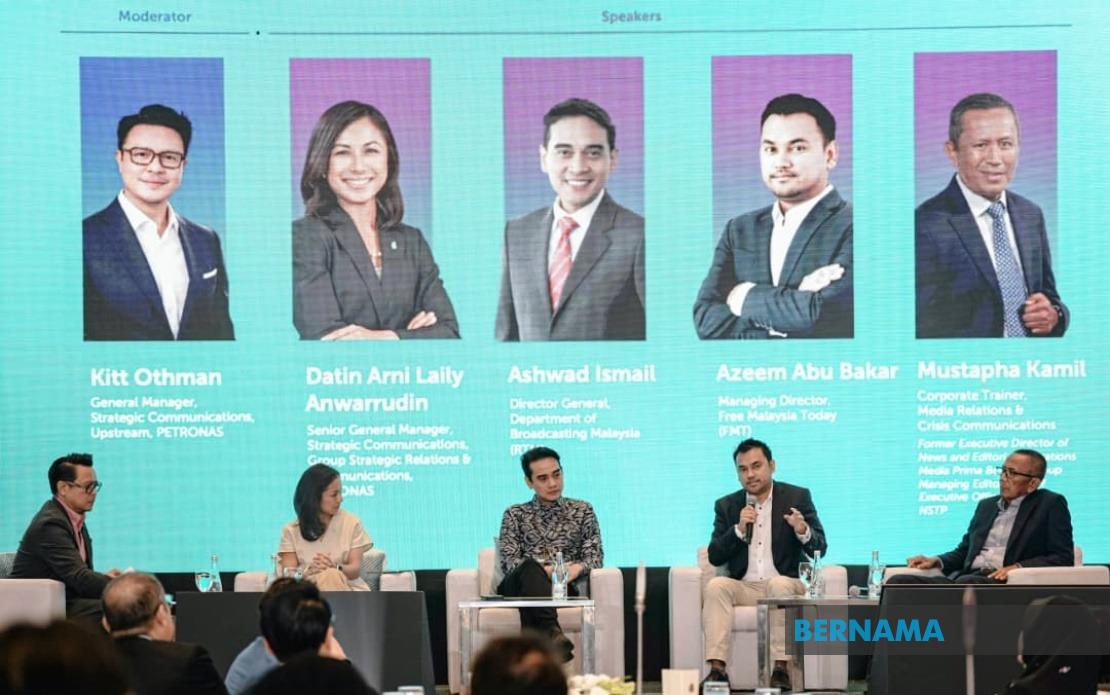
The explosive growth of artificial intelligence and the instantaneous nature of digital media are upending traditional corporate communication playbooks, forcing Malaysian organisations to fundamentally reimagine how they protect brand reputation and respond to crises. At a forum hosted by PETRONAS in collaboration with the Malaysian Press Institute, senior executives and media leaders outlined the pressures reshaping how companies must now engage with the public and manage information flow in an era where misinformation spreads at unprecedented velocity.
Datin Arni Laily Anwarrudin, Senior General Manager of Strategic Communications at PETRONAS, articulated a central tension facing modern corporations: the speed at which AI can amplify unverified claims now threatens organisational credibility faster than traditional responses can contain. She stressed that organisations must seize control of their own narrative rather than ceding that authority to external actors, whose interests may not align with factual accuracy or the company's legitimate concerns. This shift represents a departure from the reactive posture that characterised corporate communications in the pre-digital age, when companies could often wait for verification before responding to allegations or rumours.
The transparency imperative has become non-negotiable, according to Arni Laily. In an information environment where silence can be interpreted as guilt or indifference, companies face pressure to communicate openly about their operations, decisions, and positions. Failure to do so creates a vacuum that competitors, critics, or bad-faith actors will inevitably fill with their own narratives, often more sensational or damaging than the truth would warrant. This democratisation of voice through digital platforms means that no single organisation can monopolise the conversation around its own affairs—a reality that demands proactive engagement rather than defensive withdrawal.
The traditional crisis communication framework, built around a luxury of time, has become obsolete. For decades, corporate communicators operated under protocols that assumed a window of approximately 16 hours before a story reached print in the morning newspaper, during which they could gather facts, craft responses, and coordinate messaging. That timeline has evaporated entirely. Mustapha Kamil Mohd Janor, former managing editor of Media Prima and the NSTP Group, underscored that the news cycle now operates in real-time, with information spreading globally within minutes. For organisations unprepared for this velocity, the consequences can be catastrophic—a poorly considered statement issued under pressure can amplify damage rather than contain it, while silence reads as evasion.
Corporations must therefore reconstruct their internal crisis management infrastructure from the ground up. Mustapha Kamil advocated for the establishment of dedicated, structured media crisis communication teams equipped to operate at digital speed while maintaining the rigour necessary to separate verified fact from speculation. This team must operate with clear decision-making authority and protocols that allow rapid deployment without sacrificing accuracy. The challenge lies in moving swiftly without capitulating to panic, in responding decisively while still conducting the investigative work necessary to establish what actually occurred. This requires both technological infrastructure and trained personnel capable of functioning under intense pressure.
Yet even as technology accelerates the spread of information, media practitioners argue that journalism's fundamental mission remains anchored to truth-seeking. Mustapha Kamil characterised journalists as searchlights illuminating the terrain that society must navigate, helping citizens understand complex issues and reach informed decisions. Despite the proliferation of AI tools and algorithmic news distribution, this role—the cultivation of expertise, the weighing of evidence, the contextualisation of facts—cannot be automated or outsourced to technology. This perspective offers both a warning and an opportunity: while AI can expedite certain tasks, it cannot replace the judgment and institutional knowledge that experienced journalists bring to bearing witness and interpretation.
Azeem Abu Bakar, Managing Director of Free Malaysia Today, articulated a complementary vision for how media organisations themselves must evolve. Rather than attempting to compete with AI in operational efficiency, media companies should invest in developing journalists who excel in dimensions that technology cannot replicate. Azeem introduced the concept of "SUPER" journalists—professionals distinguished by their mastery of sources, their depth of understanding, their ability to perceive patterns, their operational efficiency, and their accumulated reputation. These are skills built through years of practice, embedded relationship networks, and professional integrity. They represent a form of human capital that becomes more valuable, not less, as AI handles routine information processing and data aggregation.
The panel discussion revealed emerging consensus that the AI era demands not the abandonment of traditional journalistic values but their reinforcement and redefinition for a new media landscape. Transparency, speed, accuracy, and authoritative expertise will determine which organisations and institutions retain public trust as information flows accelerate beyond human processing capacity. For Malaysian corporations and media organisations alike, the challenge is to harness technological capabilities while preserving the human judgment and ethical anchors that have historically distinguished credible communication from mere noise.
For Malaysian enterprises, this moment carries particular significance given the nation's position as a developing economy increasingly integrated into global digital networks. Local companies competing in regional and international markets must adopt communication standards commensurate with global practices while remaining attuned to the distinct cultural context and regulatory environment of Malaysia. The stakes extend beyond commercial reputation to encompass national competitiveness—organisations that master rapid, transparent, AI-aware communication gain competitive advantages not only in brand perception but in talent recruitment, stakeholder confidence, and institutional legitimacy. Conversely, those that cling to outdated crisis protocols risk losing public trust precisely when information spreads fastest and reputational damage becomes most difficult to repair.

