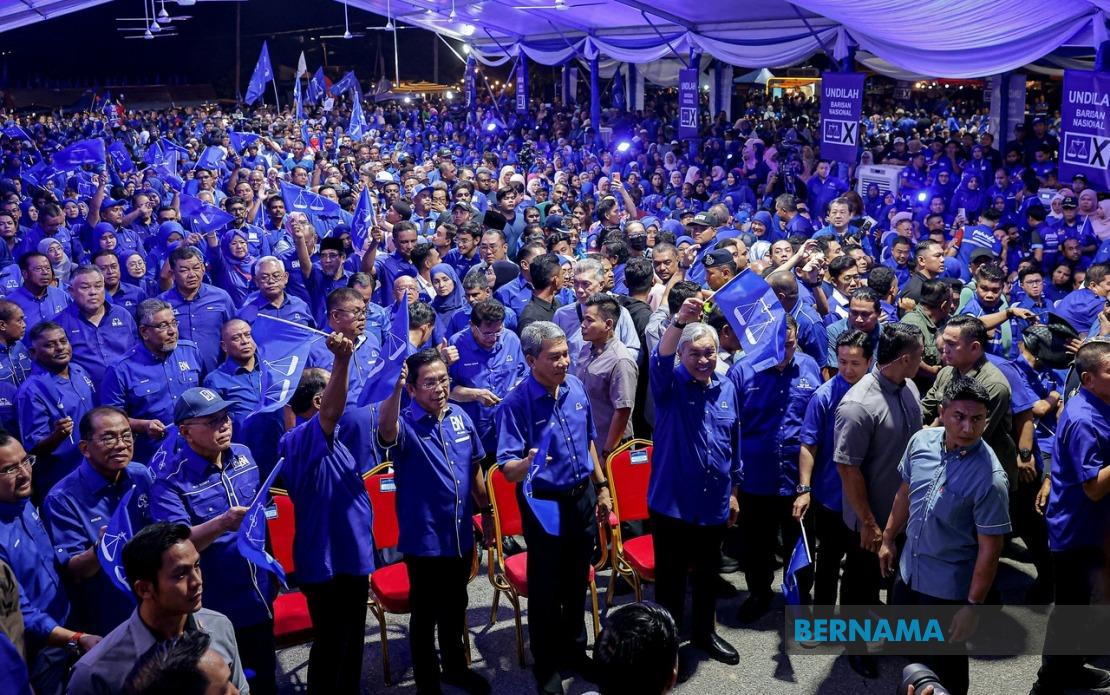
Barisan Nasional should translate the momentum of its commanding Johor state election victory into success in the forthcoming Negeri Sembilan state election, according to BN chairman Datuk Seri Dr Ahmad Zahid Hamidi. Speaking at the official launch of the coalition's election machinery and candidate announcement ceremony at Tuanku Abdul Rahman Stadium in Paroi on July 15, Ahmad Zahid positioned the Johor results as a template for replication, suggesting that disciplined party organization and voter engagement could deliver similar outcomes across the nation.
The Johor state election, held earlier this year, delivered what Ahmad Zahid characterized as a historic mandate for Barisan Nasional. The coalition captured 48 of the 56 available state seats, an outcome that secured nearly 60 per cent of the popular vote and marked the strongest electoral performance in the state's history. This result, Ahmad Zahid argued, demonstrated that Malaysian voters were receptive to BN's messaging of political stability, economic competence, and responsible governance—a narrative he suggested could resonate equally powerfully in Negeri Sembilan, where the coalition aims to improve substantially on its 2023 performance when it secured only 14 seats.
Central to Ahmad Zahid's appeal was an emphasis on internal unity within the broad BN coalition structure. He credited the Johor victory to disciplined teamwork among component parties and members working in concert rather than pursuing factional interests. This framing carried particular significance for Negeri Sembilan, where coalition divisions during the previous election cycle had constrained BN's competitiveness. Ahmad Zahid called explicitly for party members to set aside personal grievances and candidacy disappointments, subordinating individual ambitions to the collective objective of winning constituencies and retaining government control.
The coalition's election machinery directive signaled an intention to conduct intensive ground operations in the weeks preceding the August 1 polling day. Ahmad Zahid instructed party operatives to undertake systematic door-to-door canvassing and direct voter engagement, a labour-intensive but traditionally effective mobilization strategy that requires sustained organizational commitment. This approach contrasts with campaigns relying primarily on media messaging or event-based outreach, reflecting BN's apparent judgment that direct personal contact remains critical for persuading undecided voters and consolidating support among traditional constituencies.
Ahmad Zahid's insistence that candidates and party members not become preoccupied with nomination disputes reflected an internal management challenge facing Barisan Nasional. Competitive candidate selection processes frequently generate friction and disappointment among aspiring politicians and their supporters, potentially dissipating campaign energy. By explicitly reminding candidates that their responsibilities extended beyond securing nomination to encompassing wider party victory objectives, Ahmad Zahid sought to reframe candidacy decisions as organizational necessities rather than personal victories or defeats requiring public vindication.
The timing of the Negeri Sembilan campaign assumes additional regional significance given Malaysia's broader political landscape. Negeri Sembilan represents one of the remaining significant state-level battlegrounds where BN can demonstrate sustained capacity to govern effectively and attract voter support across demographic and ethnic lines. Losses in states like Penang and Selangor to Pakatan Harapan in recent cycles have narrowed BN's control of peninsular Malaysia, making the retention and expansion of influence in remaining strongholds strategically vital to the coalition's national political positioning.
The Election Commission's announced electoral calendar provided clear staging for campaign activities. With nomination day scheduled for July 15, early voting set for July 28, and polling on August 1, campaigns would span approximately two weeks of intensive activity. This compressed timeframe places heightened importance on pre-nomination preparation and organizational readiness, explaining why BN moved quickly to formally launch its machinery and confirm its slate of candidates. The rapid pace also favors better-organized coalitions with established voter databases and mobilization networks.
Ahmad Zahid's role as Deputy Prime Minister added institutional weight to his appeals for party discipline and unified effort. His position within the federal executive enhanced his authority to set expectations for BN component parties and implied that the federal government's capacity to deliver constituency-level benefits might be contingent on electoral success at the state level. This intertwining of federal and state political stakes underscores how Malaysian electoral outcomes at the state level increasingly influence national political configurations and governmental resource allocation.
The presence at the ceremony of BN deputy chairman Datuk Seri Mohamad Hasan, a senior UMNO figure with substantial influence over party machinery deployment, signified commitment to translating Ahmad Zahid's strategic directives into operational implementation. Component party leaders and coalition partners also attended, suggesting coordination across the diverse organizations comprising Barisan Nasional. Such visible coalition unity at public events served both practical and symbolic purposes, demonstrating organizational coherence to voters while reinforcing internal messaging about the necessity of maintaining collective discipline.
For Negeri Sembilan voters and regional observers, Ahmad Zahid's remarks outlined the coalition's strategic thinking entering the state election campaign. BN intended to emphasize its proven track record of governance, appeal to concerns about political stability and economic competence, and leverage organizational advantages derived from incumbent status. The contrast being constructed was between BN's presented image of responsible stewardship and potential alternatives represented by opposition coalitions. Whether this positioning would prove sufficient to overcome any voter dissatisfaction or structural challenges facing the incumbent would become evident only once campaigning intensified and opposition parties articulated their alternative visions.
The coalition's confidence in improved performance compared to the 2023 result reflected both organizational lessons learned and apparent shifts in voter sentiment. Ahmad Zahid's public projection of victory, while perhaps partly rhetorical, suggested internal polling or strategic assessments indicating genuine competitive prospects. Success in Negeri Sembilan would consolidate BN's recovery trajectory after earlier electoral setbacks, while a disappointing result would prompt renewed questioning about the coalition's broader viability as a governing force in contemporary Malaysian politics.
Moving forward, the intensity of BN's campaign operations in Negeri Sembilan would serve as a test case for the coalition's capacity to execute the unified strategy Ahmad Zahid had articulated. Whether party members could subordinate factional interests to collective objectives, whether grassroots mobilization could deliver anticipated voter engagement, and whether the Johor victory had genuinely shifted underlying voter sentiment would all determine whether BN achieved the electoral outcome Ahmad Zahid had publicly committed to pursuing. The August 1 polling results would provide definitive answers to these strategic questions.

