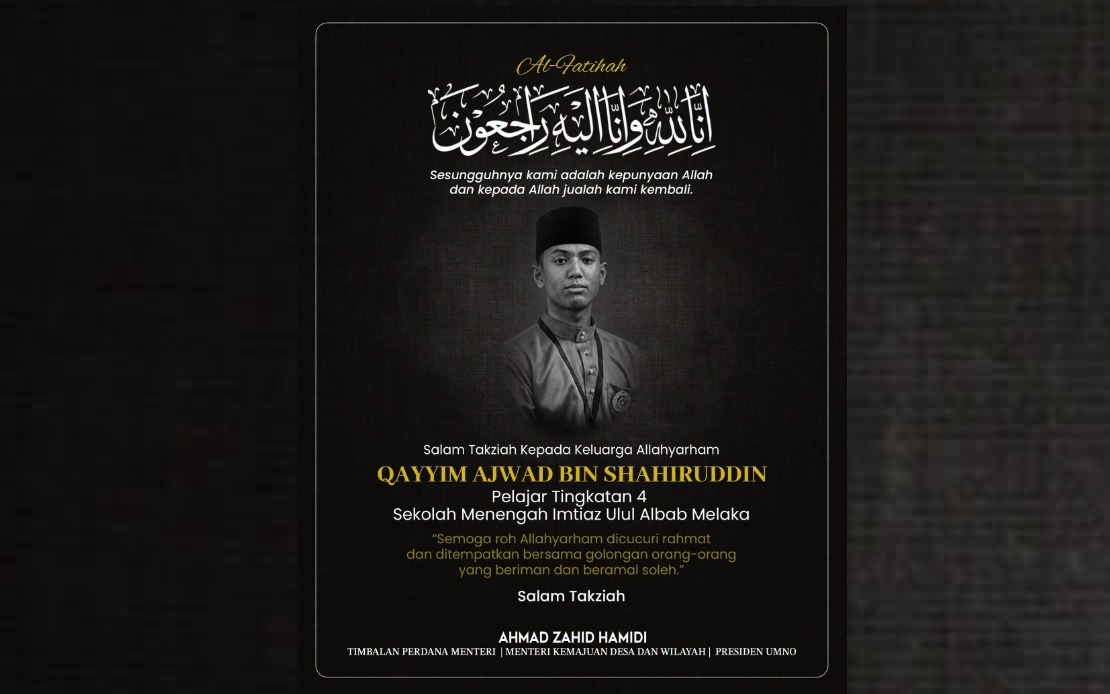
Deputy Prime Minister Datuk Seri Dr Ahmad Zahid Hamidi has expressed deep sorrow over the passing of Qayyim Ajwad Shahiruddin, a student at Sekolah Menengah Imtiaz Ulul Albab in Melaka, who died from complications arising from a road accident that took place on July 8. The incident occurred when a vehicle carrying the student, a teacher, and two other pupils from the same institution collided with a lorry in Solok Duku while the group was returning from a table tennis competition hosted at Sekolah Jenis Kebangsaan Cina Cheng.
In his statement shared on Facebook, Ahmad Zahid characterised the loss as profoundly significant, emphasising the gravity of the tragedy for both the school community and those closest to the deceased. Beyond extending sympathies to the bereaved family, the Deputy Prime Minister also directed prayers towards the speedy recovery of the other accident victims who remain under medical care for their sustained injuries. His remarks underscored the emotional weight of losing a young student and highlighted the ongoing concern for those still battling health complications from the collision.
Ahmad Zahid articulated a personal connection to the school and its students, framing his relationship with the institution in familial terms. By stating that the pupils of SM Imtiaz Ulul Albab occupy a special place in his heart comparable to his own children, he sought to convey the depth of his attachment and the intensity of his emotional response to the tragedy. This characterisation serves to demonstrate his commitment to educational institutions within his constituency and the broader community he represents.
The Deputy Prime Minister invoked Islamic teachings in his condolence message, calling upon the Muslim community to recite al-Fatihah and engage in collective supplication for the deceased student. His prayer appealed to Allah for divine mercy upon the soul of Qayyim Ajwad, requesting forgiveness of transgressions and acceptance of virtuous deeds performed during his earthly life. Additionally, Ahmad Zahid petitioned for the young man's soul to be granted a place among the righteous servants of the Almighty, reflecting Islamic funeral rites and spiritual comfort practices.
The accident that claimed the student's life represents a tragic outcome of road incidents in Malaysia, a persistent public safety concern affecting families and institutions nationwide. The July 8 collision between a private vehicle and a commercial lorry exemplifies the dangers that commuters, particularly young students and their educators, face on Malaysian roads. The incident's context—a group travelling from a sports competition—adds poignancy to the event, as it underscores how ordinary activities involving youth can culminate in life-altering tragedies.
The three-week period between the initial accident on July 8 and Qayyim Ajwad's subsequent death highlighted the severe nature of injuries sustained in the collision. This temporal gap also served as a window during which medical interventions and emergency care efforts were mobilised to save the young student's life, making the eventual outcome all the more sorrowful for those who witnessed the struggle. Medical complications arising from traumatic road accidents frequently require sustained intensive care, and the unsuccessful outcome in this instance reflects the unpredictability and severity of such injuries.
SM Imtiaz Ulul Albab's involvement in the accident extends beyond the loss of one student, as the school community collectively experienced the trauma of the event. The presence of a teacher among those injured indicates that faculty members also bore physical and psychological consequences from the incident. The accident thus reverberated through the entire school ecosystem, affecting teachers, students, and administrative staff who must process the loss of a peer and colleague simultaneously.
The incident serves as a sobering reminder for Malaysian educational institutions regarding student safety during extracurricular activities. Schools organising competitions and field trips must navigate the tension between fostering student development through diverse activities and ensuring comprehensive protective measures during transportation. The SM Imtiaz Ulul Albab tragedy underscores the importance of rigorous safety protocols, vehicle maintenance standards, and route planning for school-sponsored events.
From a broader policy perspective, the accident highlights ongoing concerns about road safety in Malaysia. Despite legislative measures and public awareness campaigns, fatal and severe collisions continue to claim lives across the nation. The involvement of both private and commercial vehicles in this incident reflects the complex dynamics of Malaysian road usage, where heavy vehicles share infrastructure with personal transport. Stakeholders including highway authorities, transport regulators, and enforcement agencies must continually evaluate strategies to reduce accident rates and minimise casualties.
The Deputy Prime Minister's personal intervention in expressing condolences also reflects the political significance attributed to educational institutions and youth welfare in Malaysian governance. Public figures frequently leverage such moments to underscore their commitment to community welfare and religious values, thereby reinforcing their connection with constituents. Ahmad Zahid's statement exemplifies how tragedy creates opportunities for leaders to reaffirm their bonds with the communities they serve.

