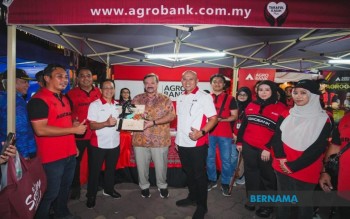
Agrobank has captured over RM8 million in financing applications through a series of face-to-face engagement sessions targeting hawkers and micro-entrepreneurs, demonstrating substantial momentum in the bank's push to democratise access to capital for small business operators across the country. The development reflects a strategic pivot towards ground-level outreach, moving the financial services conversation away from formal banking halls and into the marketplace spaces where traders conduct their daily commerce. With sessions now stretching from the Klang Valley into Sabah, the initiative represents a deliberate effort to embed Agrobank deeper into the informal and semi-formal business ecosystems that form the backbone of Malaysia's local economies.
The expansion into East Malaysia gained prominence when Agrobank held two high-profile engagement sessions in Kota Kinabalu on July 5. The Api-Api Night Market on Jalan Gaya and the Papar Tamu Farmers' Market were selected as venues, offering the bank direct access to active trading communities in settings where entrepreneurs naturally congregate. At Api-Api Night Market alone, Agrobank's representatives connected with 153 hawkers and business owners, while the Papar session engaged 95 traders from the agricultural sector. These numbers illustrate the appetite among small business operators for accessible financing solutions when presented in convenient, familiar environments rather than through traditional banking channels.
The choice of night markets and farmers' markets as focal points reflects deliberate economic geography on Agrobank's part. These venues function as critical arteries of local economic circulation in Malaysian towns and cities, channelling daily consumer spending directly to individual operators and small family enterprises. By establishing a presence in these spaces, Agrobank positions itself not as a distant institutional lender but as a financial partner embedded within the community's economic rhythms. The sessions specifically concentrated on diagnosing immediate financing needs linked to working capital maintenance and business growth, two perennial challenges for traders operating on thin margins and limited cash reserves.
The initiative aligns with a broader government agenda to accelerate financial inclusion for grassroots entrepreneurs. Finance Minister II Datuk Seri Amir Hamzah Azizan attended the Sabah sessions, signalling ministerial endorsement of Agrobank's methodology. More significantly, the engagement drive operates within the framework of Prime Minister Datuk Seri Anwar Ibrahim's directive requiring financial agencies to expedite the distribution of RM5 billion designated for small trader financing. Against this backdrop, Agrobank's RM8 million in accumulated applications represents concrete progress toward a government objective aimed at bolstering the survival and growth prospects of Malaysia's estimated millions of micro-entrepreneurs.
Agrobank Group president and chief executive officer Datuk Tengku Ahmad Badli Shah Raja Hussin framed the Sabah expansion as a fundamental commitment to understanding heterogeneous business contexts across Malaysia's diverse regions. The statement carries implicit recognition that financing needs in Kota Kinabalu's hawker zones differ materially from those in Selangor's suburban trading centres, or in rural agricultural communities. This contextual sensitivity distinguishes Agrobank's approach from conventional lending models that apply standardised criteria and products regardless of local operating conditions. By embedding staff in traders' own environments, the bank generates qualitative insights into cash flow patterns, seasonal variations, supply chain dynamics, and competitive pressures specific to each market.
The practical value of on-the-ground engagement extends beyond transaction origination into financial capability development. Agrobank's stated objective encompasses not merely disbursing capital but providing advisory services and non-financial support mechanisms that help micro-entrepreneurs build more resilient, professionally-managed operations. This holistic framing acknowledges that many small traders lack formal financial training, business planning experience, or structured accounting practices, yet possess deep operational knowledge within their sectors. By coupling financing with education and mentoring, Agrobank potentially addresses structural vulnerabilities that plague Malaysia's informal economy, where business failure rates remain high despite adequate access to initial capital.
For Malaysian policymakers and observers tracking financial inclusion metrics, the RM8 million figure offers qualified encouragement regarding the viability of direct outreach models. Traditional branch-based lending has historically under-served the hawker and micro-enterprise segment, either through rigid collateral requirements, cumbersome documentation, or simple inconvenience. The engagement session approach bypasses these frictions by bringing application assessment capabilities to traders' actual workplaces. The scale of participation—nearly 250 traders across two Sabah sessions—suggests that demand for accessible financing remains robust when institutional barriers are lowered and application processes simplified.
Yet the broader significance extends to regional economic patterns visible across Southeast Asia. Small traders and hawkers represent enormous employment reservoirs and consumer-facing economic activity in Malaysia, much like comparable segments across the region. If Agrobank's model proves scalable and profitable, it could establish a template for how regional banks and development finance institutions might better serve the grassroots economies that remain underbanked despite urbanisation and digital penetration. Malaysia's position as a relatively wealthy Southeast Asian economy with sophisticated financial infrastructure makes it logical testing ground for inclusive financing innovations that could subsequently migrate to less developed regional neighbours.
The expansion to Sabah carries additional strategic weight given East Malaysia's persistent development disparities relative to Peninsular Malaysia. Kota Kinabalu and surrounding areas have experienced substantial economic growth, yet the hawker and farmers' market sectors remain heavily reliant on informal financing through family networks, rotating savings groups, or local moneylenders offering terms far less favourable than institutional options. By establishing direct engagement channels in these locations, Agrobank creates pathways for Sabah-based traders to access formal financing at more reasonable cost, potentially reallocating some of the economic surplus currently captured by informal lenders back toward productive business investment.
The initiative's success metrics, however, extend beyond financing applications to actual disbursements and business outcomes. The RM8 million in applications represents interest and effort, but meaningful impact requires conversion of these applications into approved loans that traders actually drawdown and deploy strategically. Subsequent monitoring of these financed enterprises' performance—survival rates, revenue growth, employment creation—will ultimately determine whether Agrobank's engagement methodology translates enthusiasm into genuine economic empowerment. The bank's commitment to structured support and financial advisory services suggests management recognises this distinction and intends the initiative as catalyst for sustainable business development rather than merely transactional lending.
Looking forward, the model's expansion across Malaysia faces predictable challenges: staff capacity constraints as sessions proliferate, quality assurance in loan origination when decisions occur outside formal banking premises, and maintaining relationships with traders whose operations may lack formal business registration or standardised accounting. Yet the evident appetite among traders for accessible financing, combined with government pressure to accelerate disbursement toward vulnerable business operators, suggests continued momentum. If Agrobank successfully converts engagement session participants into long-term borrowing customers, the initiative could reshape how Malaysian development finance institutions approach their mandate to serve excluded populations, shifting emphasis from passive branch-based lending toward active, continuous engagement within commercial communities themselves.

