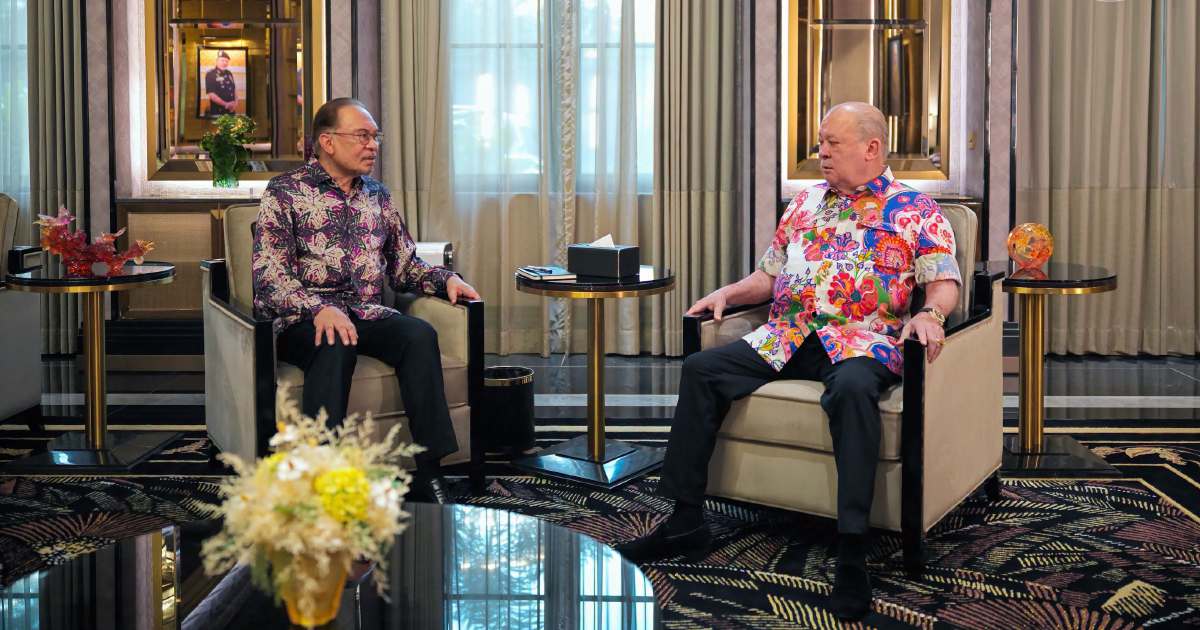
His Majesty Sultan Ibrahim, King of Malaysia, received Prime Minister Datuk Seri Anwar Ibrahim in a formal audience at Istana Bukit Tunku on the eve of the nation's 69th National Day celebrations. The meeting reflects the constitutional protocol observed between the head of state and the head of government, particularly during significant national occasions that mark Malaysia's sovereignty and unity.
The timing of the audience underscores the traditional role of the monarchy in affirming national identity during commemorative events. August 31st holds profound significance in Malaysia's historical narrative, marking the country's independence from British colonial rule in 1957. As custodian of the Malaysian Constitution, the King plays a symbolic and ceremonial role in reinforcing the values of nationhood that the National Day celebrations embody.
Istana Bukit Tunku, the official residence of the Yang di-Pertuan Agong in Kuala Lumpur, serves as the venue for such state functions and formal meetings between constitutional leaders. The palace setting lends gravitas to discussions concerning matters of national importance, particularly those relating to ceremonies and public events that command the attention of all Malaysians.
Prime Minister Anwar Ibrahim, in his capacity as the nation's chief executive, typically engages with the Agong on significant governance matters and ceremonial occasions. These audiences provide an opportunity for the government and monarchy to align on key messaging and national priorities ahead of major celebrations. The consultative nature of such meetings reflects Malaysia's constitutional monarchy system, wherein the King remains politically neutral while maintaining an advisory relationship with the government.
National Day celebrations carry considerable weight beyond ceremonial observance. They represent a moment for Malaysians across different regions, ethnicities, and religions to affirm their shared commitment to the nation's founding principles—unity, democracy, and constitutional governance. The government typically uses the occasion to highlight progress, national achievements, and forward-looking policy directions that resonate with citizens.
The 69th National Day marks nearly seven decades since independence, a milestone that prompts reflection on Malaysia's journey as a sovereign nation. From a recently-decolonized territory to a developing middle-income nation with diverse economic sectors, Malaysia's trajectory has been marked by both achievements and challenges. National Day provides a platform to celebrate these accomplishments while renewing commitment to constitutional values that bind the federation together.
For international observers and neighbouring Southeast Asian nations, Malaysia's National Day celebrations also carry regional significance. As an ASEAN founding member and a nation that has navigated complex multiethnic and multireligious dynamics, Malaysia's approach to national unity receives regional attention. The manner in which the government and monarchy present themselves during such occasions sends signals about the country's stability and commitment to democratic principles.
The audience between the Agong and Prime Minister also reflects Malaysia's constitutional provisions that vest certain ceremonial and symbolic functions in the monarchy. While executive power rests with the Prime Minister and cabinet, the Yang di-Pertuan Agong remains the constitutional head of state and commander-in-chief of the armed forces. This division of powers, inherited from Malaysia's Westminster-derived system, requires periodic formal engagement between the two offices, particularly regarding state functions and national ceremonies.
In recent years, Malaysian political dynamics have necessitated careful attention to institutional relationships and constitutional processes. The monarchy's role in maintaining the sanctity of constitutional procedures has been emphasized across various political transitions. Audiences such as this one serve to reinforce the separation of powers and the mutual respect between institutions that undergird Malaysia's democratic framework.
The National Day celebrations themselves will likely feature military parades, cultural performances, and speeches emphasizing national values and future development priorities. The Prime Minister, as the chief government representative, will address the nation with remarks touching on economic progress, social cohesion, and policy directions. The Agong's presence or participation in subsequent ceremonies will underscore the constitutional nature of these celebrations and the monarchy's role as the embodiment of national unity.
Looking ahead, the meeting between Sultan Ibrahim and Anwar Ibrahim demonstrates the continuity of Malaysia's governmental processes despite recent political changes. Both leaders, in their respective constitutional roles, contribute to the management of national affairs and the promotion of institutional stability. The audience, though brief in duration, carries symbolic weight that extends beyond its formal character into the broader architecture of Malaysian governance.

